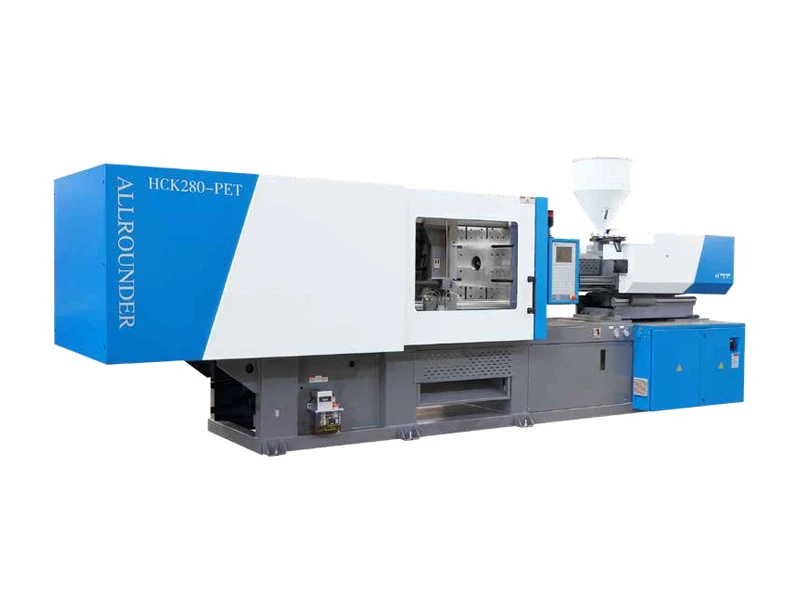
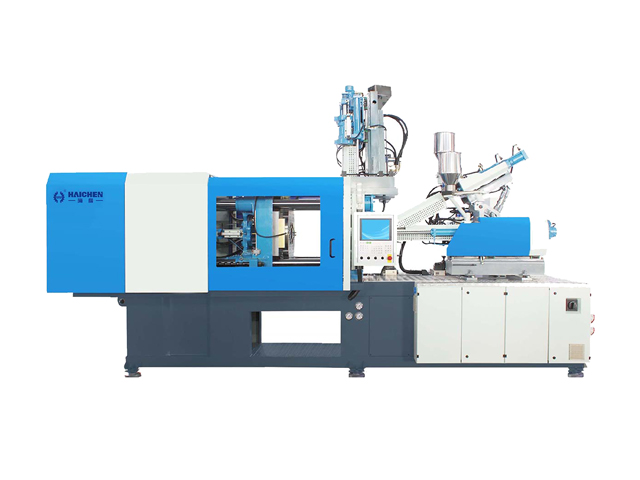
Artificial plant manufacturers face a critical equipment decision. A general-purpose injection molding machine cannot produce thin-walled petals, detailed leaf veins, or two-color flower components without defects. Short shots, flash, warpage, and rough surfaces plague standard machines when they process PE and PVC artificial plant parts. A dedicated artificial tree injection molding machine solves these problems by matching screw design, injection speed, and temperature control to the specific demands of thin-wall, small-shot-weight, multi-cavity production.
Choose an artificial tree injection molding machine by matching clamping force (85–170T for most components), shot weight (total shot should be 20–80% of machine capacity), screw design (smaller diameter for uniform melting of PE/PVC), and whether you need single-color or two-color capability. Dedicated machines outperform general-purpose models on thin-wall precision parts.
This guide provides the selection criteria, calculation formulas, tonnage recommendations, and supplier evaluation checklist for building a reliable artificial plant production line.
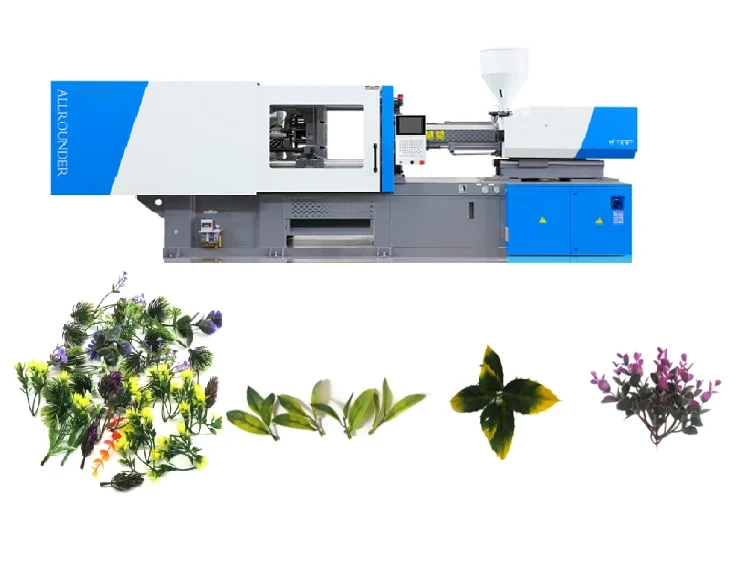
Why Do Artificial Plant Parts Need a Dedicated Injection Molding Machine?
Artificial plant components have thin walls (0.3–1.0mm), small shot weights (2–30g), and require detailed surface textures. General-purpose machines lack the injection speed, screw design, and temperature control precision to fill thin sections without short shots, flash, or deformation.
The Four Processing Challenges of Artificial Plants
| Challenge | Root Cause | Impact |
|---|---|---|
| Thin-wall filling | Petals and leaves have 0.3–1.0mm walls | Short shots, incomplete filling |
| Small shot weight | Parts weigh 2–30g | Inconsistent shot weight, poor repeatability |
| Surface texture | Veins and wrinkles require mold detail replication | Rough surfaces, unclear grain patterns |
| Two-color demand | Many products need two colors in one part | Secondary painting adds labor cost |
Konger’s artificial-flower-specific machines address these challenges through targeted optimizations on clamping structure, injection system, screw plasticization, and pressure-speed control.Their TEC series uses a custom dedicated injection screw and barrel assembly with a specially optimized length-to-diameter ratio for artificial flower materials, significantly improving the plasticizing effect of PE materials and ensuring uniform and stable melting quality.
A standard machine cannot replicate this performance. The screw design, injection response time, and temperature control precision all fall short when processing thin-wall, small-shot-weight parts. A general-purpose machine running an 8-cavity petal mold may produce 70–80% yield rate; a dedicated machine raises that to 95%+.
Product Characteristics Determine Equipment Requirements
Artificial flowers and trees have specific design features. Petals and leaves have very thin walls. They need detailed surface textures like veins and wrinkles. The parts are small but require high precision. Many products need two or more colors on a single part. These characteristics demand specialized equipment. A standard artificial trees injection machine cannot always handle these requirements.
Limitations of General-Purpose Machines
General-purpose injection molding machines often produce defects on thin-wall artificial plant parts. Common problems include short shots, sink marks, flash, warpage, and rough surfaces . The main reasons are insufficient injection speed, poor plasticization, and lack of precise temperature control for small shot volumes. General machines also lack the screw design needed for materials like PE and PVC used in artificial plant production.

How Do You Calculate the Required Clamping Force for Artificial Plant Molds?
Required clamping force = total projected area × material factor × safety factor. For artificial plant parts, the material factor is typically 2–4 tons/cm². Add 10–20% safety margin. A 16-cavity leaf mold with 2 cm² projected area per cavity requires approximately 74–154 tons.
Step-by-Step Calculatio
Required Clamp Force = Total Projected Area × Material Factor × (1.1 to 1.2)
| Material | Material Factor (tons/cm²) | Notes |
|---|---|---|
| PE | 2–3 | Low viscosity, easy flow |
| PVC | 2.5–3.5 | Higher viscosity |
| PP | 2.5–3.5 | Similar to PVC |
| ABS | 3–5 | Higher rigidity, requires more force |
Worked example: A 16-cavity artificial leaf mold with 2 cm² projected area per leaf and 4 cm² runner area, using PE:
Total projected area = (2 × 16) + 4 = 36 cm²
Required clamp force = 36 × 2.5 × 1.15 = 104 tons
A 110–130 ton machine would be suitable.
Recommended Tonnage by Component Type
| Component | Typical Weight | Common Cavities | Recommended Tonnage | Screw Diameter |
|---|---|---|---|---|
| Artificial flower petals | 2–8 g | 8–32 | 85–130 T | 25–35 mm |
| Christmas tree needles | 3–12 g | 16–64 | 85–170 T | 28–38 mm |
| Flower stems | 5–20 g | 4–16 | 100–180 T | 30–42 mm |
| Large leaf/branch | 15–40 g | 2–8 | 150–310 T | 35–50 mm |
Common artificial flower production uses machine clamping force from 85 to 170 tons. Tiancheng offers an 85-ton vertical model for simulation flower and Christmas tree parts. Larger molds and multi-cavity setups may need up to 310 tons. Konger’s TEC series covers 120–170 tons for artificial flower and plant components.
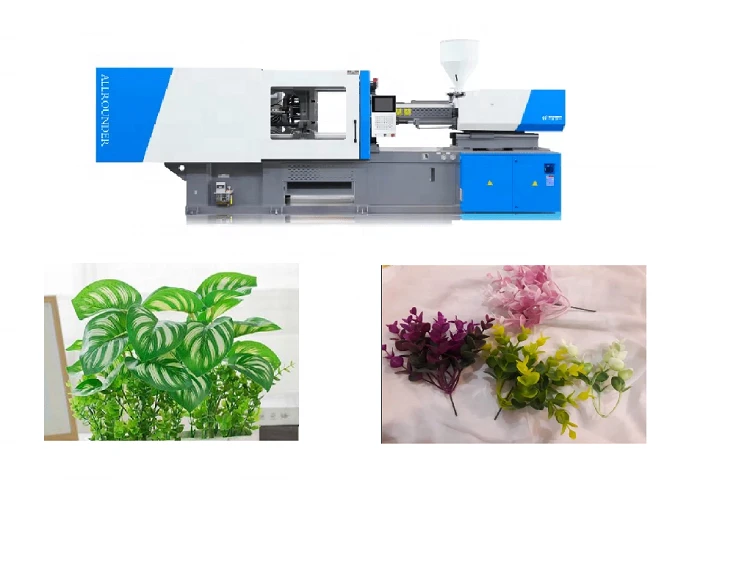
How Do You Match Shot Size to Artificial Plant Production?
Total shot weight = part weight × cavities + runner weight. The machine’s shot weight should be 20–80% of its maximum capacity. For a 16-cavity petal mold with 5g parts and 8g runner, total shot weight is 88g, so choose a machine with 110–440g shot capacity.
Shot Size Calculation
Total Shot Weight = Part Weight × Cavities + Runner Weight
Machine shot capacity should be 20–80% of the maximum. Shots below 20% cause inconsistent melting and poor repeatability. Shots above 80% leave no safety margin for material variation.
Worked example: An 8-cavity stem mold with 15g stems and 6g runner
Total shot weight = (15 × 8) + 6 = 126 g
Recommended machine shot weight: 158–630 g
Tiancheng’s TC-850-P has a theoretical shot volume of 163–222 cm³ and maximum shot weight of 145–198g (PS), suitable for multi-cavity artificial plant molds.
Screw Diameter Selection
A smaller screw diameter suits artificial plant production. The smaller screw provides more uniform melting for small shot weights and reduces residence time. Screw diameters of 28–38mm cover most petal, needle, and stem applications. Larger components (thick branches, large leaves) may require 40–50mm screws.

What Injection Parameters Work Best for PE and PVC Artificial Plants?
PE processes at melt temperatures of 170–220°C with mold temperatures of 30–50°C. PVC requires 150–190°C melt temperature with strict upper limits to prevent HCl release. Both materials need moderate injection speeds (100–150mm/s) and low screw speeds to avoid shear degradation.
PE Processing Parameters
| Parameter | Recommended Range | Notes |
|---|---|---|
| Melt temperature | 170–220°C | Higher end for thin-wall needles |
| Mold temperature | 30–50°C | Lower temp for faster cycle |
| Injection pressure | 50–80 MPa | Moderate; PE flows easily |
| Injection speed | 100–150 mm/s | Moderate speed for thin walls |
| Drying | Usually not required | PE absorbs minimal moisture |
PE injection molding typically uses processing temperatures of 200–250°C and mold temperatures of 30–50°C.A rotation speed of 35–50 RPM keeps shear heating under control.
PVC Processing Parameters
| Parameter | Recommended Range | Notes |
|---|---|---|
| Melt temperature | 150–190°C | Above 200°C causes degradation |
| Mold temperature | 20–40°C | Cool mold for faster cycle |
| Injection pressure | 60–100 MPa | Higher viscosity than PE |
| Injection speed | 80–120 mm/s | Moderate; avoid high shear |
| Drying | 80°C / 2–4 h | Essential to prevent bubbles |
PVC’s narrow processing window demands precise temperature control. The material releases corrosive HCl gas when overheated, so the injection unit must use corrosion-resistant screw and barrel materials.
Thin-Wall Injection Speed Requirements
Research on ultra-thin wall injection molding shows that injection speed contributes 71.07% of the total effect on part quality, followed by melt temperature at 23.31% and holding pressure at 5.62%.This means injection speed is by far the most critical parameter for artificial plant thin-wall parts. A machine with slow injection response cannot produce consistent petals and leaves regardless of other settings.
Konger’s TEC series provides a wider adjustable range of injection pressure and injection speed, fully meeting the rapid filling requirements for ultra-thin petal products.
How Do You Choose Between Single-Color and Two-Color Machines?
Choose a single-color machine if your products use one uniform color. Choose a two-color machine if your products require natural gradient effects or two distinct colors on one part. Two-color machines eliminate secondary painting operations and reduce labor cost by 20–40%.
Single-Color vs. Two-Color Decision Matrix
| Production Scenario | Recommended Machine | Reason |
|---|---|---|
| Solid-color petals and leaves | Single-color | Lower cost, simpler operation |
| Natural gradient flower components | Two-color (mixing type) | Seamless color transition in one cycle |
| Two distinct colors on one part | Two-color (parallel type) | Clear boundary, no secondary painting |
| Premium realistic Christmas tree branches | Two-color | Natural color variation replicates real branches |
Many artificial flowers and trees require two colors on one part. Two-color injection molding injects two different colors into the same mold in a single cycle. This eliminates secondary painting operations and gives better product appearance at lower labor cost. Haichen’s two-color machine uses two barrels, each heating and injecting different colors or materials. A single injection cycle takes approximately 20 seconds.
Konger’s CMS two-color series easily realizes high-end visual effects including two-color gradient and layered coloring.Their CMS170 color mixing machine produces gradient artificial flower stamens finished in one complete molding cycle with seamless natural color transition, no secondary assembly, painting or gluing required.
Production Efficiency Comparison
| Configuration | Cycle Time | Output per 24h | Labor per Shift |
|---|---|---|---|
| Single-color + manual painting | 15s + painting | ~4,000 pcs | 6–10 workers |
| Two-color one-step | 12–20s | ~5,000–7,200 pcs | 2–3 workers |
The two-color machine eliminates the painting station entirely. This saves 20–40% in labor cost and removes the drying workshop requirement. Konger’s CMS170 with an 8-cavity leaf mold achieves stable mass production with reject rates under effective control.

What Cycle Time and Output Can You Expect?
Artificial plant injection molding cycle times range from 8–60 seconds depending on part size and cavity count. Small petals with 16–32 cavities run at 8–15 seconds. Christmas tree branches with 4–8 cavities run at 15–30 seconds. Large components may require 30–60 seconds.
Cycle Time and Output Reference
| Component | Cavities | Cycle Time | Theoretical Output (24h) |
|---|---|---|---|
| Flower petal (small) | 16–32 | 8–12 s | 115,000–345,000 pcs |
| Christmas tree needle | 16–48 | 10–18 s | 76,800–414,000 pcs |
| Flower stem (medium) | 8–16 | 12–20 s | 34,500–115,000 pcs |
| Large leaf/branch | 2–8 | 20–40 s | 4,300–34,500 pcs |
Konger’s CMS170 with a 4-cavity hydrangea flower holder mold achieves a stable 10.89-second cycle time and supports 24-hour continuous production.RUNYI’s PE injection molding machines for Christmas tree leaves offer cycle times of 15–60 seconds depending on mold complexity.
Seasonal Capacity Planning
Artificial plant production concentrates around seasonal peaks. Christmas tree foliage and decorative leaves must be produced before the peak season begins. Topstar’s TS130 solution uses a custom “one-to-four mold” to produce four artificial plants in a single molding cycle, boosting production efficiency by approximately 100%.A single TS130 production unit achieves the output previously required by two traditional machines.
Single-Color and Two-Color Machine Configurations
Haichen provides injection molding machines specifically for artificial flower and tree production. The company has over ten years of experience in this field . Haichen offers both single-color and two-color machines. The two-color models allow customers to produce realistic two-tone leaves and petals in a single cycle. The machines use precise temperature controls and can process PE, PVC, and other common materials . Haichen also supplies the artificial christmas tree making machine with configurations for PE Christmas tree leaf production.
Complete Line Support and Technical Services
Haichen, as one of Chinese professional artificial flowers machine supplier, who provides more than just the machine. The company offers mold design consultation and production process support . Their engineering team analyzes product drawings or samples to recommend the right machine and mold configuration. Haichen also supplies molds for artificial flower and tree production . This integrated approach helps buyers avoid compatibility problems between different suppliers. The company provides installation, training, and after-sales service through its global network.
How Do You Evaluate an Artificial Plant Injection Machine Supplier?
Evaluate suppliers on four criteria: dedicated machine experience (do they have artificial-plant-specific models?), documented cycle time data (can they prove output for your component type?), screw design optimization (smaller diameter, PE/PVC-compatible), and after-sales support (spare parts, on-site commissioning, operator training).
Supplier Evaluation Checklist
| Evaluation Area | What to Verify | Red Flag |
|---|---|---|
| Dedicated machine line | Does the supplier have artificial-plant-specific models, not just general-purpose machines? | Only offers standard machines |
| Cycle time data | Can they provide documented cycle times for your component type and cavity count? | No specific data, only “fast” claims |
| Screw design | Is the screw optimized for PE/PVC thin-wall processing with small shot weights? | Standard general-purpose screw |
| Two-color capability | Does the machine support two-color mixing for gradient effects? | No two-color option |
| After-sales support | Spare parts availability, on-site commissioning, operator training | Order-on-demand only |
FAQ
What tonnage injection molding machine is needed for artificial Christmas tree production?
Most artificial Christmas tree components use 85–170 ton machines. Small petals and needles may run on 85–130 ton machines. Larger branches and multi-cavity molds may require 150–310 tons. Calculate required clamping force using the formula: Total Projected Area × Material Factor × Safety Factor.
Can a standard injection molding machine produce artificial flowers?
A standard machine can produce artificial flowers, but yield rates will be lower. General-purpose machines lack the injection speed, screw design, and temperature control precision for thin-wall parts. Dedicated artificial flower machines achieve 95%+ yield rates compared to 70–80% for standard machines.
What is the best material for artificial Christmas tree needles?
PE is the best material for premium artificial Christmas tree needles. PE injection-molds with realistic vein texture and resists UV fading. PVC serves the low-cost segment but feels stiffer and develops permanent creases. PVC requires corrosion-resistant machine components due to HCl gas release.
Do I need a two-color machine for artificial flower production?
It depends on your product line. If your products use solid colors, a single-color machine suffices. If you need natural gradient effects or two colors on one part, a two-color machine eliminates secondary painting and reduces labor cost by 20–40%.
What cycle time can I expect for artificial plant injection molding?
Cycle times range from 8–60 seconds. Small petals with 16–32 cavities run at 8–15 seconds. Christmas tree needles with 16–48 cavities run at 10–18 seconds. Large branches with 2–8 cavities may require 20–40 seconds.
How do I verify a supplier’s artificial plant machine experience?
Ask for documented cycle times with specific component types and cavity counts. Request production videos or factory visits. Check if the supplier has artificial-plant-specific models rather than general-purpose machines. Konger, for example, provides real-shot footage of 27-fork flower holder production at 10.89 seconds per cycle.
Welcome contact Haichen for more artificial plant plastic trees injection molding machine details.