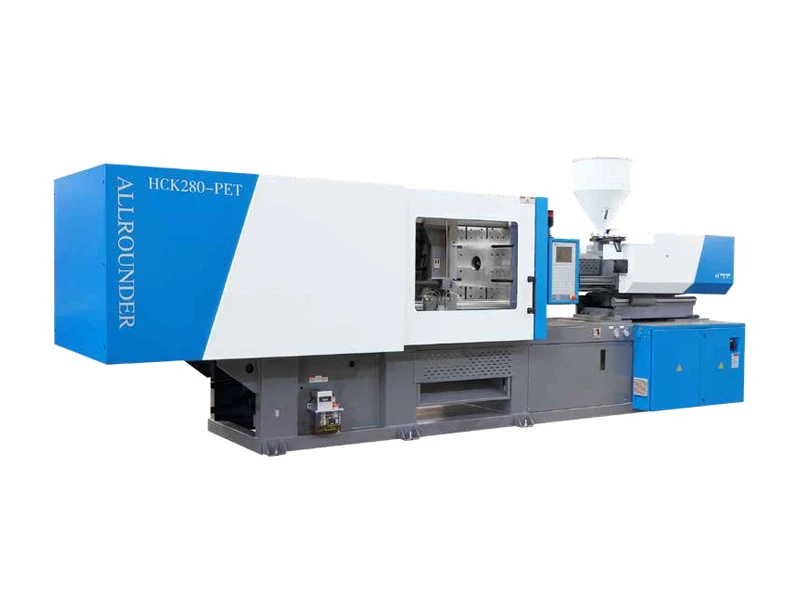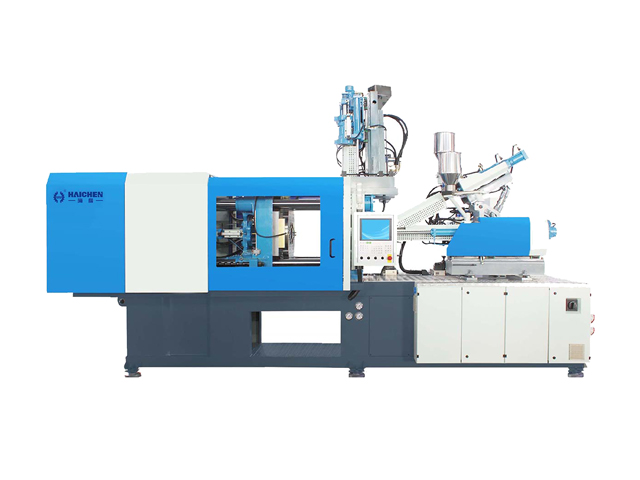
Buying an injection molding machine for plastic bottle handles is not simply a matter of choosing a machine by product weight.
A bottle handle may weigh only a few grams, but a high-cavity mold can require a much larger machine.
The mold layout, material, cavity number, runner system, production target, and mold dimensions all affect the final machine selection.
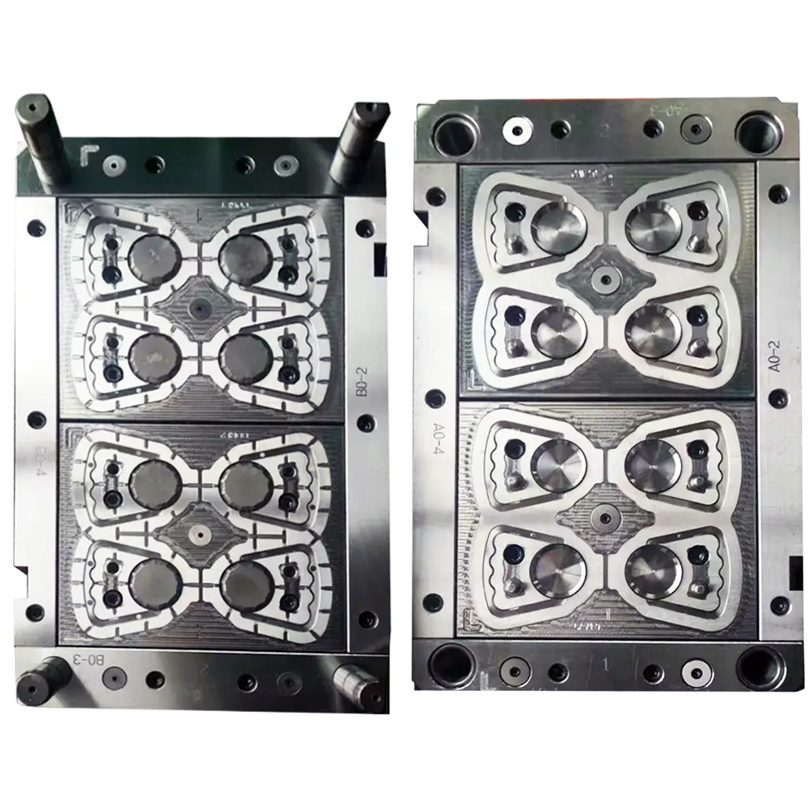
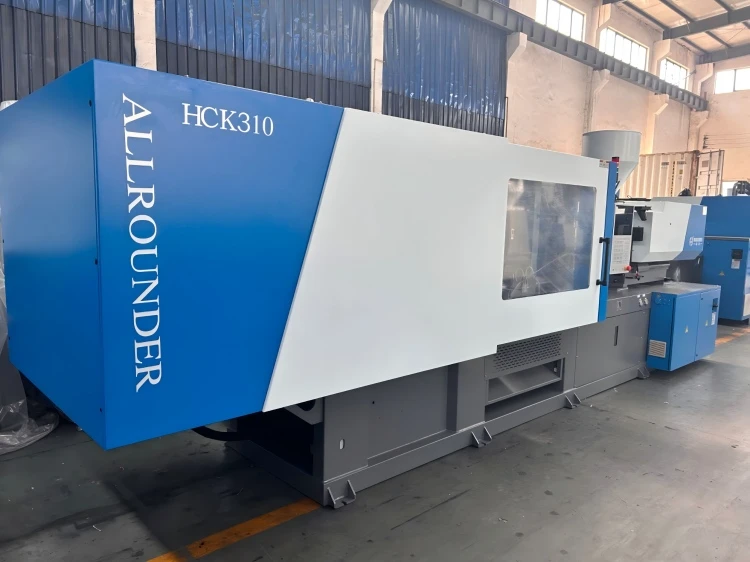
A real Haichen bottle handle project shows this clearly. The handle weighs only 5 g, but the project uses a 16-cavity hot runner mold, a 310-ton HCK310 injection molding machine, and a 25-second cycle.
This guide explains what buyers should check before ordering a machine for plastic bottle handle production.
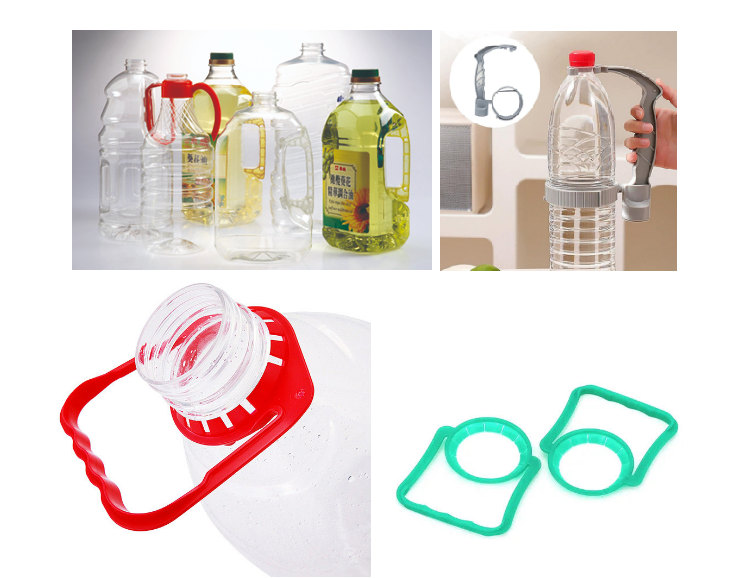
Start With the Bottle Handle, Not the Machine
Before asking for a machine price, define the actual plastic part.
For a bottle handle, useful information includes:
- Product drawing or sample
- Overall dimensions
- Product weight
- Plastic material
- Wall thickness
- Number of cavities
- Mold type
- Expected production volume
- Existing mold information
The product itself provides the starting point for machine selection.
For example, the Haichen bottle handle in the real project has an overall size of about 100 × 82 mm. The upper opening measures about 51 mm, while the lower opening measures about 35 mm.
The finished handle weighs only 5 g.
However, the mold contains 16 cavities, so the machine must support the complete multi-cavity molding project rather than one 5 g part.
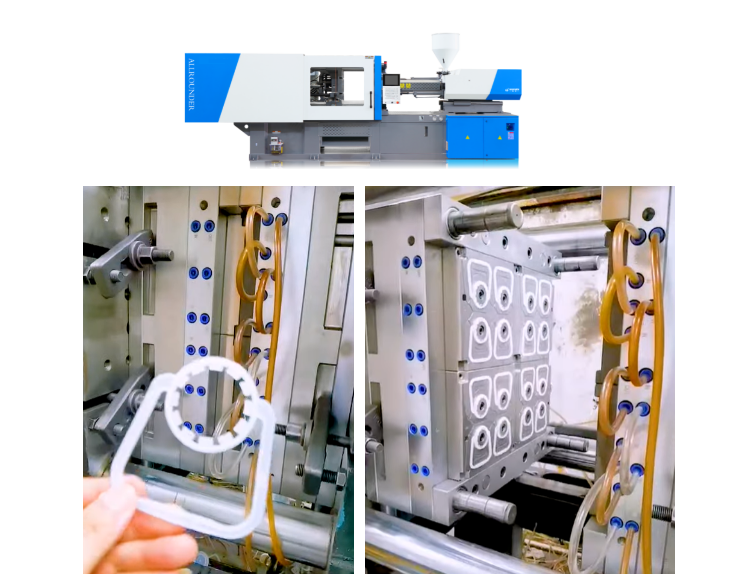
Real Plastic Bottle Handle Injection Molding Case
Here is a real Haichen production reference:
| Item | Project Data |
|---|---|
| Product | Plastic oil bottle handle |
| Product size | Approx. 100 × 82 mm |
| Product weight | 5 g |
| Material | PE |
| Mold cavities | 16 |
| Runner system | Hot runner |
| Injection molding machine | HCK310, 310T |
| Cycle time | 25 seconds |
| Handle load capacity | Approx. 3–4 kg |
The product has a frame-like structure with two openings and connection areas on both sides.
The handle also needs to carry approximately 3–4 kg in this specific production case.
This means that product quality is not only about appearance. The molded part also needs enough strength for its intended use.
Why Does a 5 g Handle Use a 310T Machine?
This is one of the most important points for buyers.
Looking only at the 5 g product weight could lead to the wrong machine choice.
The project uses:
5 g part × 16 cavities = 80 g of finished parts per cycle
The mold also has a hot runner system.
More importantly, the machine must meet the complete requirements of the mold. These include clamping force, mold dimensions, injection performance, mold opening, ejection, and other machine-to-mold matching conditions.
Therefore:Product weight alone does not determine injection molding machine size.
A small part can still require a relatively large machine when the mold contains many cavities or has a demanding layout.
This is also why a supplier should review the actual mold before confirming the machine model.
How Does Cavity Number Affect Machine Selection?
Cavity number is especially important for bottle handle production.
A 16-cavity mold produces 16 handles in one molding cycle. This can provide high production capacity without making the individual part heavier.
For the real Haichen case:
16 cavities × 3600 ÷ 25 seconds = 2,304 pieces/hour
This is the theoretical output based on the supplied cycle time.
Actual production will normally be lower because factories need to account for:
- Machine stops
- Quality inspection
- Material preparation
- Mold maintenance
- Production changes
- Operator activities
The important point is that cavity number changes the complete shot and mold layout. Therefore, it must be considered before selecting the machine.
Why Use a Hot Runner Mold for a Multi-Cavity Handle?
The real bottle handle project uses a 16-cavity hot runner mold.
A hot runner system can distribute molten plastic to multiple cavities without producing the same type of cold runner waste as a conventional cold runner layout.
For a multi-cavity production project, this can be useful when the manufacturer wants to control material waste and maintain a practical mold layout.
However, hot runner does not automatically mean that it is the right choice for every bottle handle.
The decision should consider:
- Number of cavities
- Product structure
- Plastic material
- Gate location
- Mold design
- Production volume
- Material cost
- Mold budget
For this reason, buyers should compare the complete mold solution instead of comparing only the runner type.
What Should You Check About the Bottle Handle Design?
A bottle handle needs more than a simple outline.
The design should be reviewed around the areas that affect molding and use.
Connection Areas
The two side connection areas transfer load between the handle and the bottle.
These areas deserve particular attention because weak connections can affect the final product.
Wall Thickness
Large differences in wall thickness can create different cooling and shrinkage conditions.
This can lead to deformation or dimensional variation.
Inner Openings
The openings in the handle affect the product shape, mold layout, and material flow.
In the Haichen case, the upper opening is approximately 51 mm, while the lower opening is approximately 35 mm.
Load Requirement
The real case has a load capacity of approximately 3–4 kg.
Therefore, the finished product needs to meet the customer’s intended strength requirement rather than only looking good after molding.
How Does PE Affect the Machine and Mold?
The real Haichen handle case uses PE.
Material selection affects the molding project because different plastics behave differently during:
- Melting
- Filling
- Packing
- Cooling
- Shrinkage
- Ejection
For this reason, the machine and mold should be evaluated together with the actual PE grade.
If a factory plans to change from one PE grade to another, it should not assume that the original process settings will remain unchanged.
The supplier should review the new material’s processing requirements before production.
How Does Mold Design Affect the Machine?
The injection molding machine must physically and technically match the mold.
Before purchasing the machine, check:
- Mold length and width
- Mold height
- Tie-bar spacing
- Platen dimensions
- Mold opening requirements
- Ejection requirements
- Mold weight
- Nozzle and sprue position
- Core-pulling requirements, if applicable
This step is particularly important for a 16-cavity mold.
The buyer should not select the machine first and then try to make the mold fit later.
Instead, the machine and mold should be checked as one production system.
Haichen’s public HCK310 specifications also show why mold compatibility matters: the machine has defined tie-bar spacing, platen dimensions, mold-height range, opening stroke, and ejection parameters.
How Do You Compare Different Machine Quotations?
When comparing quotations from different suppliers, do not compare only the machine price.
Ask each supplier to confirm the same basic configuration.
For example:
| Item | What to Check |
|---|---|
| Machine model | Exact model and clamping force |
| Injection unit | Screw size and injection capacity |
| Control system | Controller and operating interface |
| Mold compatibility | Mold size and tie-bar spacing |
| Runner system | Hot runner requirements |
| Ejection | Ejector configuration |
| Core pulling | Required or not |
| Auxiliary equipment | Included or excluded |
| Warranty | Scope and duration |
| Documentation | Applicable conformity documents |
| After-sales service | Installation and technical support |
A lower machine quotation is not necessarily a lower total production cost if important equipment or services are excluded.
The most useful comparison is therefore configuration against configuration.
Do You Need a 310T Machine for Every Bottle Handle?
No.
The 310T machine in this article comes from one real 16-cavity PE bottle handle project.
It should not become a universal rule that every bottle handle requires a 310T machine.
A different handle may have:
- Fewer cavities
- A different material
- A different product size
- A different mold layout
- A different runner system
- A different production target
These changes can lead to a different machine requirement.
The correct question is not:“What tonnage is normally used for bottle handles?”
A better question is:“What machine can safely and efficiently run this specific handle mold?”
How Much Production Can a Bottle Handle Mold Provide?
Production capacity depends mainly on cavity number and cycle time.
The basic calculation is:
Theoretical output = 3600 ÷ cycle time × cavity number
For the Haichen case:
3600 ÷ 25 × 16 = 2,304 pieces/hour
This gives a useful starting point for production planning.
If a factory has a monthly production target, the buyer can work backward from the required output and then discuss the appropriate cavity number and machine configuration with the mold supplier.
This approach is more reliable than selecting a machine from monthly output alone.
What Should You Ask the Injection Molding Machine Manufacturer?
Before placing an order, send the manufacturer enough information to evaluate the complete project.
At minimum, provide:
- Product drawing or sample
- Product weight
- Plastic material and grade
- Number of cavities
- Hot runner or cold runner requirement
- Mold dimensions, if available
- Expected production volume
- Existing machine information, if replacing an old machine
- Factory power supply
- Desired automation level
For a bottle handle project, also explain the required load capacity if strength is important.
In the Haichen case discussed above, the handle needs a load capacity of approximately 3–4 kg. This type of information helps the supplier understand that the project is not only about producing a 5 g plastic part.
What Should Be Included in a Machine Buying Plan?
A practical buying plan should connect four parts:
Product → Mold → Machine → Production target
The product defines the required shape, material, weight, and strength.
The mold determines the cavity number, runner system, layout, and ejection method.
The machine must then support the mold and provide suitable injection and clamping performance.
Finally, the production target determines whether the selected cavity number and cycle time make sense for the factory.
If any one of these four parts changes, the machine selection may also need to change.
Can One Machine Produce Different Bottle Handles?
Yes, provided each mold meets the machine’s installation and operating requirements.
A factory may produce different bottle handles on the same machine at different times.
However, each mold should be checked for:
- Mold dimensions
- Mold height
- Tie-bar spacing
- Shot requirements
- Clamping requirements
- Ejection
- Cooling
- Production cycle
This can make one machine more useful for factories with several bottle handle projects.
What Documents and Services Should Buyers Check?
For international machine purchases, buyers should ask the supplier which conformity documents apply to the destination market and the specific machine configuration.
For example, if the machine will enter a market where CE requirements apply, the buyer should request the relevant conformity documentation rather than simply treating “CE” as a general global certification.
The buyer should also clarify:
- Warranty terms
- Installation support
- Operator training
- Remote technical support
- Spare parts
- Electrical configuration
- User manuals
These details are part of the machine purchase and should be confirmed before the order.
Why Work With a Machine and Mold Supplier Together?
Bottle handle production depends strongly on the relationship between the machine and mold.
If the machine supplier and mold supplier work separately, the buyer may need to coordinate:
- Mold dimensions
- Machine tie-bar spacing
- Injection requirements
- Ejection
- Nozzle position
- Cycle requirements
When the same supplier can evaluate the machine and mold together, the buyer has fewer technical interfaces to manage.
For Haichen projects, the company provides injection molding machines and can also work with customers on mold and production requirements. Haichen’s current product range includes standard HCK machines and specialized configurations for different plastic applications.
FAQ
What machine is used to make plastic bottle handles?
The machine depends on the product and mold. A real Haichen oil bottle handle case uses a 310-ton HCK310 machine with a 16-cavity hot runner mold and a 25-second cycle.
Can a 5 g bottle handle require a large injection molding machine?
Yes. Product weight alone does not determine machine size. In the real case described here, the 5 g handle uses a 16-cavity mold and a 310-ton machine.
Why does the bottle handle use 16 cavities?
The 16-cavity mold allows multiple handles to be produced during each cycle. With a 25-second cycle, the theoretical output is approximately 2,304 pieces per hour.
Is a hot runner necessary for bottle handles?
Not for every project. The appropriate runner system depends on the product, material, cavity number, mold design, production volume, and cost requirements.
How strong is the bottle handle?
In the Haichen production case described in this article, the finished handle has a load capacity of approximately 3–4 kg. This figure applies to the specific product and production conditions and should not be treated as a universal PE handle specification.
Should I choose the machine before designing the mold?
It is better to consider the machine and mold together. The mold dimensions, cavity number, runner system, injection requirements, and ejection system all affect machine selection.
What information do I need to get a machine quotation?
Provide the product drawing or sample, product weight, material, cavity number, mold information, production target, and any special requirements such as load capacity or automation.