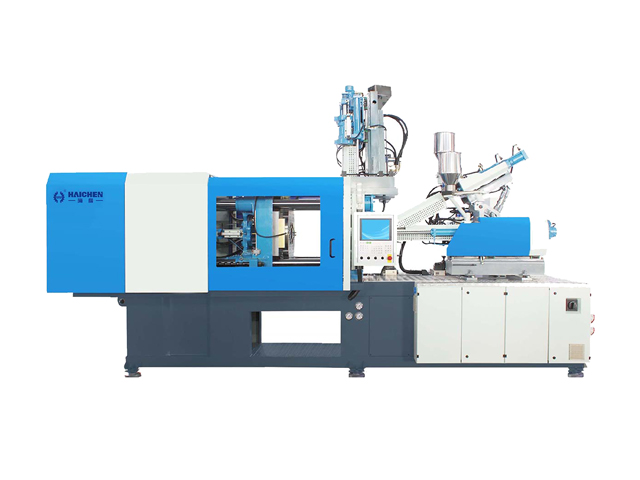
An automated PET preform injection molding line combines a PET injection molding machine, preform mold, dehumidifying dryer, material loader, cooling equipment, take-out robot, and production controls. Together, these systems turn PET resin into preforms for water bottles, juice bottles, cooking oil bottles, and other packaging products.
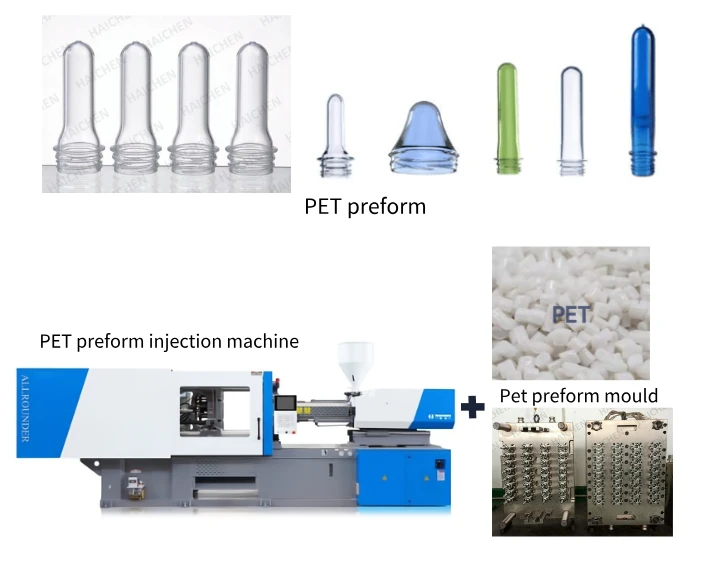
A PET preform is a small, thick-walled plastic part with a finished bottle neck. It is not the final bottle. After injection molding, the preform normally goes through stretch blow molding to become a bottle with the required shape and volume.
For manufacturers, the main challenge is not simply buying a fast injection molding machine. The mold, drying system, cooling equipment, and robot must work at the same pace. Otherwise, one part of the line can slow down the whole process.
This guide explains the main parts of an automated PET preform production line, how the equipment works together, how to estimate output, and what to check before choosing a complete system from Haichen.
What Is an Automated PET Preform Injection Molding Line?
An automated PET preform injection molding line is a connected production system that prepares PET resin, molds the preforms, removes them from the mold, and transfers them for cooling, inspection, or storage.
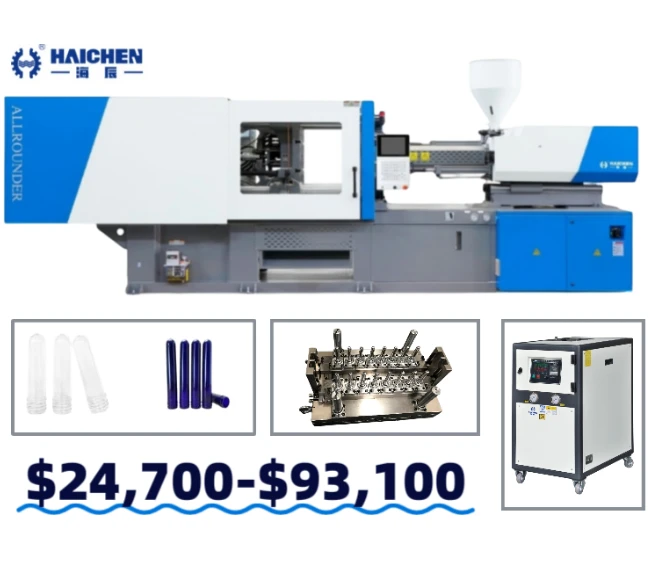
Compared with a machine that relies on manual handling, an automated line can reduce repeated manual work and make the production cycle more consistent.
The exact equipment depends on the preform design and production target. However, most systems need the following main parts:
- PET injection molding machine
- Multi-cavity preform mold
- Dehumidifying dryer
- Automatic material loader
- Mold cooling system
- Take-out robot
- Conveyor or collection system
- Control and safety equipment
Some projects also need an external preform cooling station, automatic inspection, counting, and packing equipment. In addition, the line may need a compressed air supply for pneumatic grippers or mold actions.
The equipment should be selected as one system. Buying each item separately without checking compatibility can lead to cycle delays, handling problems, or poor production balance.
What Equipment Does an Automated PET Preform Production Line Need?
PET Preform Injection Molding Machine
The injection molding machine is the core of the system.
It melts PET resin and injects the melt into the preform mold. The machine must provide enough clamping force, injection capacity, plasticizing output, and mold space for the selected product.
PET preform production also places strong demands on repeatability. The neck finish, part weight, and wall thickness must remain consistent so that the preforms can move through the next blow molding stage.
Before choosing the machine, check:
- Preform weight
- Neck finish and diameter
- Number of mold cavities
- Total shot weight
- Target cycle time
- Mold dimensions
- Required daily output
The injection unit must prepare enough material before the next cycle. Meanwhile, the clamping unit must keep the mold closed during injection.
For this reason, a suitable PET preform injection molding machine should match both the product and the mold.
High-Precision PET Preform Mold
The mold determines the shape of each preform.
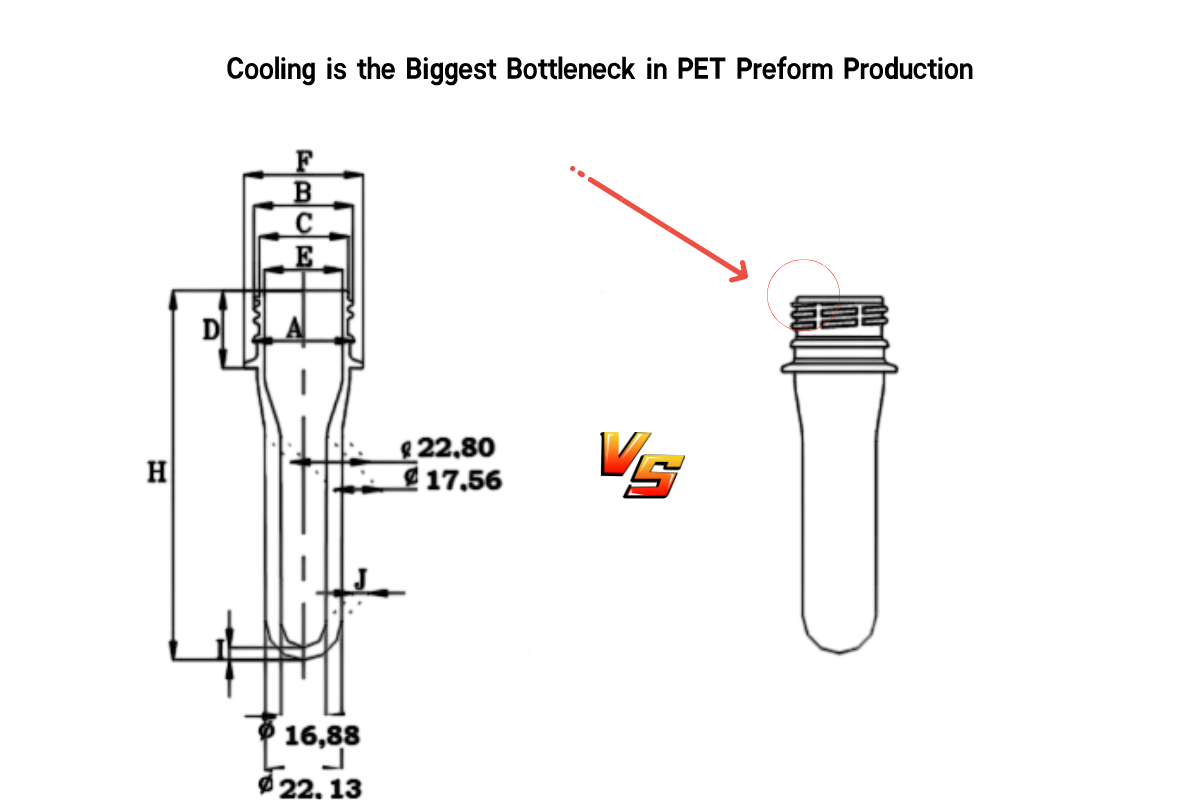
Its cavity forms the body, while the core and neck insert create the neck finish. The mold also needs a suitable cooling layout and balanced filling across all cavities.
A multi-cavity mold can produce many preforms during one cycle. However, increasing the cavity number also increases the total shot weight and places more demands on mold balance, temperature control, and machine capacity.
The mold design should match:
- Neck finish
- Preform weight
- Preform length
- Wall thickness
- Number of cavities
- Cooling layout
- Hot runner design
- Expected production volume
The neck finish deserves special attention because it must fit the cap and sealing system after the bottle is blown.
For that reason, buyers should confirm the mold design and machine specification together before placing an order.
Dehumidifying Dryer and Material Loader
PET resin absorbs moisture from the air. If the resin contains too much moisture during melting, hydrolysis can reduce the material’s molecular weight and affect preform strength and appearance.
A suitable dehumidifying dryer prepares the resin before it enters the injection molding machine.
The drying system should provide the conditions required by the selected PET grade. Temperature, drying time, airflow, and dew point should follow the resin supplier’s technical data and the system design.
After drying, an automatic loader transfers the material to the machine hopper.
This helps keep the material flow steady and reduces the need for operators to move resin by hand.
For high-volume PET preform production, the dryer and loader should have enough capacity to support the injection cycle. A dryer that cannot prepare material fast enough may interrupt an otherwise well-matched line.
Cooling System for PET Preforms
Cooling affects cycle time and preform quality.
During injection molding, the mold removes heat from the molten PET. The cooling system must provide enough flow and heat removal to keep the mold temperature stable.
If cooling capacity is too low, the machine may need a longer cycle. In addition, uneven cooling can affect preform dimensions and release.
A typical system may include:
- Water chiller
- Mold cooling circuits
- Water pumps and filters
- Flow monitoring
- External cooling station, when required
Some production systems use a robot to move preforms to an external cooling station. This can help separate part cooling from the time the mold stays closed.
However, an external station does not guarantee a fixed cycle-time reduction in every project. The result depends on preform weight, mold design, cooling conditions, and the layout of the system.
Take-Out Robot and Part Handling
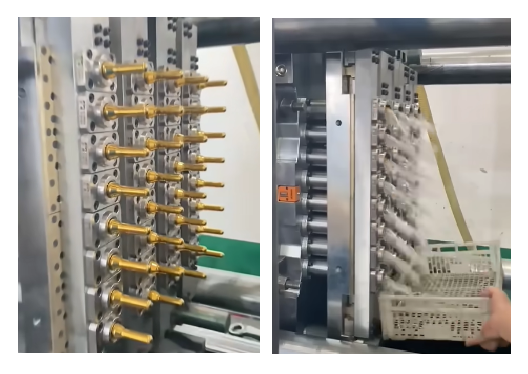
After the mold opens, a take-out robot removes the preforms and transfers them to the next position.
Automatic handling can reduce manual contact and protect the neck finish from damage. It can also keep part removal in step with the machine cycle.
Before selecting a robot, confirm:
- Robot payload
- Required movement range
- Mold opening space
- Preform handling method
- Gripper design
- Safety signals
- Conveyor position
- Cycle-time target
The robot must complete its movement before the machine starts the next cycle. Therefore, the machine, robot, and mold should be tested together.
Some systems need compressed air for grippers or other pneumatic actions. Others may use different handling methods. The factory should provide the required air supply according to the selected equipment rather than assume that one arrangement fits every line.
Conveyor, Inspection, and Collection Equipment
After removal, the preforms may move through a conveyor or cooling station before they enter a collection box or inspection area.
For some projects, operators inspect samples during production. Higher-volume systems may use automatic inspection or counting equipment.
Inspection can cover:
- Neck finish
- Part weight
- Appearance
- Color
- Bubbles or visible defects
- Short shots
- Deformation
The inspection plan should match the product specification and downstream blow molding requirements.
A conveyor must also handle the expected output. If it cannot remove preforms quickly enough, the robot may need to stop, which can slow the whole production line.
How Does an Automated PET Preform Injection Molding Line Work?
The production process follows a series of connected steps.
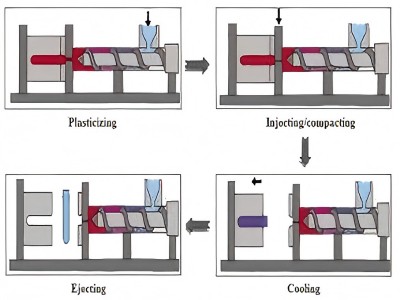
Step 1: Dry the PET Resin
The dryer removes moisture from the PET resin before molding.
The operator should follow the resin supplier’s drying instructions and check that the system can maintain the required conditions.
Proper drying helps protect the resin during melting.
Step 2: Feed the Resin to the Machine
An automatic loader transfers dried PET pellets to the injection molding machine.
A closed material path can help protect the resin from moisture pickup during transfer.
Step 3: Melt and Inject the PET
The screw moves the resin through the heated barrel and prepares the shot.
The injection unit then pushes the molten PET into the preform mold. Injection speed and pressure must suit the resin, preform weight, and mold design.
For multi-cavity molds, the melt must reach each cavity in a balanced way.
Step 4: Cool the Preforms
The mold removes heat from the plastic.
The required cooling time depends on the preform design, wall thickness, mold cooling, and target quality.
If the system includes external cooling, the robot can move the preforms to the cooling station after removing them from the mold.
Step 5: Remove and Transfer the Preforms
The robot removes the preforms and transfers them to a conveyor, cooling station, or collection area.
This reduces repeated manual handling and helps keep the cycle consistent.
Step 6: Inspect and Collect the Preforms
The production team checks the preforms according to the agreed quality plan.
Acceptable preforms move to storage or the next production step. If the factory also produces finished bottles, the preforms later enter a suitable stretch blow molding machine.
The full process can be shown as:
PET Resin → Dehumidifying Dryer → Auto Loader → Injection Molding Machine → Preform Mold → Robot Take-Out → Cooling and Inspection → Collection or Blow Molding
How to Choose the Right Automated PET Preform Production System
The correct line depends on product requirements rather than automation level alone.
Match the Machine to Preform Weight
The part weight affects the total shot size.
For a multi-cavity mold, calculate:
Total shot weight = Preform weight × Number of cavities + Runner weight, where applicable
The machine must also plasticize enough resin during the target cycle.
Do not use the maximum published shot weight as the only selection rule. Ask the supplier to check the useful shot range, screw diameter, plasticizing capacity, and actual PET requirements.
Choose the Right Number of Mold Cavities
More cavities can raise output because the mold creates more preforms in each cycle.
However, cavity number also increases the shot weight and changes the required clamping force, mold size, cooling demand, and tooling cost.
The best cavity count depends on:
- Daily output target
- Preform weight
- Cycle time
- Machine capacity
- Mold investment
- Expected operating hours
- Quality requirements
A lower-cavity mold may suit smaller orders or a new project. A higher-cavity mold may fit a stable, high-volume operation.
The supplier should confirm the machine and mold combination before making a final recommendation.
Check Neck Finish and Bottle Design
Preforms with different neck finishes are not always interchangeable.
The mold should match the intended bottle cap and sealing system. It should also suit the preform’s weight, length, and final bottle design.
For example, a lightweight water bottle preform has different requirements from a heavy preform for an oil bottle or large container.
Therefore, send the bottle drawing or specification when requesting a quotation.
Calculate Output From Cavities and Cycle Time
A basic formula helps estimate theoretical output:
Hourly output = Number of cavities × 3,600 ÷ Cycle time in seconds
Haichen’s published PET machine page includes an example of a 28 mm neck, 12 g preform made with a 32-cavity mold on an HCK250 fast-injection machine, with a listed 14-second cycle.
Using those figures:
32 × 3,600 ÷ 14 = about 8,229 preforms per hour
This is theoretical output before allowing for startup, downtime, quality checks, mold maintenance, and other interruptions. Actual output should be measured during the production trial.
The same page also lists a 24-cavity, 15 g preform example on an HCK250 standard machine with a 20-second cycle. That example gives a theoretical output of 4,320 preforms per hour.
These figures are application examples, not guaranteed results for every mold or project. They show why the preform weight, cavity number, and cycle time should be checked together.
Check the Required Automation Level
Not every factory needs the same degree of automation.
| Automation Level | Main Equipment | Suitable Planning Goal |
|---|---|---|
| Basic | Machine, mold, dryer, and basic handling | Trial production or lower output |
| Semi-automatic | Machine, mold, dryer, loader, cooling, and selected handling equipment | Reduced manual feeding and more stable operation |
| Integrated automatic line | Machine, mold, material handling, robot, cooling, conveyor, and selected inspection | Higher-volume production and coordinated handling |
These are planning categories rather than fixed industry standards.
A full automatic line still needs people to supervise production, check quality, refill materials, maintain equipment, and respond to faults. Therefore, calculate labor needs from the actual line layout rather than assuming that automation removes all operators.
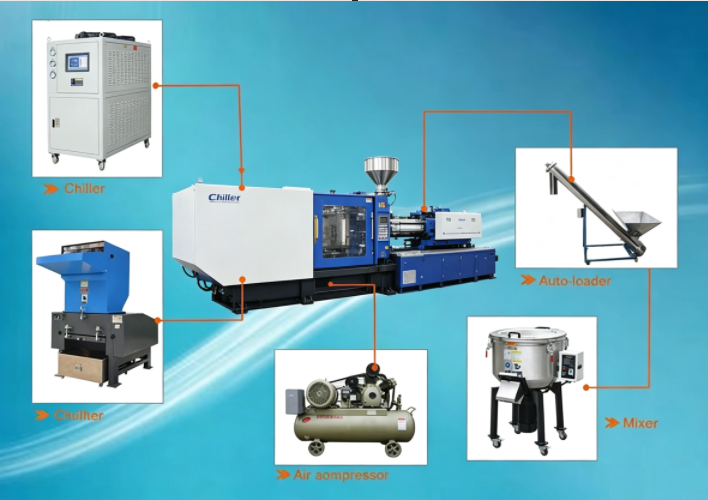
What Auxiliary Equipment Does a PET Preform Line Need?
The required equipment depends on the mold, machine, preform design, and factory utilities.
Dehumidifying Dryer
PET drying is a key process requirement. Size the dryer according to resin consumption and the drying conditions of the selected grade.
Auto Loader
The loader moves dried material to the injection machine. It should have enough capacity to support production without repeated stoppages.
Chiller and Mold Cooling
The chiller and cooling circuits must remove enough heat for the planned cycle.
Review water flow, temperature control, maintenance access, and the cooling needs of the mold.
Take-Out Robot
A robot must remove the preforms safely within the required cycle. Confirm that its range, gripper, and movement match the mold and conveyor arrangement.
External Cooling Station
An external station may help cool preforms after mold removal. It is useful when the machine and mold design can benefit from separating part cooling from the mold-open stage.
However, the final benefit should be confirmed through process testing.
Compressed Air and Safety Equipment
Some robots and mold actions need compressed air. Other systems may use different components.
Check the air demand and supply requirements of the actual equipment. Also plan safety guarding, emergency stops, and machine-robot interlocks as part of the integrated system.
Common Problems in PET Preform Automation
Automation can improve handling, but it does not remove the need for proper process control.
Cloudy Preforms or Bubbles
Moisture in PET can cause material degradation and visible defects.
Check the drying process, material transfer, and resin condition. Follow the supplier’s drying instructions and verify the equipment settings.
Uneven Preform Weight
Different preform weights can come from unstable injection conditions, cavity imbalance, material changes, or an unsuitable process setup.
Check machine data, mold condition, and cavity balance before changing settings.
Neck Damage During Take-Out
The robot or gripper may damage the neck finish if it uses the wrong contact points or removal path.
Review the gripper design and robot movement. The take-out process should protect the neck area and transfer the preform without unnecessary contact.
Long Cycle Time
Cycle time may increase when cooling is insufficient, the robot takes too long, or the material preparation system cannot keep up.
Review the full sequence rather than focusing only on injection speed. The dryer, mold, machine, robot, and cooling system must all support the target cycle.
Frequent Line Stops
Stops may come from material shortages, robot faults, cooling problems, safety signals, or faults in auxiliary equipment.
A useful production record should track the stop reason, duration, affected equipment, and corrective action. This gives the team a clearer view of the actual bottleneck.
How to Improve PET Preform Production Efficiency
The most useful improvements come from balancing the whole line.
Balance the Machine and Auxiliary Equipment
A high-output injection machine cannot deliver its target if the dryer, chiller, robot, or conveyor becomes the bottleneck.
Check the planned output of each piece of equipment. The auxiliary systems should support the same production target as the injection machine.
Monitor Actual Cycle Time
Record the cycle time over a representative production run.
Also record startup time, interruptions, rejected parts, and planned maintenance. This gives a more useful output figure than theoretical capacity alone.
Keep the Cooling System Stable
Stable cooling can help maintain a repeatable cycle.
Inspect filters, water flow, temperatures, and cooling connections according to the equipment maintenance plan.
Track Quality Alongside Output
A faster cycle does not help if the line produces more rejected preforms.
Monitor part weight, neck dimensions, visual quality, and any measurements required by the bottle design. Confirm the process window during trials before making major speed changes.
Which Haichen Equipment Can Support PET Preform Automation?
Haichen’s published PET machine range includes HCS servo machines and HCK hybrid PET machines. Its product page also describes an external robot cooling arrangement for selected production setups.
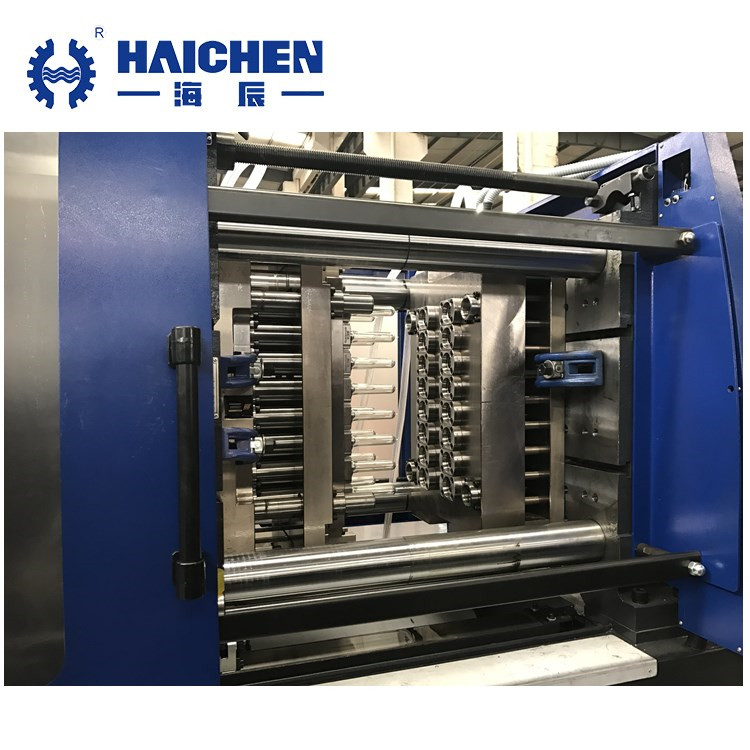
Haichen lists several application examples, including:
- A 28 mm neck, 12 g preform using a 32-cavity mold on an HCK250 fast-injection machine
- A 30 mm neck, 15 g preform using a 24-cavity mold on an HCK250 standard machine
- A PET jar preform using an HCK200 with a four-cavity mold
- A large water-bucket preform example using an HCK400
The listed cycle times differ because the part weight, mold, cavity number, and machine configuration differ. Use them as reference applications, not as promises of what another project will achieve.
For machine details, see Haichen’s PET preform injection molding machine page.
For the broader production-line layout, see the PET bottle preform injection molding production line guide. If you are planning the investment, Haichen also has a separate PET preform production line cost guide.
What Information Should You Provide for a PET Preform Line Quotation?
A supplier can recommend the system more accurately when the inquiry includes:
- Bottle or preform drawing
- Neck finish
- Preform weight
- PET resin grade
- Number of cavities
- Target cycle time
- Required daily or hourly output
- Mold specifications, if available
- Required automation level
- Factory cooling and compressed-air conditions
- Downstream blow molding requirements
With these details, the supplier can review the machine, mold, dryer, loader, cooling, robot, and control system as one production line.
Frequently Asked Questions
What is an automated PET preform injection molding line?
It is a connected system that uses a PET injection molding machine, preform mold, material preparation equipment, cooling system, robot, and other supporting equipment to make PET preforms with coordinated handling.
Does PET preform production need a dehumidifying dryer?
PET resin normally needs proper drying before injection molding. The required drying conditions depend on the resin grade and supplier instructions. A suitable dehumidifying system helps prepare the resin for stable processing.
How many cavities should a PET preform mold have?
The right number depends on preform weight, output target, cycle time, mold cost, and machine capacity. Higher cavity counts can increase output per cycle, but they also increase the shot weight and place more demands on cooling and mold balance.
How do I calculate PET preform output per hour?
Multiply the cavity number by 3,600 and divide by cycle time in seconds. This gives theoretical output. Actual output will be lower when production interruptions, startup, inspection, maintenance, and rejected parts are included.
Does a PET preform line include a blow molding machine?
Not always. A preform injection molding line makes the preforms. A separate stretch blow molding process is normally needed to turn those preforms into finished bottles. Some factories buy the two systems separately.
Can Haichen supply the complete PET preform system?
Haichen’s public materials describe support for PET machines and auxiliary equipment such as dryers, chillers, and robots. Confirm the exact equipment scope, automation interface, installation requirements, and production target with Haichen when requesting a project quotation.
Plan Your Automated PET Preform Injection Molding Line
Send Haichen your preform drawing, neck finish, part weight, mold cavity number, and daily output target. Also include the resin grade and any requirements for cooling, robot handling, inspection, and downstream blow molding.
Haichen can use these details to review the machine size and supporting equipment for your project. This helps you compare complete production configurations rather than selecting the injection molding machine alone.
Author: Yang, Senior Engineer, Haichen Machinery