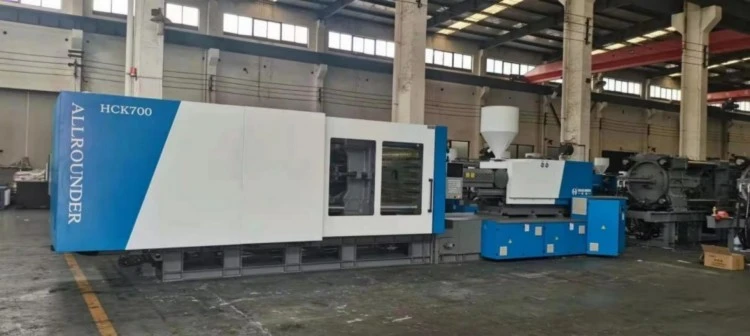
Plastic crate injection molding requires precise control over pressure, temperature, and cooling. Because crates are large, deep, and often have complex mesh patterns (ventilated slots), they are highly prone to specific molding defects. The most common problems are warpage from uneven cooling, long cycle times from poor heat dissipation, and inefficient part take-out with sprue handling.
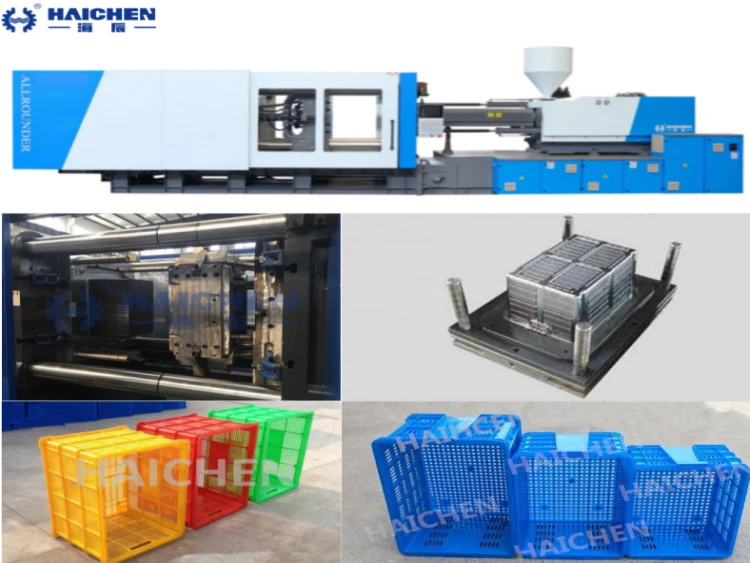
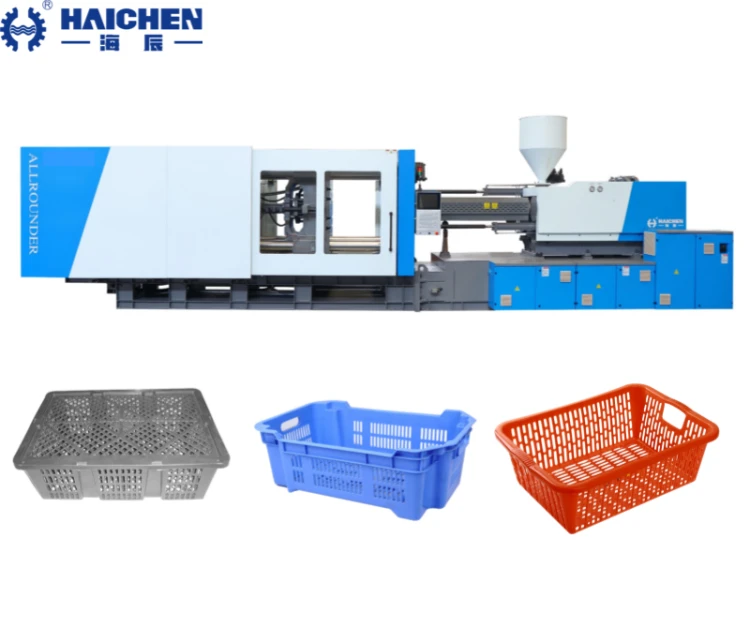
Plastic crates – milk, egg, and beer crates – have thin walls, dense rib structures, and large surface areas. These features push standard injection molding to its limits. As a machine builder, HAICHEN sees three core issues: warpage, cooling bottlenecks, and low automation.
Warpage comes from uneven cooling and differential shrinkage. Inadequate cooling makes thin-wall beer crates deform during ejection. Manual part removal and sprue cutting waste time and damage products. This article explains proven solutions: pneumatic take-out systems, cold runners with robotic sprue pickers, and beryllium copper cooling inserts. A real HAICHEN case study shows how these solutions work together.
Warpage Control in Plastic Crate Injection Molding
Material Selection and Mold Design Fundamentals
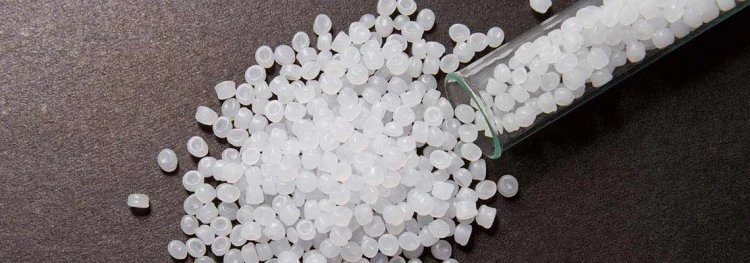
The choice of crate material directly influences shrinkage and warpage. HDPE and PP are the most common options, but each has distinct crystallization behavior and melt flow index. Meanwhile, the plastic crate mould design – including gate position, cooling layout, and steel grade – must match the material’s flow characteristics to ensure balanced filling. A well-tuned crate machine combined with auxiliary equipment (e.g., temperature controllers and granulators) reduces defects from the start. For high-volume production, industrial crate machines should integrate mold flow simulation and closed-loop process control, enabling consistent dimensional accuracy across millions of cycles.
Uniform Wall Thickness and Rib Design
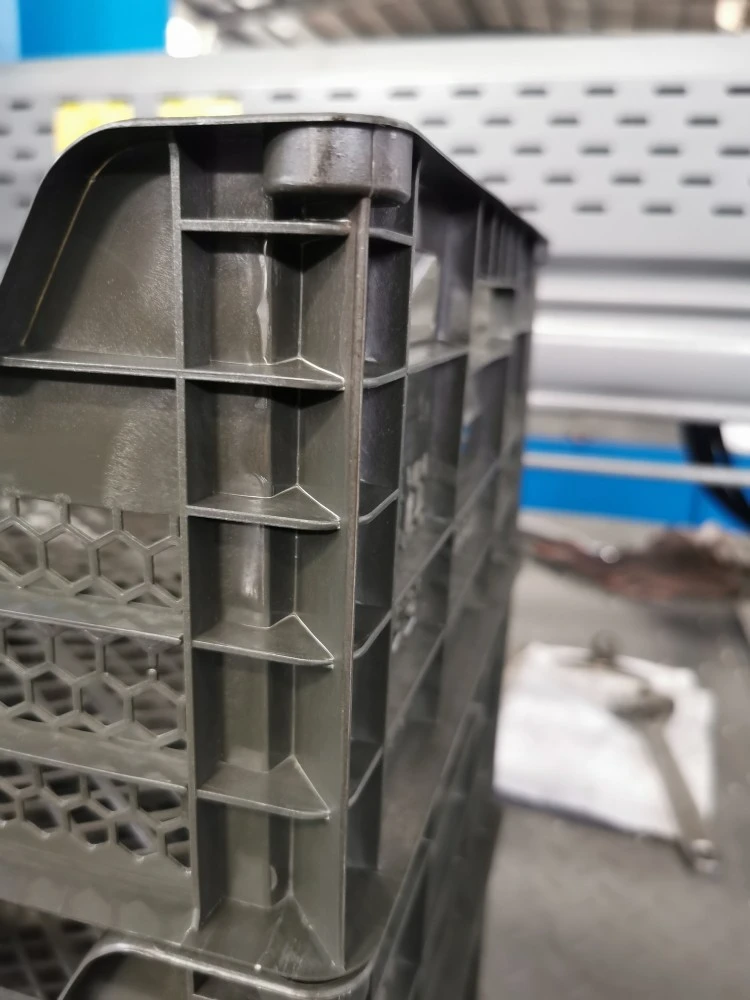
Uneven wall thickness causes non-uniform shrinkage, leading to warpage. Design crates with consistent wall thickness. Use rounded transitions at rib roots to reduce stress concentration.
Cooling Channel Layout and Mold Temperature Control
Place cooling channels near gate areas and rib intersections. Keep the core (moving side) 10-15°C cooler than the cavity side. This keeps the crate on the moving side and reduces ejection distortion. Use a mold temperature controller to keep zone differences within ±3°C.
Holding Pressure and Material Shrinkage Management
HDPE shrinks 1.5-2.5% during cooling. Compensate with holding pressure. Recommended holding pressure is 80-100 bar, extended until the gate seals. Recalibrate parameters when switching materials.
Take-Out and Sprue Handling for Plastic Crate Molding
Pneumatic Take-Out Advantages
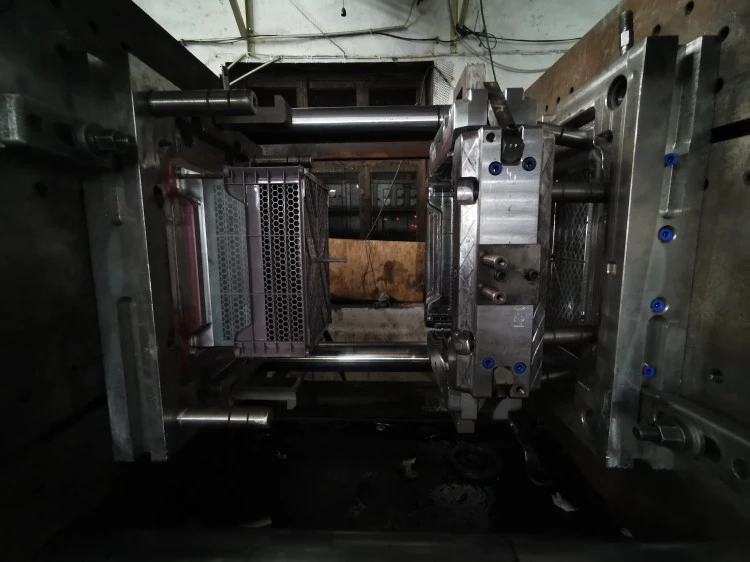
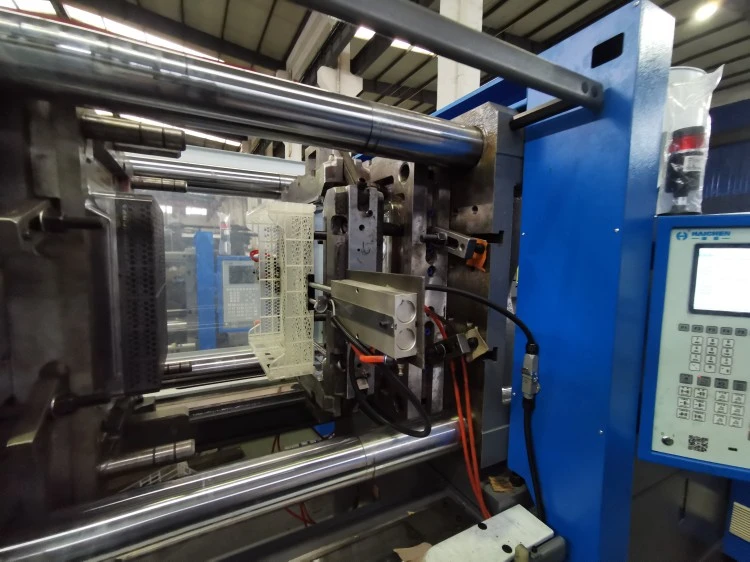
Pneumatic robots remove crates within one second after mold opening. No oil contamination – safe for food-contact crates. Adjustable clamping force protects thin walls from crushing.
Cold Runner with Robotic Sprue Picker
Cold runner molds are cheaper and faster to change, but they produce sprue waste. Add a secondary robot arm or sprue picker. It extracts the sprue and drops it into a granulator for recycling. This saves 8-12% material cost.
Cycle Time Reduction
Manual take-out takes 3-5 seconds. Pneumatic take-out takes 1 second. Combined with auto sprue separation, typical milk crate cycles drop below 15 seconds.
Cooling Solutions for Thin-Wall Crate Injection Molding
Standard Steel Conducts Heat Poorly
Beer crates have wall thickness of only 1.5-3 mm with dense bottom ribs. P20 steel has a thermal conductivity of ~30 W/m·K. Heat builds up at rib junctions. If cooling is insufficient, the soft plastic deforms under ejector pins.
Beryllium Copper Inserts Solve the Problem
Beryllium copper (BeCu) offers thermal conductivity of 105-130 W/m·K – 3 to 4 times higher than P20. Place BeCu inserts at rib intersections and deep cavity corners. This shortens cooling time by 3-5 seconds per shot.
Cost Comparison
| Material | Thermal conductivity (W/m·K) | Cost impact |
|---|---|---|
| P20 steel | ~30 | Baseline |
| High-conductivity steel | ~45 | +2-3% |
| Beryllium copper | 105-130 | +5-8% |
Saving 3 seconds per shot at 3,000 shots/day adds 1,000 more crates daily. BeCu pays back in less than 6 months.
Plastic Crate Injection Molding Case Study
Mold and Material Configuration
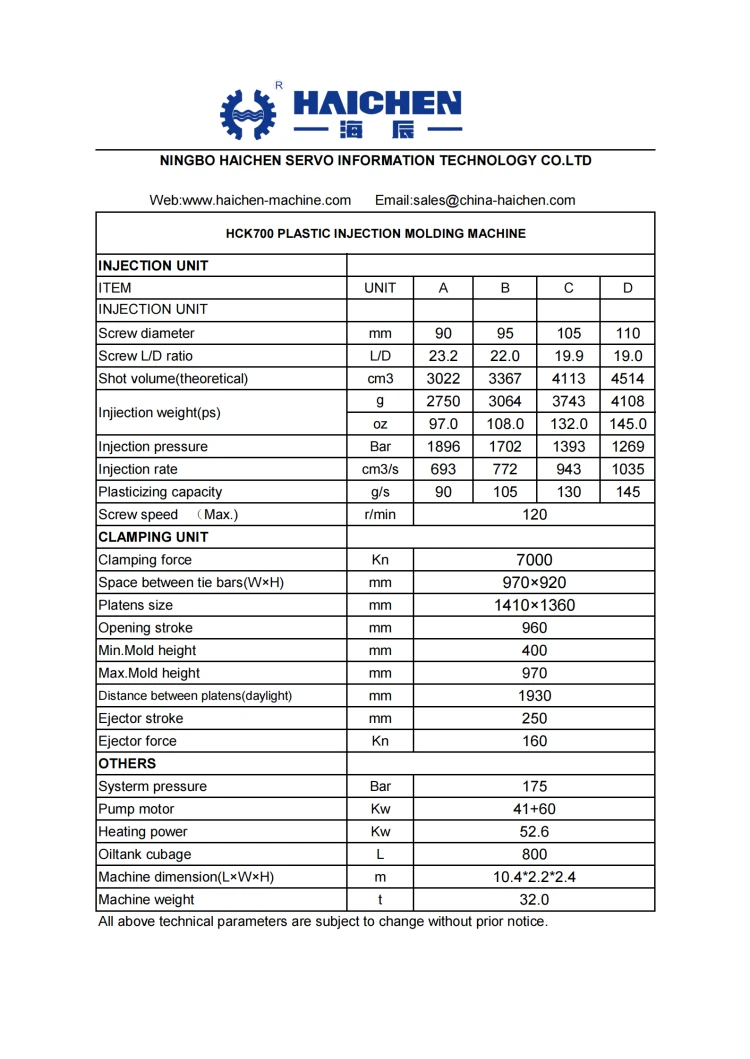
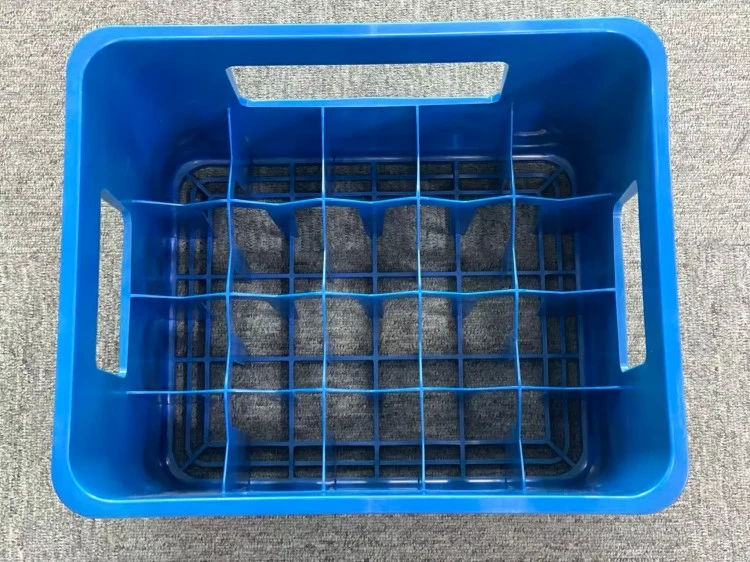
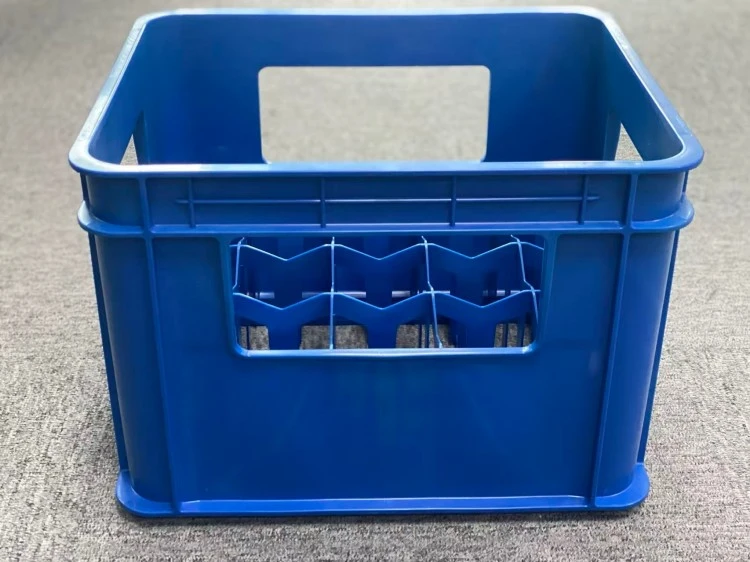
HAICHEN supplied a complete solution for a beer crate customer using the K-series injection molding machine with 700 tons clamping force. Key parameters are shown below.
| Parameter | Data |
|---|---|
| Product size (L×W×H) | 270 × 350 × 310 mm |
| Part weight | 1800 g |
| Mold type | Hot runner, single cavity |
| Mold base material | P20 (standard S50C) |
| Cavity / core / slider / stripper plate | China 718H |
| Number of cavities | 1 |
| Mold dimensions (L×W×H) | 750 × 670 × 600 mm |
| Mold weight | 2600 kg |
| Injection molding machine | Haichen K-series, 700 ton |
| Ejection | Auto ejection + 2 German MERKLE oil cylinders for reset |
| Service life | 1 million cycles |
Cooling and Hot Runner Design
12 beryllium copper inserts are installed on the floating plate to remove heat rapidly from rib junctions. A 6-point valve-gate hot runner ensures balanced melt filling for the single cavity, reducing sprue waste.
Production Results and Lifespan
This mold runs on the Haichen K-series 700-ton machine. Thanks to BeCu fast cooling, typical cycle time is 25-30 seconds. The auto-ejection oil cylinders reset precisely, maintaining dimensional stability over 1 million cycles.
Customer feedback: Warpage rate below 0.5%. No pin puncture or rib tearing. Stable daily output of 2,800-3,000 crates.
Problem-Solution Summary
| Problem | Solution | Haichen Capability |
|---|---|---|
| Warpage | Uniform wall, optimized cooling, proper holding pressure | Mold flow analysis, parameter tuning |
| Slow cooling | BeCu inserts, zone temperature control | BeCu machining, chiller integration |
| Slow take-out/sprue | Pneumatic robot + sprue picker | Full automation package |
| Thin-wall deformation | Hot runner + BeCu + proper ejection | Custom mold design, turnkey line |
The combination of proper material selection, optimized cooling design, and automated take-out systems directly addresses the three most common problems in plastic crate injection molding. These solutions have been validated across multiple production lines with measurable improvements in cycle time, warpage rate, and overall yield.
Frequently Asked Questions
Q: How to select the right clamping tonnage for a given crate size and weight
A: Estimate by projected area × cavity pressure (typically 300-500 bar). For a 1200×1000mm crate, 500-1000T is common; thicker walls or high regrind content may require higher tonnage.
Q: What is the recommended regrind ratio and its effect on quality
A: Keep ≤30% to avoid loss of impact strength and flowability. Always dry and filter regrind, and adjust holding pressure and speed accordingly.
Q: How to detect and resolve cooling channel scaling or blockage
A: Check temperature difference between inlet and outlet (normally ≤3-5°C) and flow rate. Use descaling agents periodically; severe cases require mechanical cleaning or pipe replacement.
Q: How to synchronize the automation robot with the injection molding machine
A: Use I/O or fieldbus signals (mold open, ejection complete) to trigger the robot. Set safety interlocks and delays to prevent collisions.
Q: What maintenance is needed after the mold reaches its design life (e.g., 1 million cycles)
A: Beyond routine polishing and replacing wear parts, perform CMM inspection on critical dimensions. Consider hard chrome plating or re-heat treatment for extended life, and replace inserts or cores as needed.