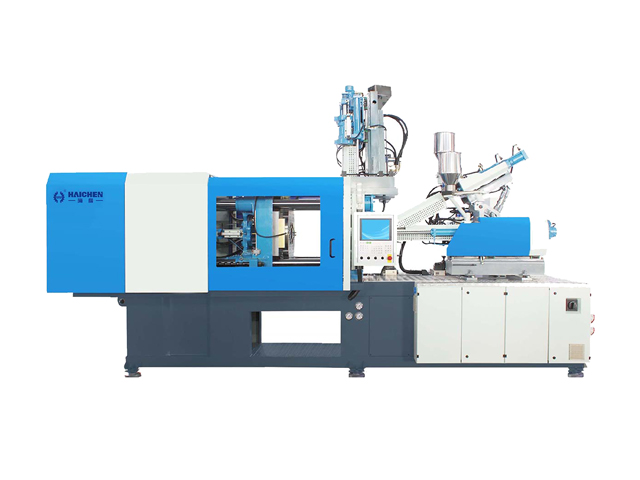
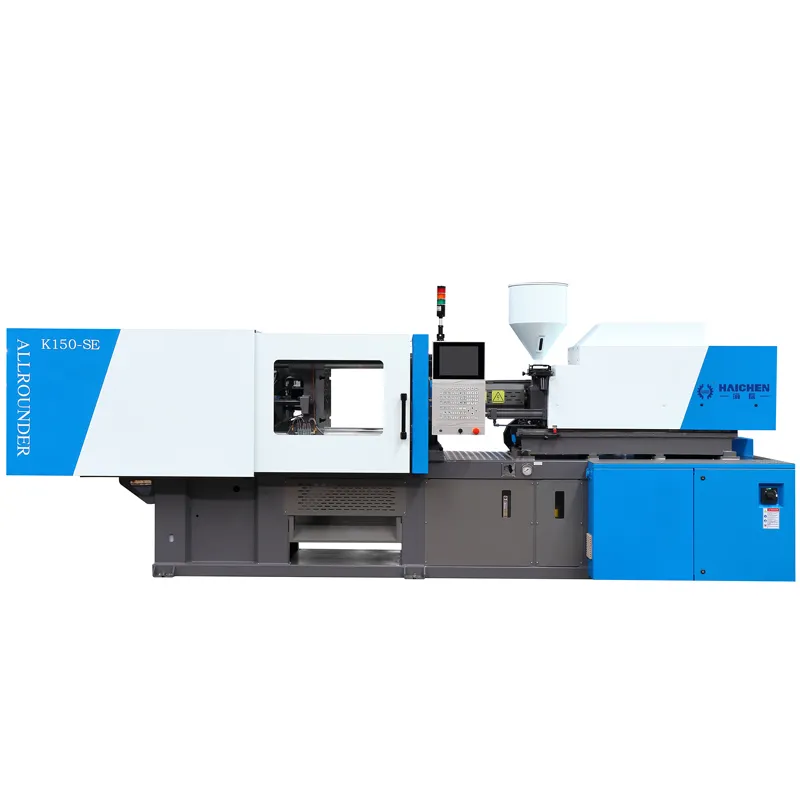
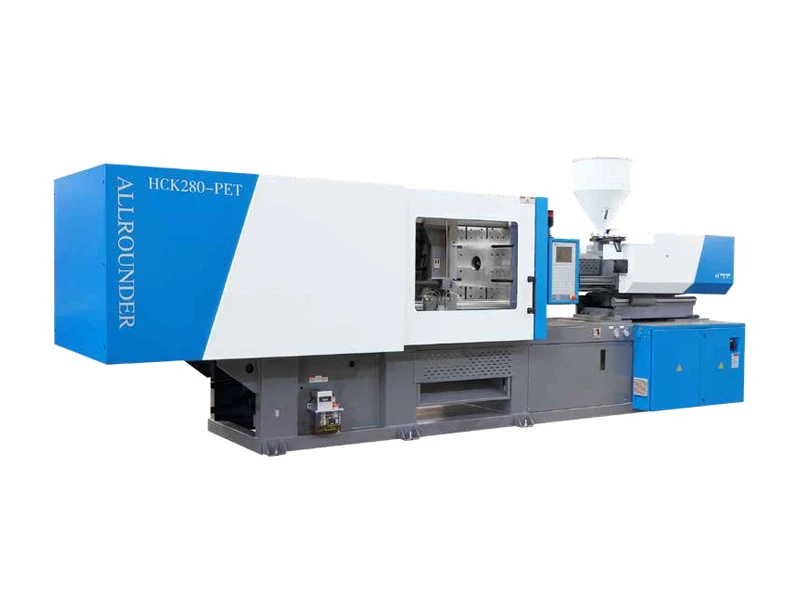
Choosing the right capacity for your plastic bowl injection molding machine comes down to three things: output target determines cavity count, bowl size determines tonnage, and material determines configuration.
Output target → cavity count – Under 10,000 pieces per day? Go with 4 cavities and an 80–120 ton machine. 10,000–50,000 pieces per day? 8 cavities and 120–180 tons. 50,000–150,000 pieces per day? 16 cavities and 180–250 tons. Over 150,000 pieces per day? 24–32 cavities and 250–350 tons. More cavities lower your per-unit cost, but they also require higher tonnage and more mold investment.
Bowl size → tonnage – Bigger bowls and thicker walls need more clamping force. A small 150mm bowl with a 4-cavity mold needs about 180 tons. A large 250mm bowl with the same 4-cavity mold may need 600 tons or more. Do not guess — calculate based on projected area and cavity pressure.
Material → configuration – PP is the most common material for bowls. It flows well and works with a standard screw. PS needs higher injection pressure. PET needs a special screw and higher processing temperatures. Different materials mean different machine setups.
Here is the bottom line: figure out your daily output target, measure your bowl’s projected area and wall thickness, and choose your material. Once you have these three numbers, you can lock in the tonnage, cavity count, and configuration for your plastic bowl injection molding machine. Below we break down each factor in detail.
- How Are Plastic Bowl Injection Molding Machine Capacities Graded? – From Tonnage to Daily Output
- Configurations and Case Studies for Different Capacity Levels – Haichen’s Real-World Experience
- How to Choose the Right Capacity Level for Your Plastic Bowl Production
How Are Plastic Bowl Injection Molding Machine Capacities Graded? – From Tonnage to Daily Output
- Clamping Force Determines Mold Size and Cavity Count
- Shot Weight and Plasticizing Capacity Determine Output per Cycle
- Cycle Time Determines Output Per Hour
- Capacity Grading Reference Table
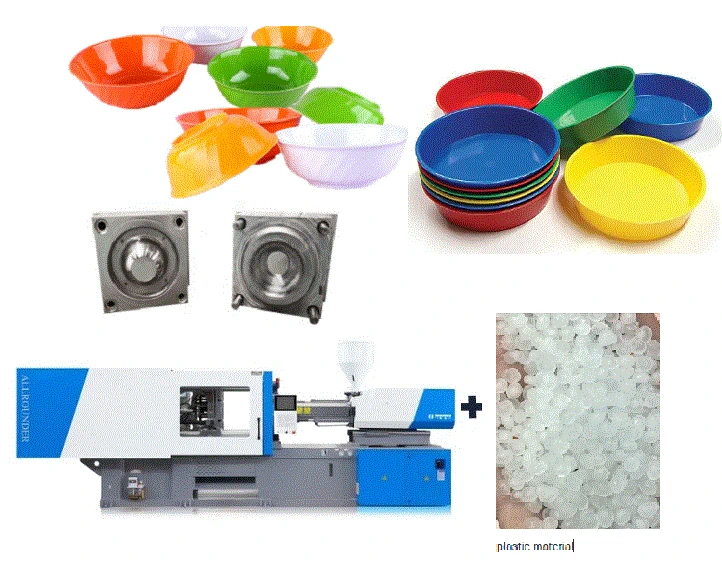
Clamping Force Determines Mold Size and Cavity Count
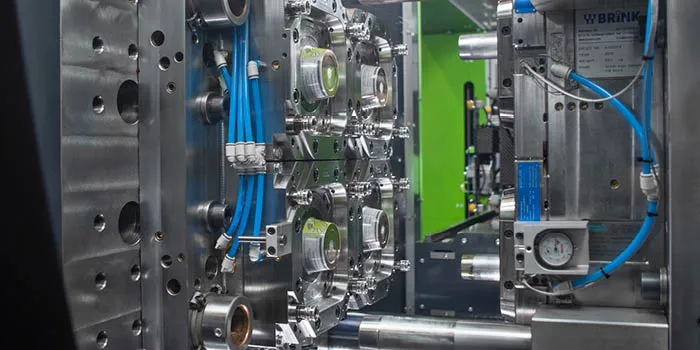
The clamping force of an injection molding machine for bowls directly affects the size of the mold it can accommodate and the number of cavities it can run. For plastic bowls, different tonnage ranges suit different product sizes and output targets.
A practical rule of thumb: each cm² of projected mold area requires 3–5 tons of clamping force, with an additional 10–20% safety margin. For example, a bowl with a 200mm diameter has a projected area of about 314 cm². At 4 tons/cm², the theoretical clamping force is about 125 tons; with a 20% safety margin, you need around 150 tons. This is the starting point for selecting a bowl injection molding machine.
For larger bowls or multi-cavity molds, higher tonnage is required. A 16‑cavity small bowl mold may only need 250 tons, while a 4‑cavity large bowl mold may need 600 tons or more.
Shot Weight and Plasticizing Capacity Determine Output per Cycle
Beyond tonnage, shot weight and plasticizing capacity are key parameters that determine a plastic bowl production machine’s capacity. The shot weight (in grams) must match the total weight of parts produced per cycle, including runners.
For a typical PP bowl weighing 30–80 grams, a machine with a 400g shot capacity can produce 4–6 bowls per cycle (including runner waste), while a machine with a 200g shot capacity can only produce 2–3. Therefore, when selecting a plastic bowl making machine, you must consider not just tonnage but also how well the shot weight matches your product weight. Industry practice suggests the shot size should be 20–80% of the machine’s maximum capacity to ensure consistent filling.
Cycle Time Determines Output Per Hour
Plastic bowl cycle times typically range from 8 to 25 seconds, depending on wall thickness, cooling efficiency, and mold design. Thin-wall disposable bowls (0.5–1.0mm wall thickness) have short cycle times, while thick-wall household bowls (2–3mm) need longer cooling.
The formula for daily output is:
Daily output ≈ (3600 / cycle time in seconds) × number of cavities × 24 hours × yield rate
For example, a 4-cavity mold with a 15-second cycle and 95% yield produces approximately: (3600/15) × 4 × 24 × 0.95 ≈ 21,888 pieces per day.
Capacity Grading Reference Table
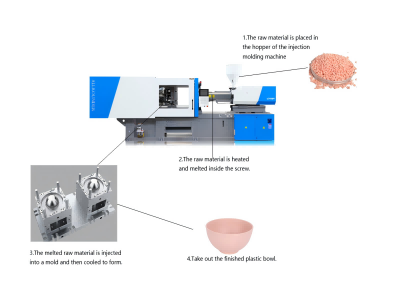
| Capacity Level | Clamping Force Range | Typical Cavities | Suitable Bowl Type | Daily Output (24h) |
|---|---|---|---|---|
| Small / Trial | HCK 110–180 tons | 1–2 cavities | Small bowls, samples | 2,000–8,000 pcs |
| Medium Capacity | HCK 180–410 tons | 4–8 cavities | Household bowls, disposable bowls | 15,000–50,000 pcs |
| High Volume | HCK 400–800 tons | 8–16 cavities | All bowl types (including thin-wall) | 50,000–150,000 pcs |
| Ultra-High Volume | HCK 800+ tons | 16–32 cavities | Thin-wall disposable bowls | 150,000+ pcs |
[INSERT IMAGE: Plastic bowl production capacity comparison chart, ALT: plastic bowl injection molding machine capacity levels]
Configurations and Case Studies for Different Capacity Levels – Haichen’s Real-World Experience
- Medium Capacity – 4–8 Cavities, 15,000–50,000 pcs/day
- High Volume – 8–16 Cavities, 50,000–150,000 pcs/day
- Ultra-High Volume – High-Speed Thin-Wall Dedicated Machines
Medium Capacity – 4–8 Cavities, 15,000–50,000 pcs/day
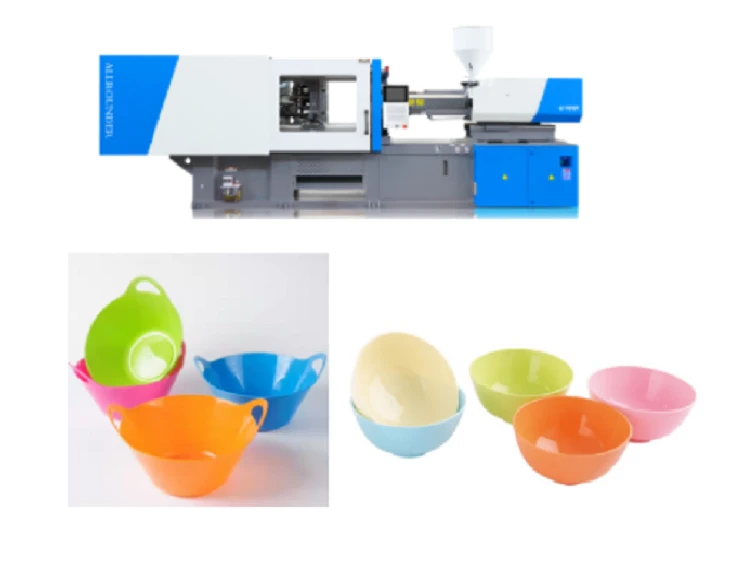
For medium-scale production, Haichen recommends the HCK 270–530 ton series with 4–8 cavity molds. This configuration offers a good balance between investment cost and production efficiency, with stable operation and low maintenance costs.
Haichen Case – Household PP Bowl
A Southeast Asian customer producing household PP bowls needed a plastic bowl injection molding machine that could handle their target output. The bowl had a 180mm diameter, 2.5mm wall thickness, and weighed about 65 grams. Target daily output was 30,000 pieces.
Step 1 – Calculate tonnage:
-
Projected area of the bowl ≈ 254 cm², plus runner ≈ 300 cm²
-
PP cavity pressure at 400 bar → theoretical clamping force ≈ 300 × 400 ÷ 1000 = 120 tons
-
Adding 20% safety margin → recommended 150–180 ton machine
Step 2 – Determine cavity count:
-
Target: 30,000 pcs/day, effective production time 22 hours/day
-
4 cavities at 15-second cycle → about 21,000 pcs/day → insufficient
-
6 cavities at 15-second cycle → about 31,000 pcs/day → meets target
-
Final recommendation: 6-cavity mold
Auxiliary equipment included a servo energy-saving system (reduces long-term electricity costs), auto loader (reduces manual feeding), take-out robot (auto removal + sprue cutting), and water chiller (stable mold temperature, shorter cooling time).
Final configuration: Haichen HCK 180-ton servo injection molding machine + 6-cavity hot runner mold + auto loader + robot take-out system + water chiller.
Results after commissioning:
-
Cycle time: 14–16 seconds (including part removal)
-
Daily output: approximately 32,000 pieces (22 hours)
-
Yield rate: over 97%
-
Energy consumption per piece: about 40% lower than same-tonnage traditional hydraulic machines
-
Labor: reduced from 4 operators/shift to 1 operator/shift
The customer recovered the full equipment investment within 12 months.
High Volume – 8–16 Cavities, 50,000–150,000 pcs/day
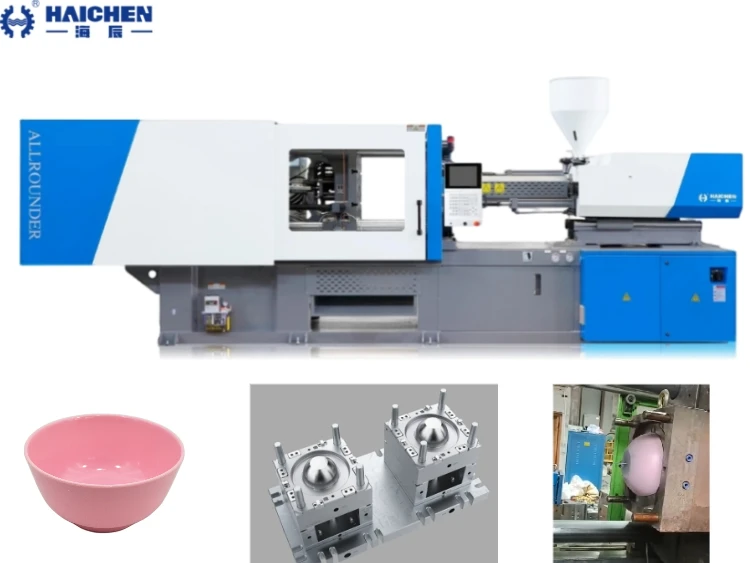
For high-volume production serving chain restaurants or retail channels, Haichen recommends the HCK 530–800 ton series with 8–16 cavity molds. High-speed thin-wall dedicated machines are often used for disposable bowl production. In the thin-wall packaging sector, high-speed injection machines can achieve cycle times as low as several seconds. Some thin-wall molds can run 42 cavities in 7 seconds on high-speed machines, achieving daily output exceeding 500,000 pieces.
Haichen’s thin-wall dedicated configurations include:
-
High-response servo system (stable pressure at high injection speeds)
-
Special screw design (optimized plasticizing for PP/PS thin-wall materials)
-
Quick mold change system (reduces downtime between production runs)
Ultra-High Volume – High-Speed Thin-Wall Dedicated Machines
For the disposable tableware market, ultra-high volume production is essential. At K 2025, Engel demonstrated an all-electric PET thin-wall injection molding machine with a stack mold, producing 12 cups (10g each) in 5 seconds with 30% rPET content.
Haichen offers similar high-speed solutions with clamping forces of 800 tons and above, combined with 16–32 cavity thin-wall molds, high-speed robots for automatic part removal, and conveyor stacking systems. These configurations can achieve daily outputs of 150,000 pieces or more, meeting the supply needs of large food packaging enterprises.
How to Choose the Right Capacity Level for Your Plastic Bowl Production
- Assess Your Order Volume and Growth Expectations
- Product Wall Thickness and Material Affect Capacity Choice
- Automation Configuration Directly Impacts Actual Output
- Capacity Selection Reference Table
- Investment Return Reference
Assess Your Order Volume and Growth Expectations
Your annual output target determines the minimum capacity you need:
-
Annual output below 1 million pieces → Medium capacity (180–400 tons, 4–6 cavities). Short investment payback period, high flexibility.
-
Annual output 1–5 million pieces → High volume (400–800 tons, 8–12 cavities). Balances efficiency and return on investment.
-
Annual output above 5 million pieces → Ultra-high volume (800+ tons, 16+ cavities). Pursues the lowest per-unit cost.
Product Wall Thickness and Material Affect Capacity Choice
Thin-wall disposable bowls (0.5–1.0mm wall thickness) are suitable for high-speed thin-wall dedicated machines, with cycle times compressed to 8–12 seconds for maximum output.
Thick-wall household bowls (2–3mm wall thickness) require longer cooling time and should not over-pursue speed — prioritize stability instead.
PP is the most common material for plastic bowls. However, materials like PC require longer cooling times and will reduce capacity accordingly. Haichen machines support PP, PC, ABS, and many other materials.
Automation Configuration Directly Impacts Actual Output
Beyond the plastic bowl injection molding machine itself, auxiliary equipment significantly affects production capacity:
-
Auto loader: Reduces manual feeding time, prevents material shortages and machine stops
-
Water chiller / mold temperature controller: Precise mold temperature control, shortens cooling time
-
Take-out robot: Automatically removes parts and cuts sprues, reduces mold open/close waiting time
Haichen injection molding machines come standard with Euromap 12/67 robot interfaces, compatible with most mainstream robot brands for plug-and-play automation.
Capacity Selection Reference Table
| Your Annual Output | Recommended Tonnage | Recommended Cavities | Recommended Haichen Model | Key Configuration Tips |
|---|---|---|---|---|
| < 1 million pcs | 180–400T | 4–6 cavities | HCK 270 / HCK 360 | Standard screw, basic automation |
| 1–5 million pcs | 400–800T | 8–12 cavities | HCK 530 / HCK 650 | Servo energy-saving, robot take-out |
| > 5 million pcs | 800T+ | 16–32 cavities | HCK 800 / Custom | Thin-wall dedicated, full automation |
Investment Return Reference
Taking a medium-capacity configuration (Haichen HCK 400T, 4 cavities, daily output 30,000 pieces) as an example:
-
Equipment investment: Includes main machine + mold + auxiliary equipment
-
Energy cost per piece: Servo models save 30–50% energy compared to traditional hydraulic machines
-
Labor cost: Fully automatic configuration can reduce 2–3 operators
-
Payback period: Typically 12–18 months
Haichen provides free capacity calculations and investment return analysis based on your specific product parameters.
Common Questions About Plastic Bowl Injection Molding Machines
What is the minimum tonnage for plastic bowl production?
For small bowls (under 150mm diameter) with a 4‑cavity mold, 120–180 tons is usually sufficient. For larger bowls or higher cavity counts, you need more tonnage. Use the formula: projected area × cavity pressure ÷ 1000 × safety factor.
How many cavities should a bowl mold have?
It depends on your output target. For medium-volume production, 8 cavities is common. For high-volume production, 16‑24 cavities gives better per‑part cost. But for very high volume, 32 cavities or more can be cost‑effective.
Which material is best for plastic bowls?
PP is the most common choice — it’s flexible, heat‑resistant, and food‑grade. PS is cheaper but more brittle, suitable for disposable bowls. PET is clear and recyclable but requires higher processing temperatures.
How much can servo energy saving really save?
A servo‑driven plastic bowl injection molding machine can save 30‑50% on electricity compared to a traditional hydraulic machine. For a factory running 24/7, that saving can amount to tens of thousands of dollars per year.
Haichen Machinery – your plastic bowl injection molding machine partner. From HCK 180 to HCK 800+, we help you get the right capacity for your bowl production.
Author: Yang, Senior Engineer, Haichen Machinery