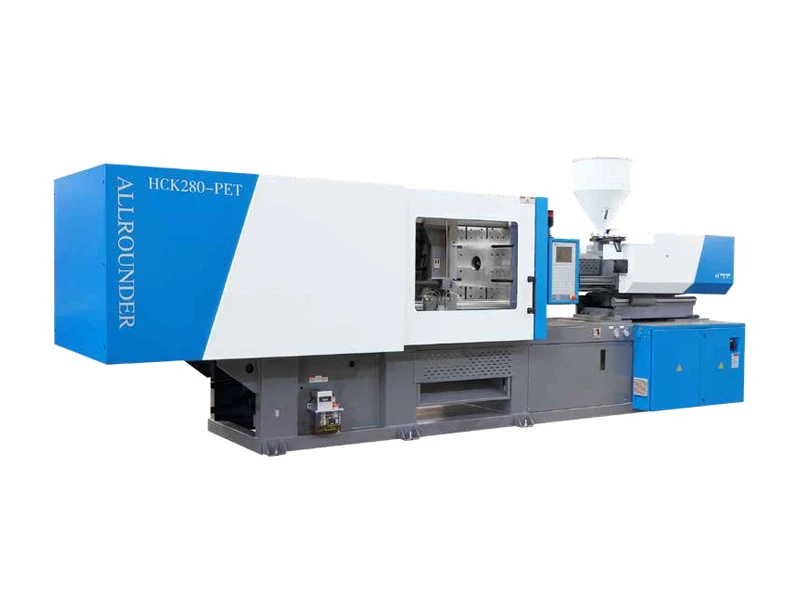
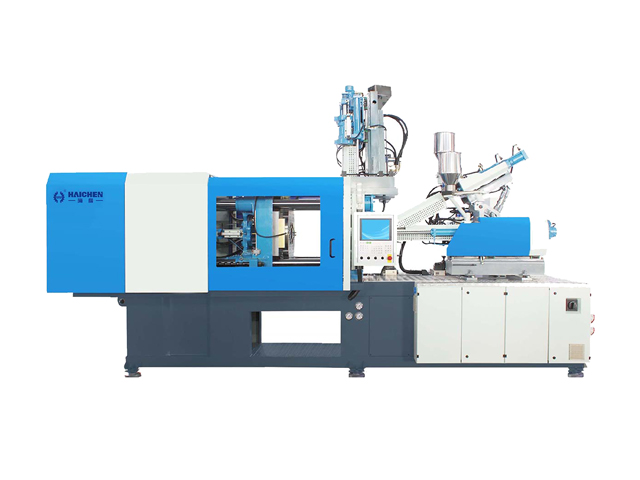
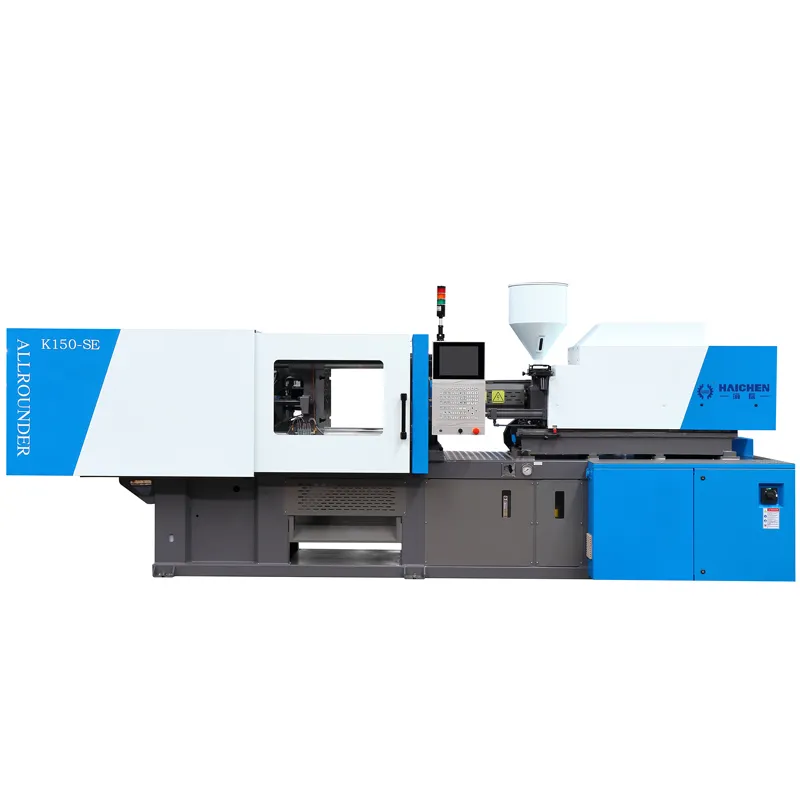
Bottle handles are small, structural parts that must withstand repeated lifting loads while maintaining a clean appearance. They are typically produced by injection molding from HDPE or PP, with mold cavity counts ranging from 4 to 12 and cycle times of 10–15 seconds. Choosing between HDPE and PP affects part stiffness, impact resistance, shrinkage compensation, and processing window.
HDPE offers better impact resistance and chemical resistance, making it suitable for heavy-duty handles on large containers. PP provides higher stiffness and tensile strength, better for handles requiring structural rigidity. HDPE has higher shrinkage (2.0–4.0%) than PP (1.5–2.5%), which requires different mold compensation.
This guide covers the key differences between HDPE and PP for bottle handle production, the injection parameters for each material, common defects and solutions, and how to match the machine to your mold.
What Is the Difference Between HDPE and PP for Bottle Handles?
HDPE is tougher and more impact-resistant but has lower stiffness and higher shrinkage. PP is stiffer and stronger in tension but has lower impact strength. For bottle handles, HDPE is preferred for heavy containers (5-gallon water bottles, chemical drums); PP is preferred for handles requiring structural rigidity and thin-wall designs.
Material Property Comparison
| Property | HDPE | PP | Impact on Bottle Handle Production |
|---|---|---|---|
| Density (g/cm³) | 0.94–0.97 | 0.90–0.91 | PP produces lighter parts |
| Melting Temperature (°C) | 130–137 | 160–170 | PP requires higher barrel temperature |
| Mold Temperature (°C) | 20–60 | 20–80 | PP has wider mold temperature window |
| Shrinkage Rate (%) | 2.0–4.0 | 1.5–2.5 | HDPE requires larger shrinkage compensation |
| Tensile Strength | Lower | Higher | PP offers greater structural rigidity |
| Impact Resistance | Excellent | Good | HDPE handles bending and drop impact better |
| Stiffness | Lower | Higher | PP feels more rigid in hand |
| Chemical Resistance | Very good | Excellent | Both suitable for chemical containers |
| Cost (USD/kg) | ~1.0–1.4 | ~1.1–1.5 | HDPE generally cheaper |
PP exhibits higher tensile strength due to its stiffer molecular structure, while HDPE shows higher hardness due to its denser crystalline structure. For bottle handles that need to flex without breaking, HDPE is the better choice. For handles that must maintain shape under load without deformation, PP is preferred.
Which Material Is Better for Different Bottle Handle Types?
| Handle Type | Recommended Material | Reason |
|---|---|---|
| 5-gallon water bottle handle | HDPE | High impact resistance for repeated lifting |
| Cooking oil bottle handle | PP | Stiffness maintains shape under load |
| Chemical container handle | HDPE | Superior chemical resistance |
| Thin-wall snap-fit handle | PP | Higher stiffness and better flowability |
| Heavy-duty drum handle | HDPE | Maximum toughness and impact resistance |
Why Material Selection Matters for Bottle Handle Production
Material Choice Affects Production Cost and Quality
The material you choose for water bottle handles changes your production cost and product quality. HDPE and PP are the two most common options for this application. Each has different strengths, processing needs, and cost structures. Getting this choice wrong leads to higher scrap rates and unhappy customers.
Two Materials Dominate the Bottle Handle Market
HDPE (High-Density Polyethylene) and PP (Polypropylene) together account for most bottle handle production worldwide. A study from Bericap’s R&D Center shows HDPE offers high rigidity and good manufacturability for handles . PP provides better flow and surface finish. Both work, but the right choice depends on your specific product requirements and production setup.
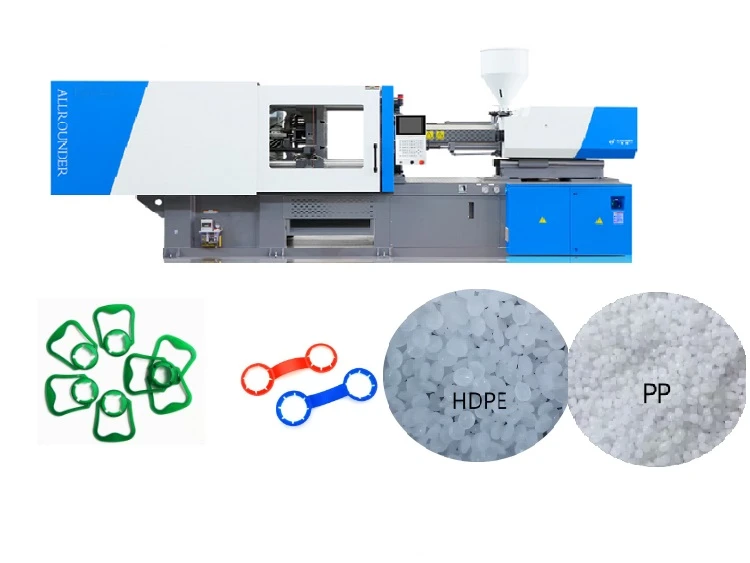
HDPE vs. PP: A Side-by-Side Compare bottle Handle material
Physical Properties That Impact Performance
The table below shows the key property differences between HDPE and PP for bottle handles.
| Property | HDPE | PP | Impact on Production |
|---|---|---|---|
| Tensile Strength | 31.7 MPa | 23.4 MPa | HDPE carries heavier loads |
| Density | 0.96 g/cm³ | 0.90 g/cm³ | PP gives lighter parts |
| Melting Range | 180-205°C | 160-168°C | PP needs less heating energy |
| Shrinkage Rate | 1.5-3% | 1.5-2.5% | PP dimensions are more stable |
| UV Resistance (no additives) | Poor | Poor | Both need stabilizers outdoors |
HDPE handles heavier loads. This makes it suitable for large water containers of 5 liters or more. PP produces lighter parts. Its lower melting temperature means lower energy costs during processing.
Processing Parameters for Each Material
Your injection molding machine settings must match the material you process. Choose the right injection molding machine for bottle handles. The key parameters for bottle handles are:
| Parameter | HDPE | PP |
|---|---|---|
| Melt Temperature | 200-260°C | 200-240°C |
| Mold Temperature | 30°C | Similar to HDPE |
| Injection Time | 0.7-1.2 seconds | 0.7-1.2 seconds |
| Holding Pressure | 40-65 MPa | 40-65 MPa |
HDPE needs tighter temperature control because of its higher crystallinity. PP processes at slightly lower temperatures. Both materials work within similar injection time and holding pressure ranges.
How Each Material Behaves in the Mold
PP flows better than HDPE. This helps PP fill thin sections of the handle design more easily. If your handle has complex shapes, PP gives better results.
PP also produces clearer surface details. This matters if your handle has grip textures or logos. HDPE’s higher shrinkage can blur fine features.
HDPE offers better warpage resistance than PP . This is why many bottle handle injection molding machine manufacturer suppliers recommend HDPE for parts requiring tight dimensional control. The trade-off is that HDPE needs more careful processing.
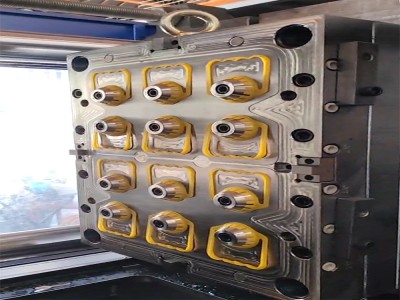
Production Cost Analysis for Bottle Handles Material
Raw Material Costs and Their Variability
HDPE costs approximately $0.98-1.56 per kilogram. PP ranges from $1.00-3.00 per kilogram. The price gap changes based on region and order volume. PP’s lower processing temperature saves some energy cost.
Scrap Rate and Its Impact on Total Cost
The real cost difference comes from scrap rate, not raw material price. The Bericap study found that optimizing gate design could improve breaking force by 44.4% with only 2.1% weight increase . This shows that small design choices affect product quality and cost. For multi-cavity molds (24-72 cavities), even a 2% scrap increase adds significant cost to production.
Which Material Works Best for Your bottle Handles Design?
When to Choose HDPE Bottle Handles?
Choose HDPE when:
-
Handles carry heavy loads (large water containers): like plastic water bottle handles
-
Products face cold temperatures during use or shipping
-
Warpage control is critical for assembly
-
Maximum impact resistance is required
HDPE’s higher tensile strength and impact resistance make it the safer choice for demanding applications .
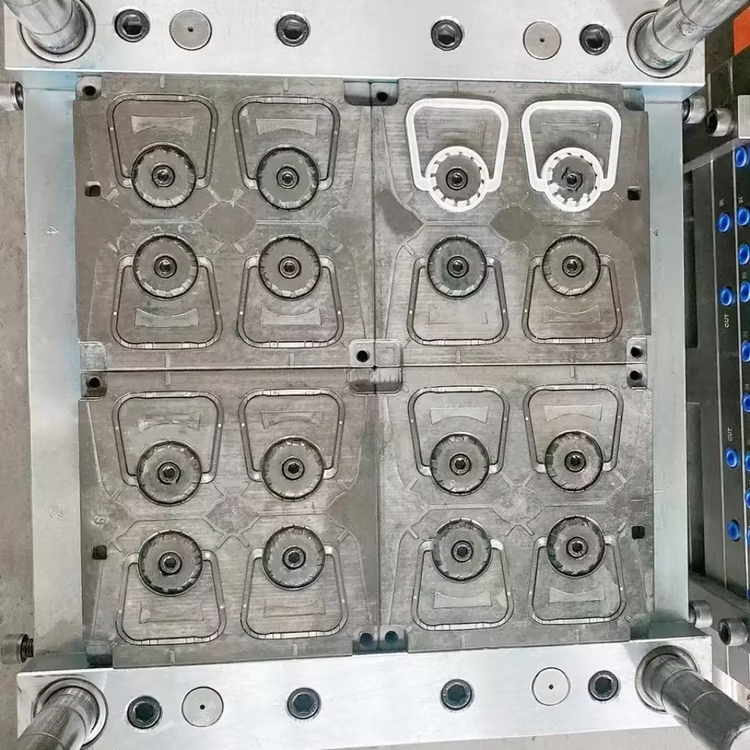
When to Choose PP bottle handles?
Choose PP when:
-
Handles need fine surface details or logos
-
Hot-fill applications are involved (above 71°C)
-
Lightweighting is a priority
-
Flow into thin sections is required
PP’s lower density and better flow make it suitable for complex handle designs.
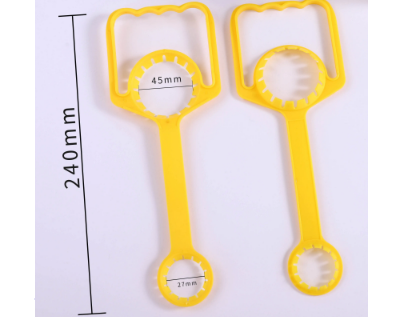
Machine Requirements for Both Materials
Most bottle ring handle injection molding machine manufacturer equipment supports both materials. The machine configuration may need adjustments when switching between materials. These adjustments include screw design, heating barrel settings, and temperature control parameters.
How a Bottle Handle Injection Molding Machine Manufacturer Supports Material Choice?
Haichen’s Technical Support for Material Trials
As a bottle handle injection molding machine manufacturer, Haichen provides technical support for material selection. The company works with customers to test HDPE and PP under actual production conditions . This testing helps identify the right material for specific handle designs before full production starts.
Haichen’s engineering team evaluates mold design, gate location, and material flow to optimize production parameters. This approach reduces trial-and-error time and gets production running faster.
Machine Configuration and Material Switching
Haichen’s plastic injection molding machines include features that support both HDPE and PP production. The injection units use precise temperature controls to handle different melting ranges. The clamping systems maintain consistent pressure for both materials. How to Choose a Ring Handle Injection Molding Machine? 6 Questions Procurement Personnel Care About Most?
The company also supplies screw designs that work effectively with HDPE’s higher crystallinity and PP’s lower viscosity. This flexibility helps buyers produce different handle types without buying separate machines.
| HCK180 PLASTIC INJECTION MOLDING MACHINE | ||||
| INJECTION UNIT | ||||
| ITEM | UNIT | A | B | C |
| INJECTION UNIT | ||||
| Screw diameter | mm | 40 | 45 | 50 |
| Screw L/D ratio | L/D | 24.7 | 22.0 | 19.8 |
| Shot volume(theoretical) | cm3 | 283 | 358 | 442 |
| Injiection weight(ps) | g | 257 | 326 | 402 |
| oz | 9.1 | 11.5 | 14.2 | |
| Injection pressure | Bar | 2231 | 1763 | 1428 |
| Injection rate | cm3/s | 157 | 199 | 245 |
| Plasticizing capacity | g/s | 16 | 22 | 26 |
| Screw speed (Max.) | r/min | 220 | ||
| CLAMPING UNIT | ||||
| Clamping force | Kn | 1800 | ||
| Space between tie bars(W×H) | mm | 520×470 | ||
| Platens size | mm | 740×690 | ||
| Opening stroke | mm | 460 | ||
| Min.Mold height | mm | 200 | ||
| Max.Mold height | mm | 550 | ||
| Distance between platens(daylight) | mm | 1010 | ||
| Ejector stroke | mm | 130 | ||
| Ejector force | Kn | 50 | ||
| OTHERS | ||||
| Systerm pressure | Bar | 175 | ||
| Pump motor | Kw | 25 | ||
| Heating power | Kw | 14.0 | ||
| Oiltank cubage | L | 160 | ||
| Machine dimension(L×W×H) | m | 5.2×1.3×1.8 | ||
| Machine weight | t | 6.0 | ||
Achieving Quality and Cost Goals with Haichen Injection Molding Machine
Haichen’s injection molding machines offer energy-saving servo systems that reduce power consumption during bottle handle production. The machines also include advanced sensors for monitoring injection pressure and temperature during each cycle. We will rich experience of Injection Molding Machine for Oil Bottle Handles: Complete Selection Guide.
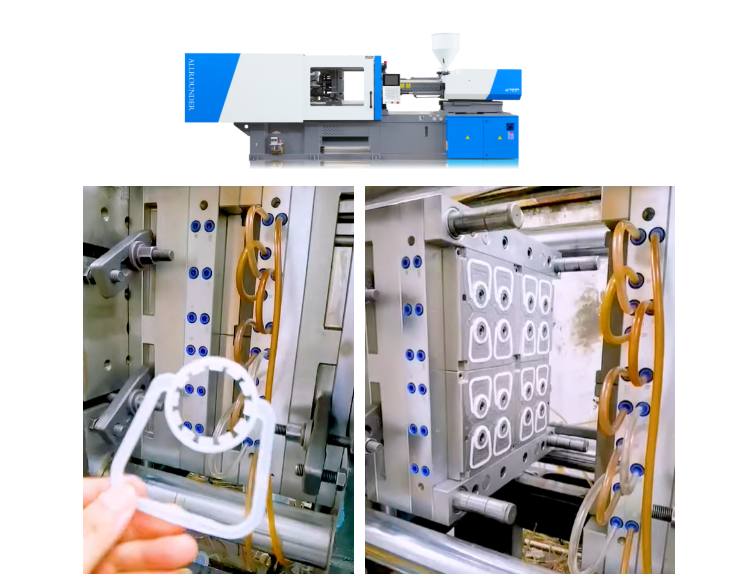
We will help our customers compare ring handle vs. jug handle: Differences in Injection Molding Machine Selection for Plastic Bottle Handle Products. And then with professional skills to make most suitable machine selection decision.
These features help maintain consistent part quality and reduce scrap rates. Haichen, as a bottle handle injection molding machine manufacturer, Haichen focuses on equipment that delivers reliable output across different materials and production conditions.
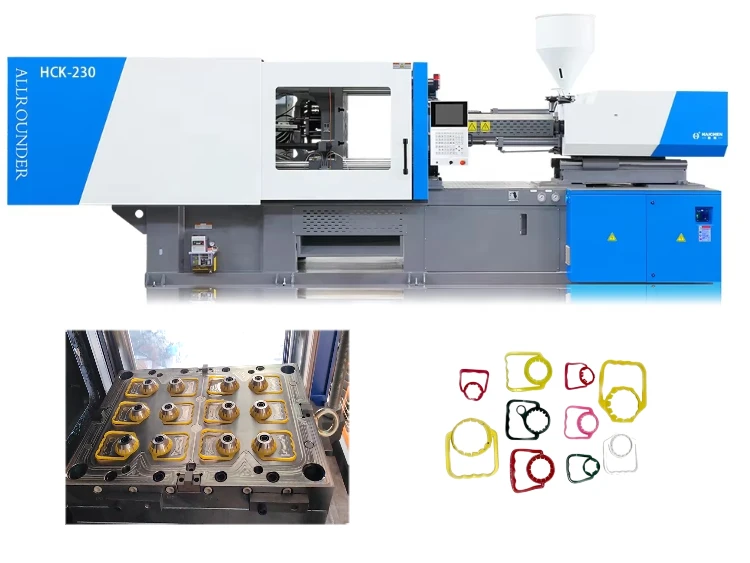
Contact Haichen for material testing and machine configuration support. Our team helps buyers evaluate HDPE and PP for their specific handle requirements.
FAQ
Is HDPE or PP better for bottle handles?
It depends on the application. HDPE offers better impact resistance and toughness, making it suitable for heavy-duty handles on large containers. PP provides higher stiffness and tensile strength, better for handles that must maintain shape under structural load.
What is the shrinkage rate of HDPE vs PP?
HDPE shrinkage is 2.0–4.0%, while PP shrinkage is 1.5–2.5%. HDPE requires larger shrinkage compensation in mold design. This difference is due to HDPE’s higher crystallinity.
What injection molding machine tonnage is needed for bottle handles?
A 12-cavity bottle handle mold with HDPE typically requires 130–180 tons of clamping force. The exact tonnage depends on the projected area of each cavity and the material factor (3–4 tons/cm² for HDPE, 3.5–5 tons/cm² for PP).
Can HDPE and PP be molded on the same machine?
Yes. Both are polyolefins with similar processing characteristics. However, the processing temperature windows are different: HDPE processes at 180–230°C barrel temperature, while PP requires 200–250°C. The machine must be capable of reaching PP’s higher temperature range if both materials will be used.
What causes flash in HDPE bottle handle molding?
Flash is caused by insufficient clamping force, worn mold parting surfaces, or excessive injection pressure. HDPE is particularly prone to flash because of its high flowability. Ensure the machine’s clamping force is sufficient for the projected area and inspect mold parting surfaces regularly.
What is the cycle time for bottle handle injection molding?
Typical cycle times for bottle handle injection molding range from 8 to 15 seconds, depending on part weight, wall thickness, cavity count, and cooling efficiency. A 12-cavity 1.3g HDPE handle can run at approximately 11 seconds per cycle.