
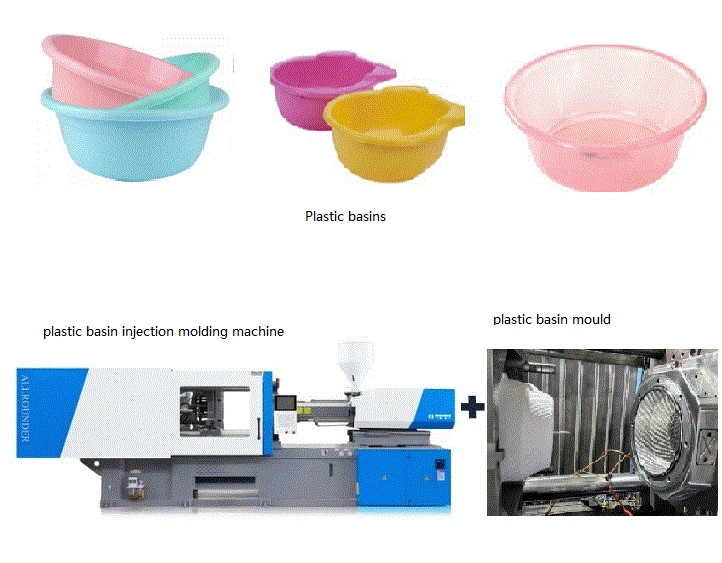
A basin injection molding machine is the core equipment that turns plastic pellets into large household basins, laundry tubs, and storage containers. Choosing the right machine for large basins is not straightforward — a 580mm diameter basin, including the runner system, can have a projected area exceeding 3000 cm², requiring clamping forces that many standard machines cannot deliver.
The global market for plastic processing machinery continues to expand as demand for household plastic products grows worldwide. A plastic basin making machine must handle large molds, thick walls, and long cooling times. For large basins (580–650mm diameter), you typically need clamping forces of 450 tons or more.
The selection of a large basin injection molding machine depends on three critical parameters: clamping force (determined by projected area), shot weight (must cover 800–1500g basin weight), and mold opening stroke (must accommodate deep-cavity products). This guide explains how to calculate each parameter, with real case studies from actual production lines — including a Zambia customer we helped select the right basin making machine for their large basin production.
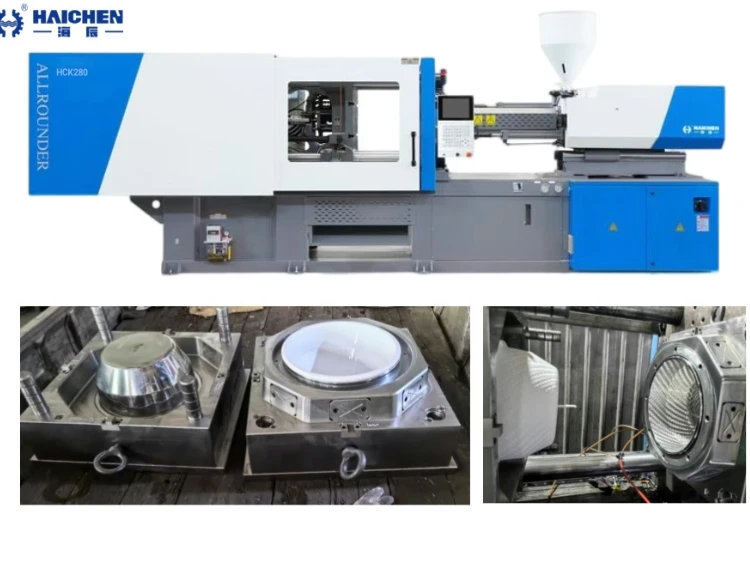
Haichen Machinery has over 20 years of experience in basin injection molding machine manufacturing. Our HCK series machines are designed specifically for large basin production, with clamping forces from 450 to 800 tons and servo energy saving as standard.
Global Plastic Processing Machinery Market Growth (2025–2032)
| Year | Market Value (USD Billion) | CAGR |
|---|---|---|
| 2025 | 45.7 | — |
| 2026 | 47.9 | 4.8% |
| 2032 | 73.9 | 4.8% |
Source: Market Research Reports
What Is a Basin Injection Molding Machine?
Definition and Core Function
A basin injection molding machine melts plastic pellets (typically PP or HDPE) and injects the molten plastic into a large mold cavity to produce household basins, laundry tubs, and storage containers. The machine must handle large shot weights (800–1500g per part) and high clamping forces to keep the mold closed during injection.
Key Components of a Large Basin Injection Molding Machine
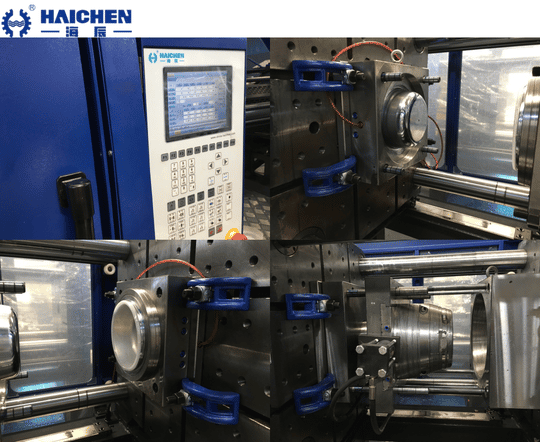
| Component | Function |
|---|---|
| Clamping Unit | Applies high clamping force (450–800 tons) to keep the mold closed |
| Injection Unit | Melts plastic pellets and injects them into the mold under high pressure |
| PLC Control System | Controls temperature, pressure, speed, and sequence of operations |
| Screw and Barrel | Specially designed for PP and HDPE materials, often with bimetallic coating |
| Cooling System | Removes heat from thick basin walls (3–3.5mm) |
| Robot Interface (CE12) | Supports automatic part removal and handling |
| Hydraulic Core-Pull System | Handles complex undercuts in basin molds |
Differences from Standard Injection Molding Machines
A large basin injection molding machine differs from standard injection molding machines in several key aspects:
| Feature | Standard Machine | Basin Machine |
|---|---|---|
| Clamping force | 100–300 tons | 450–800 tons |
| Shot weight | 200–500g | 800–1,500g |
| Tie-bar spacing | 500–700mm | 870×820mm or larger |
| Opening stroke | 400–600mm | 850mm or more |
| Wall thickness | 2–3mm | 3–3.5mm |
| Cooling system | Standard cooling | Enhanced cooling for thick walls |
| Mold type | Multi-cavity | Single-cavity or family molds |
How to Calculate Tonnage for Large Plastic Basins
The Basic Formula for Clamping Force
Clamping force is the pressure the machine applies to keep the mold closed during injection. The basic formula for a basin injection molding machine is:
Clamping Force (tons) = Projected Area (cm²) × Cavity Pressure (kg/cm²) ÷ 1000
Where:
-
Projected Area: The part’s vertical projection onto the mold parting surface, including runners
-
Cavity Pressure: Depends on material and part design. For PP, typically 300–500 kg/cm²; for HDPE, 350–450 kg/cm²
How to Measure Projected Area for Large Basins
For a large basin, measure the maximum outer contour projected onto the parting surface, then add the runner area. For a large basin with a 580mm diameter:
-
Basin projected area ≈ π × 29² ≈ 2640 cm²
-
Including the runner system, the total projected area can exceed 3000 cm²
Safety Margin and Haichen’s Selection Experience
In practice, you need to add a 10–20% safety margin to the theoretical value. For a large PP basin:
-
Projected area 3000 cm² × cavity pressure 400 kg/cm² ÷ 1000 = 1200 tons (theoretical opening force)
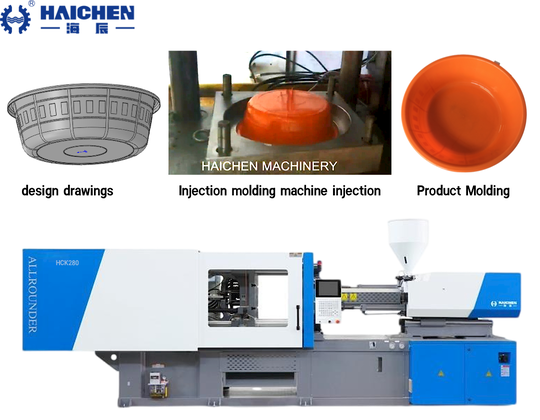
However, for single-cavity, shallow-cavity large basin molds, the actual clamping force needed is far lower than the rough projection formula suggests. Real-world experience shows that 450 tons of clamping force is sufficient for large basin production. The HCK450 has been proven in Zambia and other African countries for large basin projects.
Practical Tonnage Examples
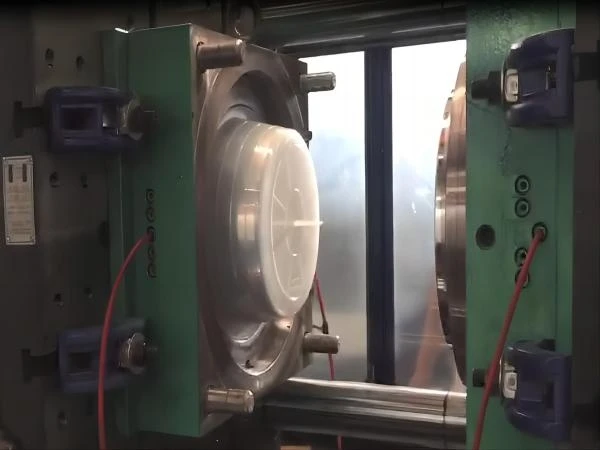
| Basin Diameter | Wall Thickness | Cavity Count | Recommended Tonnage | Haichen Model |
|---|---|---|---|---|
| 500–550mm | 3.0mm | Single | 380–450 tons | HCK 450 |
| 580–600mm | 3.2mm | Single | 450–530 tons | HCK 530 |
| 600–650mm | 3.5mm | Single | 530–650 tons | HCK 650 |
| 650mm+ | 4.0mm | Single | 650–800 tons | HCK 800 |
Shot Weight – A Critical Parameter for Basin Injection Molding Machine Selection
Injection Capacity Must Match Part Weight
Besides tonnage, shot weight is another critical factor for a basin making machine. Large basins are heavy — a 580mm diameter PP basin with 3.2mm wall thickness can weigh 800–1500 grams.
The part weight (including runner) should not exceed 70–85% of the machine’s maximum theoretical shot weight. Producing large basins typically requires a basin injection molding machine with 1000g to 3000g of injection capacity.
For the HCK450, the shot weight capacity with an optimized PP screw is approximately 1,200–1,800g, which comfortably covers most large basin applications. For the HCK530, the capacity increases to 1,500–2,500g, handling even the largest basins.
Plasticizing Capacity Determines Production Efficiency
Beyond maximum shot weight, plasticizing capacity (g/s) is just as important. Plasticizing capacity determines how fast the large basin injection molding machine can melt plastic, directly affecting cycle time and daily output.
Large basins have thick walls and use a lot of material per shot (up to 1500g). If plasticizing capacity is too low, the machine waits for the screw to finish melting before the next cycle, extending cycle time and lowering output.
Opening Stroke and Tie‑Bar Spacing Matter Too
In addition to shot weight, opening stroke and tie‑bar spacing are critical for a basin injection molding machine. Large basins are deep — a 580mm diameter basin can be 280–300mm deep or more. The machine’s opening stroke must be greater than the part depth plus room for removal.
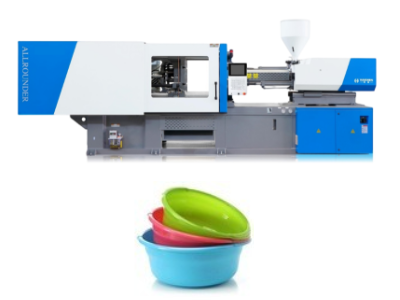
| Haichen Model | Opening Stroke | Tie‑Bar Spacing | Max Mold Height |
|---|---|---|---|
| HCK 450 | 760–810mm | 770×720mm | 830mm |
| HCK 530 | 850mm | 870×820mm | 870mm |
| HCK 650 | 900mm | 870×820mm | 920mm |
| HCK 800 | 960mm | 870×820mm | 970mm |
Tonnage and Cavity Count Selection Guide for Plastic Basins
How to Read the Selection Table
The table below shows recommended configurations for different basin sizes and production targets. Use this as a starting point — always calculate based on your specific basin dimensions and material.
Basin Injection Molding Machine Selection Table
| Basin Size | Weight | Wall Thickness | Recommended Tonnage | Haichen Model | Typical Cycle Time | Daily Output (22h) |
|---|---|---|---|---|---|---|
| Small basin (500mm) | 700–900g | 2.8–3.0mm | 380–450 tons | HCK 450 | 30–35s | 2,200–2,600 pcs |
| Medium basin (580mm) | 900–1,200g | 3.0–3.2mm | 450–530 tons | HCK 530 | 32–38s | 2,000–2,400 pcs |
| Large basin (600mm) | 1,200–1,500g | 3.2–3.5mm | 530–650 tons | HCK 650 | 35–42s | 1,800–2,200 pcs |
| Extra-large basin (650mm+) | 1,500–2,000g | 3.5–4.0mm | 650–800 tons | HCK 800 | 38–45s | 1,500–1,900 pcs |
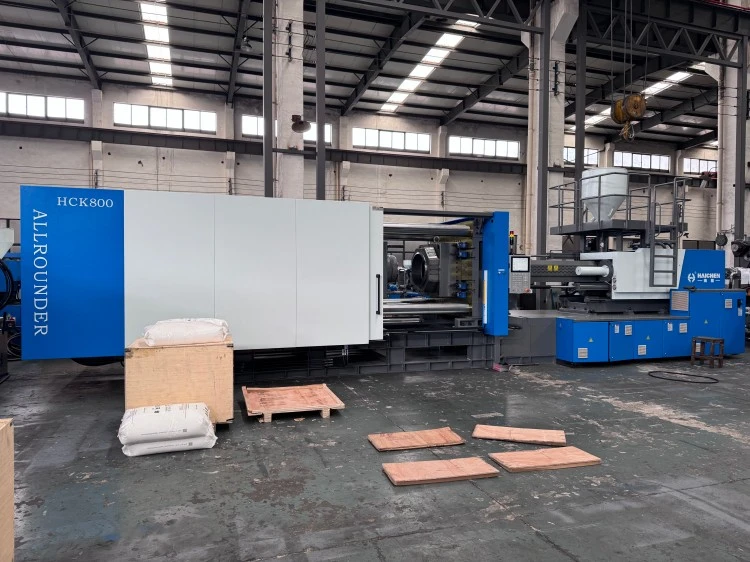
Real Case – Zambia Large Basin Production Line
Project Background and the Customer’s Initial Idea
A Zambian customer planned to set up a large basin production line. Their product was a 580mm diameter PP basin with a wall thickness of about 3.2mm, depth of about 280mm, and a weight of about 900 grams.
The customer’s first idea was to choose a smaller, cheaper machine to save money. They thought large basins looked simple and assumed a smaller basin making machine could handle the job. This is a common mistake for buyers new to large basin production — Zambia’s plastics processing market is growing fast, but many customers lack experience in equipment selection.
How Haichen Guided the Customer – Three Steps
Correcting the “Small Machine, Big Part” Misconception
We did not simply tell the customer they were wrong. Instead, we explained the technical principle: during injection, high‑pressure melt enters the cavity and creates a large opening force. If clamping force is too low, the mold opens slightly, causing flash (excess plastic around the edges) or even incomplete parts. The smaller machine the customer had considered would have produced severe flash in actual production.
Using Accurate Calculations to “Show the Numbers”
We analyzed the customer’s product carefully:
-
Projected area: Basin area about 2640 cm², plus runner ≈ 3000 cm²
-
Cavity pressure: PP at 400 kg/cm²
-
Theoretical clamping force: 3000 × 400 ÷ 1000 = 1200 tons (rough estimate)
But we also explained: for single-cavity, shallow-cavity large basin molds, the actual clamping force needed is far lower than the rough projection formula suggests, because the real cavity pressure distribution differs from the theoretical value. 450 tons of clamping force, proven in real production, is more than enough for this product. We backed this up with production data from similar products — showing that 450 tons was the “just right” choice.
Sharing Haichen’s African Experience to Build Confidence
We showed the customer successful examples from other African markets. In Côte d’Ivoire, a leading household goods manufacturer runs basin injection molding machines producing PP water buckets, basins, and other daily plastic products. In Malawi, Arkay Plastics Industries started with 4 injection molding machines in 1997 and now produces over 160 different plastic household products, including basins, buckets, and containers.
These examples showed the customer that African markets have strong demand for large plastic basins — and that Haichen machines are a reliable choice to support that production. After seeing real production data and product photos, the customer trusted our recommendation.
Final Solution and Production Results
The final configuration was a Haichen HCK 450 basin injection molding machine with:
-
An optimized PP‑specific screw for uniform melting
-
A servo energy‑saving system to reduce long‑term electricity costs
-
Tie‑bar spacing and opening stroke matched to large basin molds
Actual production results:
-
Cycle time: stable at 35–40 seconds
-
Yield rate: over 98%
-
Energy savings: 30–50% less than traditional hydraulic machines
-
Daily output: approximately 2,000–2,500 large basins per machine
The customer was very satisfied with both stability and energy efficiency. More importantly, they learned a valuable lesson: choosing a machine for large plastic basins is not about guessing — it requires accurate calculation of projected area, shot weight, and mold dimensions, backed by real production data.
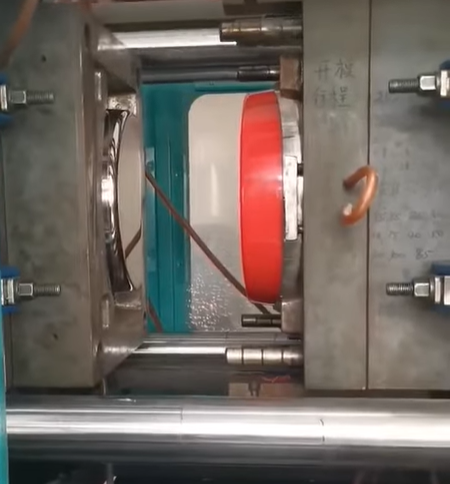
HCK Series for Large Basin Production
HCK Models and Their Applications
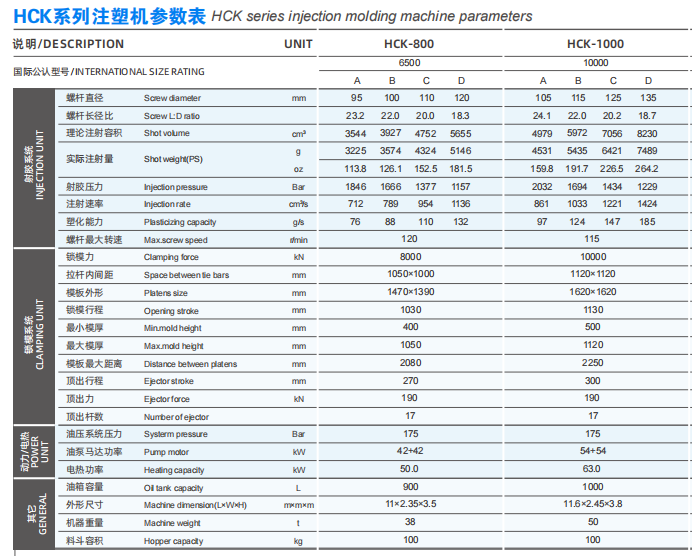
Haichen’s HCK series basin injection molding machines cover the full range of large basin production needs:
| HCK Model | Clamping Force | Best for | Typical Basin Size | Key Features |
|---|---|---|---|---|
| HCK 450 | 450 tons | Small to medium basins | 500–550mm | Balanced performance, energy efficient |
| HCK 530 | 530 tons | Medium basins | 550–580mm | High stability, good shot capacity |
| HCK 650 | 650 tons | Large basins | 580–600mm | Heavy-duty clamping, high output |
| HCK 800 | 800 tons | Extra-large basins | 600mm+ | Maximum clamping for thick-wall basins |
Key Features of HCK Series for Large Basin Production
All HCK series large basin injection molding machines come with:
-
Servo energy saving – reduces electricity costs by 30–50%
-
CE12 robot interface – supports automation integration
-
Multi-zone PID temperature control – ±1°C accuracy
-
Large platen size – accommodates oversized basin molds
-
Long opening stroke – handles deep-cavity products
-
Multi-language control system – supports 21 languages
-
Hydraulic core-pull interfaces – standard on all models
Why HCK Series Excels in Basin Production
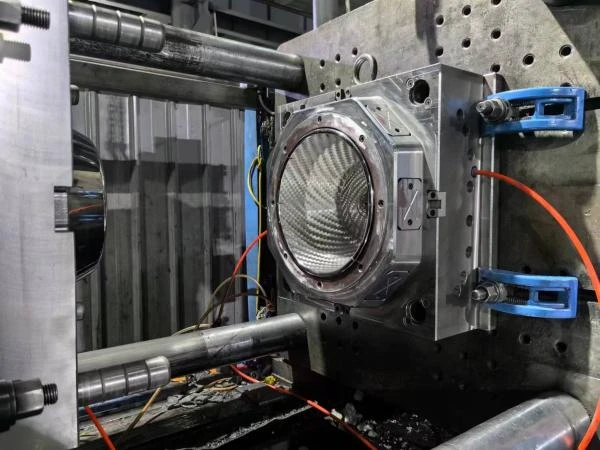
The HCK series basin making machine is designed for demanding basin production with:
-
530–800 tons clamping force for large projected areas
-
870×820mm tie-bar spacing for oversized molds
-
850–960mm opening stroke for deep-cavity products
-
Optimized screw design for PP and HDPE materials
-
Double-cylinder injection for stable, repeatable performance
Haichen has supplied basin injection molding machines to customers across Southeast Asia, the Middle East, South America, and Africa. Our HCK series machines are built for 24/7 operation with minimal maintenance.
Mostly Asked Questions
What is a basin injection molding machine?
A basin injection molding machine melts plastic pellets and injects them into a mold to form large household basins, laundry tubs, and storage containers. The machine heats the plastic, injects it under high pressure, cools it, and ejects the finished basin. These machines are designed for large parts with thick walls and long cooling times.
What tonnage do I need for large plastic basins?
For a 580mm diameter PP basin with a single-cavity mold, 450 tons is typically sufficient. For larger basins (600mm+) or thicker walls (3.5mm+), you may need 530–650 tons. Always calculate based on your specific basin dimensions and material.
What is the typical cycle time for a large plastic basin?
Cycle times for large basins typically range from 30 to 45 seconds, depending on basin size, wall thickness, and cooling efficiency. For the HCK 450 with a 580mm basin, cycle times are typically 35–40 seconds.
What materials can a basin injection molding machine process?
Most basin injection molding machines process PP (polypropylene) and HDPE (high-density polyethylene) . PP is the most common choice due to its balance of strength, flexibility, and cost. Haichen machines support both materials with optimized screw designs.
Can one basin injection molding machine produce different basin sizes?
Yes, by changing molds. The HCK series large basin injection molding machines support quick mold changes. The control system stores process recipes for different molds, allowing fast recall and setup. However, large basin molds may require different clamping forces — always check that your machine’s capacity matches the mold requirements.
Why is external cooling not required for large basin production?
Unlike PET preforms, large basins do not require external cooling stations. The wall thickness (3.0–3.5mm) allows sufficient cooling inside the mold. The HCK series machines feature optimized cooling channel interfaces that work with mold temperature controllers to shorten cooling time and prevent warpage.
Does Haichen provide whole-line solutions for basin production?
Yes. Haichen provides the basin injection molding machine, mold recommendations, drying system, chilling system, robot, and conveyor. We also provide installation, commissioning, and operator training. Our service covers many countries worldwide — including the Zambia case mentioned in this guide.
Haichen Machinery – your basin injection molding machine partner. From HCK 450 to HCK 800Regarding the PLC, it’s very likely a power failure on the mainboard. Could you try turning on the screen and see what feedback it gives? This way, we can help you resolve the power failure issue (send a battery) and download a compatible program version, which we’ll then send to you for troubleshooting., we help you get the right machine for your large basin production.
Author: Yang, Senior Engineer, Haichen Machinery


