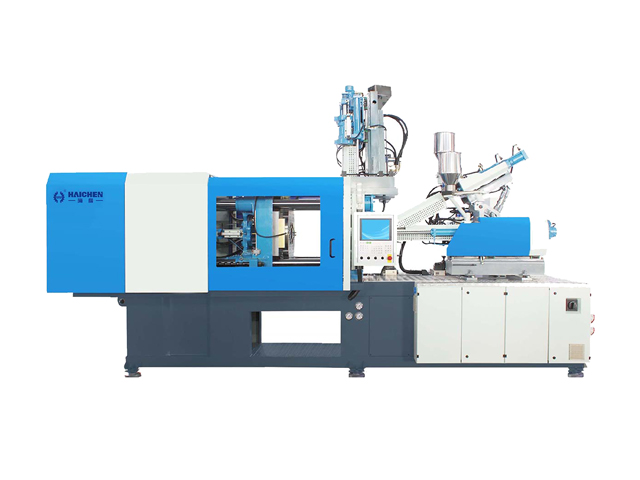
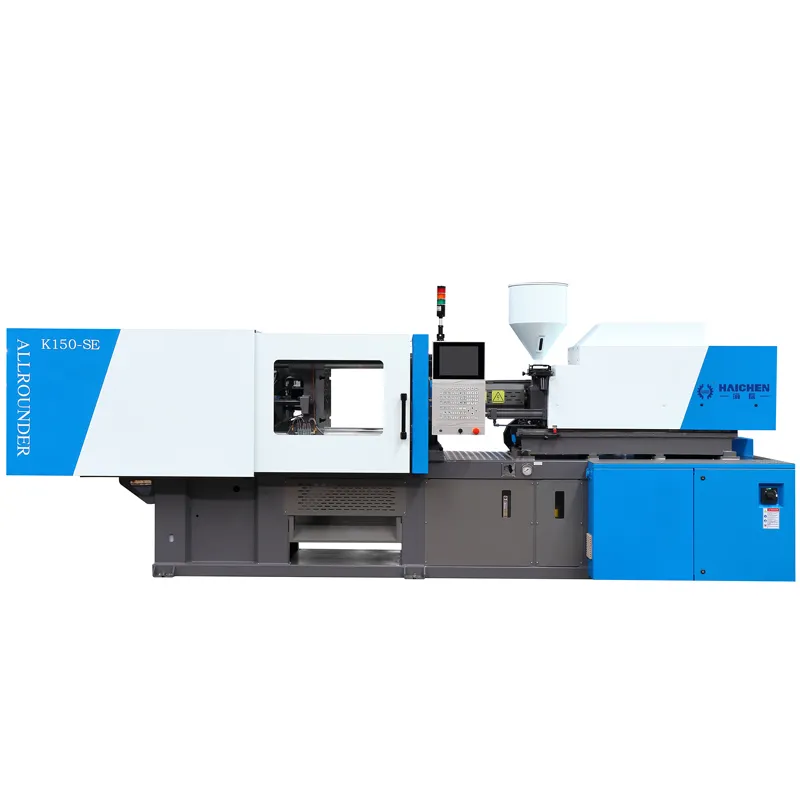
Choosing a plastic basin injection molding machine is not simply a matter of matching the product weight to a machine tonnage.
A large basin may be lightweight but still need high clamping force because of its large projected area.
Therefore, machine selection should consider the basin size, projected area, product weight, mold dimensions, injection volume, and production target together.
This guide explains the main points to check before choosing a machine for plastic basin production.
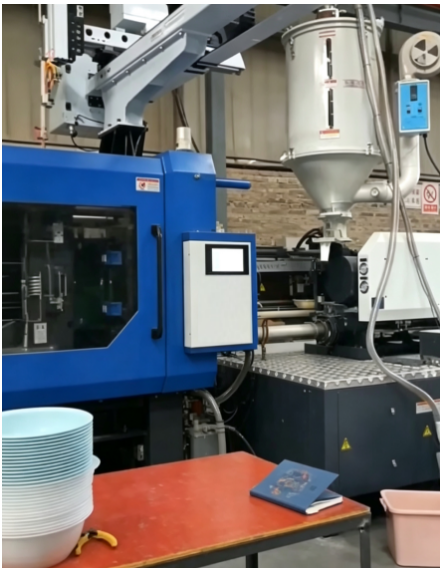
What Machine Is Used to Make Plastic Basins?
Plastic basins are commonly made from polypropylene (PP). PP offers good toughness, chemical resistance, and suitable processing performance for many household products.
The injection molding process is straightforward:
- PP material enters the injection unit.
- The screw melts and mixes the material.
- The machine injects the melt into the basin mold.
- The mold cooling system removes heat from the product.
- The mold opens and ejects the finished basin.
However, the machine size can vary greatly between different basin designs.
A small basin and a large household wash basin may use different machine configurations even when their product weights are relatively close.
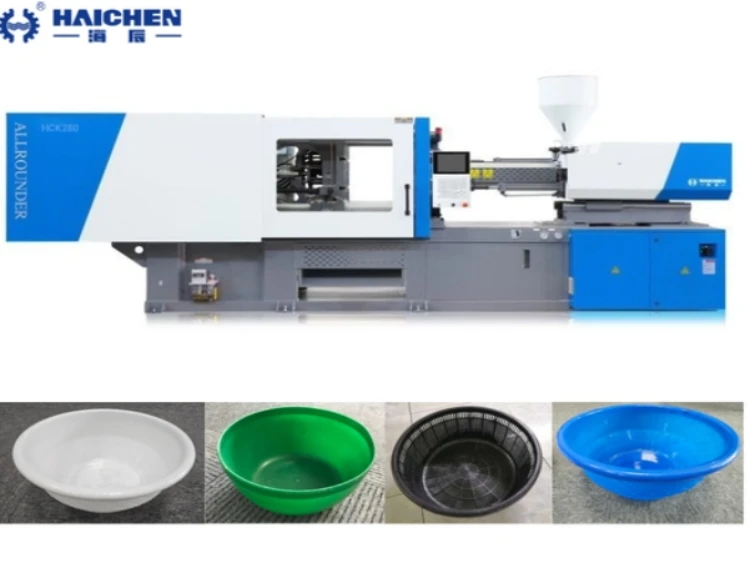
What Determines the Machine Size?
When selecting a plastic basin injection molding machine, start with these five factors:
- Projected area
- Required clamping force
- Product and runner weight
- Mold dimensions
- Required production cycle
The production target also affects the final machine choice.
1. Projected Area
Projected area is one of the most important factors for basin production.
The projected area is the area of the product and mold that the injection pressure acts against when viewed from the mold opening direction.
Because a basin usually has a wide opening, its projected area can be much larger than its weight suggests.
For this reason, a 400 g basin does not automatically need the same machine as another 400 g plastic product.
2. Clamping Force
The injection pressure tries to push the mold open. The clamping unit must provide enough force to keep the mold closed.
A preliminary calculation can use:
Required clamping force ≈ projected area × cavity pressure × safety factor
The actual calculation depends on the material, mold design, cavity number, processing conditions, and other factors.
So, do not choose a basin machine from a simple table such as “500 g product = 300T machine.”
The product drawing and mold information give a much more reliable basis for machine selection.
3. Shot Size
The injection unit must provide enough material for one complete molding cycle.
The required shot includes:
Total shot weight = product weight × cavity number + runner weight
For example, if a single-cavity basin weighs 500 g and the runner weighs 50 g, the required shot is approximately 550 g.
The machine should also have enough process margin instead of operating continuously at its maximum shot capacity.
4. Mold Dimensions
The mold must fit the injection molding machine.
Before confirming a machine, check:
- Mold width and height
- Mold thickness
- Tie-bar spacing
- Platen size
- Maximum mold opening
- Ejector requirements
- Mold weight
A machine may have enough clamping force but still be unsuitable if the mold cannot fit between the tie bars or within the available mold installation range.
5. Cycle Time
Cycle time directly affects production output.
For a single-cavity mold, theoretical hourly output can be calculated as:
3600 ÷ cycle time = pieces per hour
For example, a 20-second cycle gives:
3600 ÷ 20 = 180 pieces per hour
This is a theoretical figure. Actual output will be lower when production downtime, inspection, material loading, mold adjustment, and maintenance are included.
Therefore, the required daily output should be considered together with the expected cycle time.
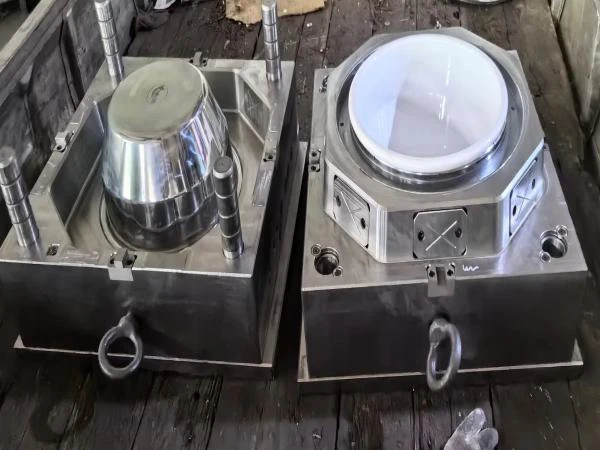
Why Basin Weight Alone Is Not Enough
Product weight is important because it affects the injection unit. However, it does not determine the machine tonnage by itself.
Consider two plastic products that both weigh 500 g.
The first product may have a small projected area. The second may have a wide basin shape with a much larger projected area.
The second product may require more clamping force even though both products have the same weight.
This is why a machine manufacturer normally checks both the injection unit and the clamping unit before recommending a machine.
In simple terms:
- Product weight mainly affects the injection unit.
- Projected area strongly affects the clamping unit.
- Mold dimensions affect machine compatibility.
- Cycle time affects production capacity.
All four should work together.
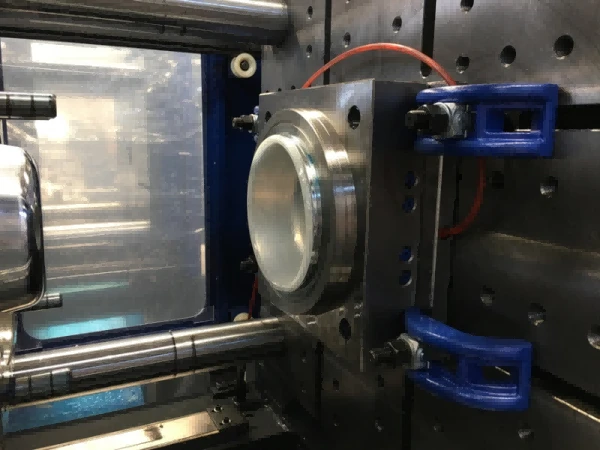
How Does the Basin Mold Affect Machine Selection?
The basin mold also plays an important role.
Cavity Number
Large household basins often use a single-cavity mold because of their product size. Smaller products may allow different cavity arrangements.
More cavities increase production output, but they also increase the required shot weight and may change the clamping force requirement.
Gate Design
The gate controls how the molten plastic enters the cavity.
For a wide basin, the gate position should support stable filling across the cavity. The final design depends on the basin shape, wall thickness, material, and appearance requirements.
Cooling
Cooling has a direct effect on cycle time.
A basin mold usually has a relatively large cavity area, so the cooling layout needs to remove heat evenly from the product.
Poor cooling can increase cycle time and may also affect shrinkage and product quality.
Mold Steel
The suitable mold steel depends on the expected production volume, product requirements, surface finish, and budget.
P20 and 718 are common choices for many plastic molds, but the final steel selection should come from the mold design and production requirements.
There is no single mold steel that fits every basin application.
Real Plastic Basin Injection Molding Cases
Real production cases can provide a useful reference when selecting a machine. However, each product still needs an individual check.
310T Injection Molding Machine
A 310T injection molding machine can be considered for small and medium plastic basin applications when the projected area, shot weight, mold size, and production target fall within the machine’s working range.
The machine provides a 3100 kN clamping force and 670 × 620 mm tie-bar spacing.
The injection unit can use different screw configurations, allowing the machine to match different product shot requirements.
For a specific basin, the final selection should come from the actual product drawing and mold data.
360T Injection Molding Machine
A 360T machine provides 3600 kN of clamping force and a larger mold installation range than a 310T model.
It can be considered when the basin has a larger projected area, larger mold, or higher shot requirement.
The machine provides 720 × 670 mm tie-bar spacing, with different screw configurations available for different injection requirements.
However, a larger machine is not automatically a better choice. If a 310T machine already meets the product and mold requirements, moving to a 360T machine may add unnecessary investment.
410T Injection Molding Machine
A 410T machine provides 4100 kN of clamping force and a larger injection unit.
It can be considered for larger basin molds or applications that require higher clamping or injection capacity.
The machine provides 770 × 720 mm tie-bar spacing and different screw configurations.
As with the smaller models, the final choice should depend on the actual basin and mold rather than the machine tonnage alone.
310T vs 360T vs 410T
These three machine sizes can serve different production requirements:
| Machine | Main advantage | Typical consideration |
|---|---|---|
| 310T | Lower machine capacity and investment | Small to medium basin applications |
| 360T | Higher clamping and injection capacity | Larger basin designs |
| 410T | Higher overall capacity | Larger molds and demanding applications |
These are only starting points, not fixed rules.
For example, a 360T machine is not necessarily better than a 310T machine. The better machine is the one that provides enough clamping force, injection capacity, mold space, and production speed without unnecessary capacity.
What Information Should You Send to a Machine Manufacturer?
If you want a more accurate machine recommendation, prepare the following information:
- Product drawing or clear product photo
- Basin length, width, and height
- Product weight
- Plastic material and grade
- Required daily output
- Number of cavities
- Mold dimensions
- Mold weight, if available
- Existing mold information
- Target cycle time, if known
A product drawing is especially useful because the projected area cannot always be estimated correctly from product weight.
With these details, the machine manufacturer can check the clamping force, injection unit, mold installation space, and expected production capacity.
FAQ
What material is commonly used for plastic basins?
PP is one of the most common materials for plastic basins. The exact PP grade should match the required strength, flexibility, appearance, and processing conditions.
How many tons is needed to make a plastic basin?
There is no fixed machine tonnage for all plastic basins.
The required clamping force depends mainly on projected area, cavity pressure, mold design, and safety margin. Product weight and shot size also need to be checked.
Can a 310T machine make a 500 g plastic basin?
It may be possible, but product weight alone cannot confirm the machine size.
The basin projected area, mold dimensions, shot weight, material, and production target should all be checked.
What is the typical cycle time for plastic basin injection molding?
There is no universal cycle time.
It depends on wall thickness, material, mold cooling, product design, injection settings, and mold construction. A cycle around 20 seconds may be achievable for some applications, but the actual cycle should come from mold trials and production conditions.
Is a bigger injection molding machine always better?
No.
An oversized machine can increase the initial investment without improving production efficiency.
The better approach is to select a machine that provides enough clamping force, injection capacity, mold space, and production speed for the actual basin and mold.