
Choosing the right small injection molding machine starts with the product, mold, material, and required output rather than machine size alone. Small molding equipment can serve laboratories, electronics manufacturers, medical-component producers, sample makers, and factories producing small plastic parts in medium or high volumes.
A compact machine can reduce floor-space requirements and make small-part production more practical. At the same time, buyers still need to check clamping force, shot weight, mold dimensions, injection rate, plasticizing capacity, and automation requirements before placing an order.
For Haichen, small-machine selection starts with the customer’s actual production conditions. The HCK30 to HCK80 range covers several compact applications, from laboratory specimens and color cards to small precision components and gears.
What Is a Small Injection Molding Machine?
A small injection molding machine uses the same basic molding process as a larger machine. The injection unit melts thermoplastic resin, injects it into a mold, holds pressure, and then allows the molded part to cool and eject.
The main difference is machine capacity and physical scale.
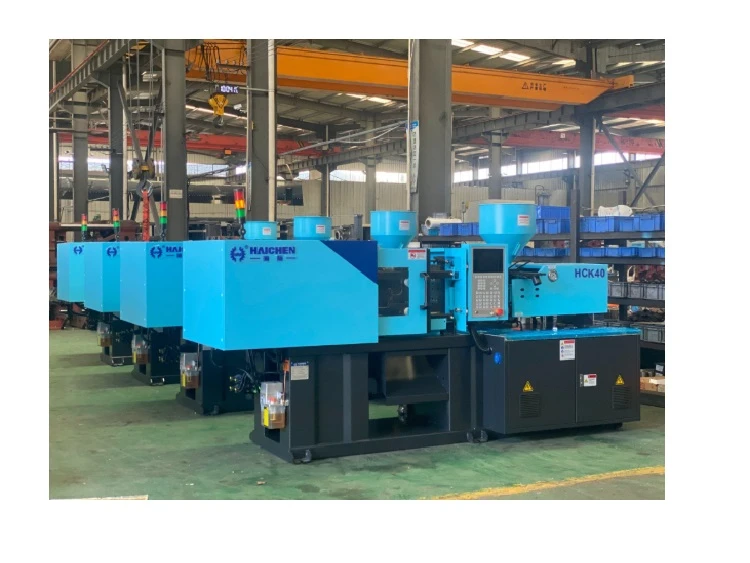
Small machines generally suit applications where the product and mold do not require large clamping force or a large shot size. Market definitions vary, so buyers should compare actual machine specifications rather than relying on the word “small” alone. One current industry guide, for example, describes small machines in the 10–50 ton range, while Haichen’s compact HCK range extends into the 80-ton class.
Typical applications include:
- Laboratory test specimens
- Color cards and material samples
- Small gears
- Electronic components
- Connectors
- Small automotive parts
- Medical components
- Consumer-product accessories
- Prototype and small-batch production
Compact machines can also work well when a factory wants a dedicated machine for smaller parts instead of tying up a larger production machine.
Small Injection Molding Machine Applications
Small Machines for Laboratory Production
Laboratories often need equipment that can mold small quantities of material with simple operation.
Haichen’s HCK30 targets laboratory applications such as tensile-test specimens, impact specimens, and color cards. The compact format helps research teams test materials without using a large production machine.
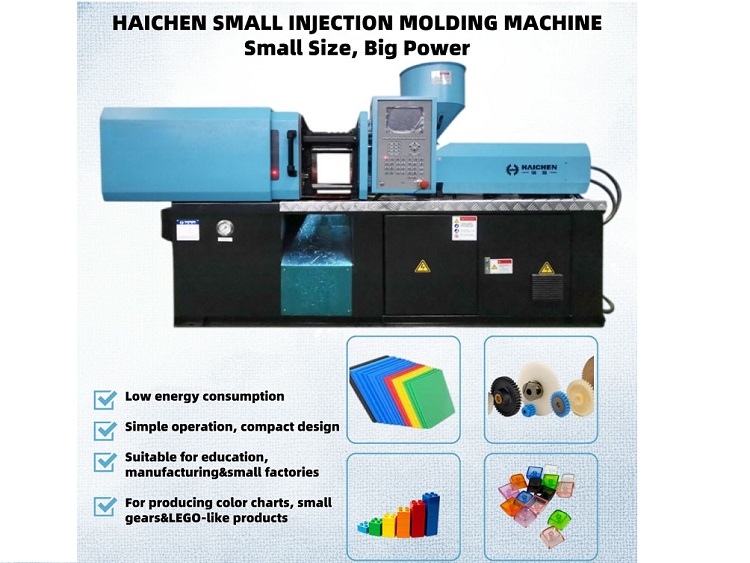
This setup can be useful when a laboratory needs to:
- Compare different resin grades
- Prepare standard test pieces
- Develop a new formulation
- Produce color samples
- Run small experimental batches
For research work, the machine should provide enough control for repeatable test samples while keeping installation and operating requirements manageable.
Small Plastic Machines for Gears and Precision Parts
Small gears, connectors, inserts, and other technical components often require accurate filling and stable process control.
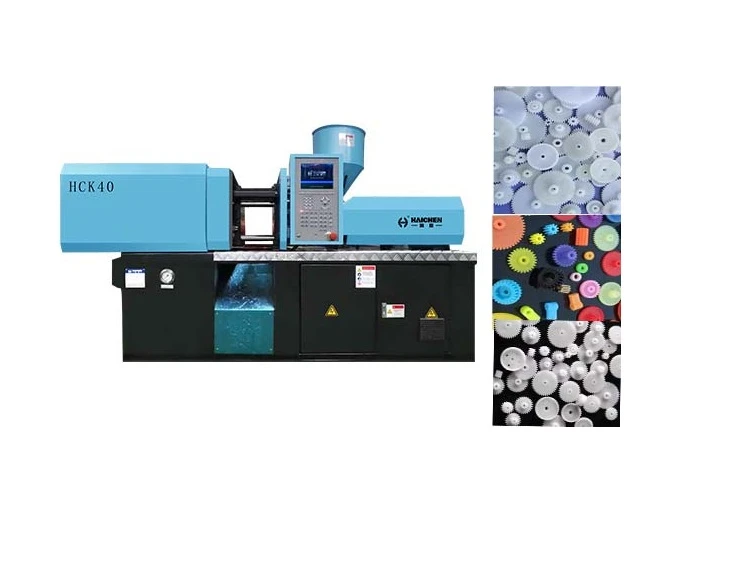
Haichen identifies the HCK50 for applications such as precision gears and other electronic components. The company also describes thicker mold plates, small mold positioning features, and a dual-cylinder injection arrangement for this application.
A current micro-molding facility also shows why compact machines can suit precision production: dedicated micro-molding cells commonly combine compact molding machines with automation and inspection equipment for medical and technical parts.
However, machine size does not automatically determine molding precision. Mold construction, material behavior, process control, machine condition, and measurement systems all affect the final part.
Small Machines for Electronics and Medical Components
Small plastic components appear in connectors, sensor housings, clips, valves, and other technical products.
These applications often place more emphasis on:
- Repeatable injection
- Stable temperature control
- Consistent shot weight
- Clean production conditions
- Automated part handling
- Dimensional control
Some international manufacturers offer all-electric small machines specifically for medical and electronics applications, including cleanroom options. ENGEL, for example, positions its e-mac for medical, electronics, packaging, and technical molding applications.
The important point for buyers is to match the machine configuration to the product requirements rather than assuming every medical or electronic part needs the same machine.
How to Choose the Right Tonnage
Clamping force is one of the first numbers buyers usually look at.
However, product weight or part size alone does not determine tonnage.
You should consider:
- Projected part area
- Number of cavities
- Material
- Expected cavity pressure
- Mold layout
- Safety margin
A basic relationship is:
Required clamping force ≈ projected area × cavity pressure × safety factor
The exact calculation varies by product and process.
For example, a one-cavity connector can require much less force than a four-cavity housing even when the individual parts are similar in weight.
Current engineering guidance also emphasizes that excessive clamping force can increase energy use, mold wear, and production cost without improving part quality.
What Does 30 Tons Mean?
A 30-ton machine can suit very small products, laboratory samples, test pieces, and certain precision components.
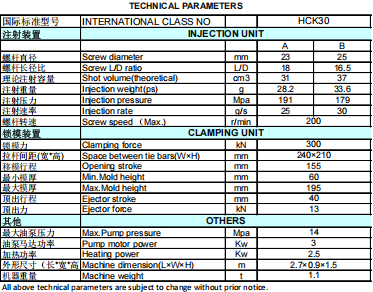
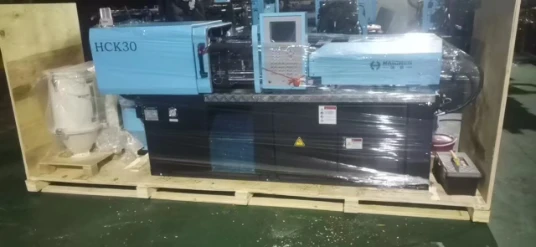
Haichen’s HCK30 uses a 30-ton clamping unit and offers two screw options. Its published specifications list theoretical shot volumes of 31 cm³ and 37 cm³, with PS injection weights of 28.2 g and 33.6 g.
This makes the HCK30 suitable for small-shot applications where the mold and product fall within those machine limits.
What About 50 Tons?
A 50-ton machine provides more clamping capacity and shot capacity than a 30-ton unit.
Haichen positions the HCK50 for small precision applications, including gears and electronic components.
The buyer should still verify shot size, mold dimensions, and product geometry before choosing the 50-ton class.
When Does an 80-Ton Machine Make Sense?
An 80-ton machine can serve larger small-part molds or multi-cavity applications that exceed the practical range of a 30- or 50-ton machine.
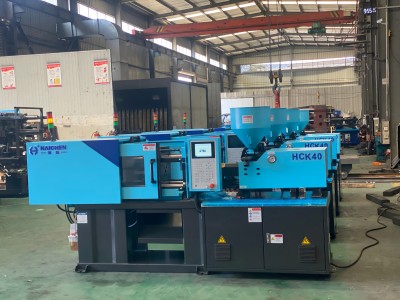
Haichen’s compact-machine range currently includes the HCK80, and its published small-machine page lists the model alongside HCK30, HCK40, HCK50, and HCK70.
The best model depends on the mold rather than the number on the nameplate.
Shot Size Matters as Much as Clamping Force
Many buyers focus on tonnage and overlook shot capacity.
That can create another common problem: the machine has enough clamping force, but the injection unit does not provide the required shot or plasticizing capacity.
Use this basic calculation:
Total shot weight = part weight × cavity number + runner weight
For example, a 5-gram component in a 4-cavity mold requires at least 20 grams of part material before you add the runner system.
The machine should also recover the required shot within the planned cycle.
A machine with a large theoretical shot size is not necessarily the best choice if the screw cannot plasticize the material efficiently at the required cycle time.
Screw and Barrel Design for Small-Part Molding
Small-part molding requires more than simply using a smaller screw.
The injection unit needs to match the actual shot size and resin.
Important factors include:
Screw Diameter
A smaller screw can provide better control when the required shot is small.
At the same time, the screw should provide enough plasticizing capacity for the planned cycle.
L/D Ratio
The L/D ratio influences melting and residence time. The correct value depends on the machine and resin.
For example, Haichen’s HCK30 specification lists screw L/D ratios of 18 and 16.5 for its two screw options.
This is a useful example of why buyers should look at the actual machine data instead of using one universal L/D requirement for all small-part applications.
Plasticizing Capacity
The injection unit must prepare the required shot before the next cycle.
If plasticization takes too long, the machine becomes the bottleneck. On the other hand, excessive screw speed or unnecessary residence time can create material problems for heat-sensitive resins.
Low-Shear Processing
Some materials require careful shear control.
For example, engineering resins and certain additives can react badly to excessive heat generated during plasticizing.
Therefore, the screw configuration should match the resin grade, melt-flow characteristics, shot size, and cycle time.
Mold Size and Machine Dimensions
A small machine still needs enough space for the mold.
Check:
- Tie-bar spacing
- Platen size
- Minimum mold height
- Maximum mold height
- Opening stroke
- Ejector stroke
- Mold weight
Haichen’s compact HCK models publish mold-height, tie-bar, shot-weight, and other machine dimensions for each model.
Do not select a machine only because its clamping force looks correct.
A mold that cannot physically fit the machine remains unusable regardless of tonnage.
Small Injection Molding Machine for Automation
Compact equipment can work well with automated production.
A small automated cell may include:
Material loader → injection machine → mold → robot → conveyor → inspection
Automation can help with:
- Part removal
- Insert loading
- Inspection
- Sorting
- Packaging
- Scrap separation
For example, current micro-molding facilities combine compact injection machines with robots and vision inspection for precision components.
A compact machine can also make automation easier in a restricted production area. BOY’s micro-molding equipment, for example, emphasizes compact machine dimensions and easy integration into production cells.
Small Injection Molding Machine Price
Machine price varies considerably because “small machine” covers different specifications and applications.
Current market listings show a broad range. For example, Made-in-China currently lists small injection machines at prices ranging from several thousand dollars to tens of thousands of dollars, depending on machine type and configuration.
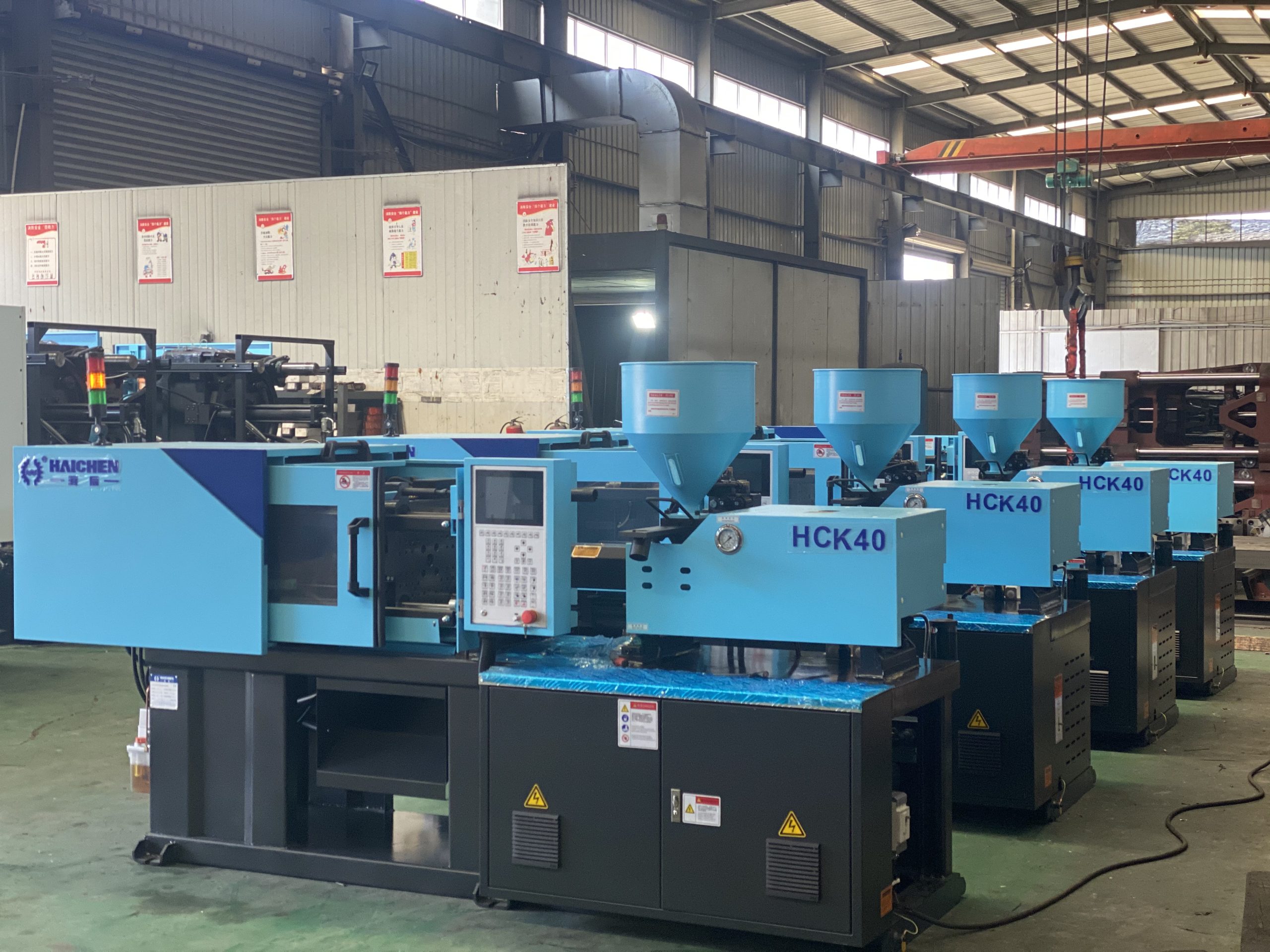
Haichen’s own published pricing content also notes that mini-machine costs depend on machine specification, function, production capacity, technology level, and other factors.
What Determines the Price?
The main factors include:
- Clamping force
- Shot size
- Screw and barrel
- Control system
- Hydraulic or electric drive
- Servo configuration
- Mold requirements
- Automation
- Robot
- Auxiliary equipment
A 30-ton laboratory machine and an 80-ton automated production machine may both qualify as small machines, but their total prices can differ substantially.
Therefore, buyers should compare complete machine specifications rather than using a single “small injection molding machine price” as a benchmark.
Small Injection Molding Machine vs. Micro Injection Molding Machine
The terms “small” and “micro” often overlap, but they do not always mean the same thing.
A small injection molding machine can serve ordinary small plastic parts as well as technical components.
A micro injection molding machine focuses more heavily on extremely small parts, tiny shot sizes, micro features, or specialized applications.
For example, dedicated micro-molding equipment may use specialized injection units, compact clamping systems, and process controls aimed at very small components.
For a buyer, the practical question is:
How small is the product, and how small is the required shot?
A 30-ton conventional machine may work perfectly for a small plastic component without requiring a specialized micro-molding system.
HCK30–HCK80 Small Machine Range
Haichen currently presents several compact HCK models for small-part production.
| Model | Clamping Force | Typical Positioning |
|---|---|---|
| HCK30 | 30 tons | Laboratory samples and very small parts |
| HCK40 | 40 tons | Small molded components |
| HCK50 | 50 tons | Precision parts and small gears |
| HCK70 | 70 tons | Small technical components |
| HCK80 | 80 tons | Larger small-part and multi-cavity applications |
The published Haichen specifications list HCK30 through HCK80 in its small-machine range.
The exact application depends on the mold, material, shot weight, and required output.
For example, Haichen identifies HCK30 for laboratory test specimens and HCK50 for precision gears and electronic components.
How to Select a Small Machine for Your Product
Before requesting a quotation, prepare the following information:
| Information | Why It Matters |
|---|---|
| Product weight | Determines shot requirement |
| Product dimensions | Helps estimate projected area |
| Material grade | Affects processing conditions |
| Cavity number | Determines total shot and output |
| Mold dimensions | Confirms machine fit |
| Cycle time | Determines plasticizing capacity |
| Annual output | Determines production rate |
| Automation level | Determines machine-cell configuration |
With these figures, a manufacturer can recommend the machine more accurately.
For example, a 30-ton machine may suit a one-cavity laboratory mold, while a 70- or 80-ton machine may make more sense for a multi-cavity production mold.
Why Floor Space Matters
A compact machine can offer another practical advantage: lower space requirements.
This matters in:
- Laboratories
- Technical centers
- Small workshops
- Clean production cells
- Educational facilities
- Factories adding dedicated small-part capacity
Compact machines can also make it easier to install several production cells in the same area.
However, do not judge footprint alone. Leave sufficient clearance for:
- Mold changes
- Material loading
- Maintenance
- Robot movement
- Electrical access
- Operator access
Haichen as a Small Injection Molding Machine Manufacturer
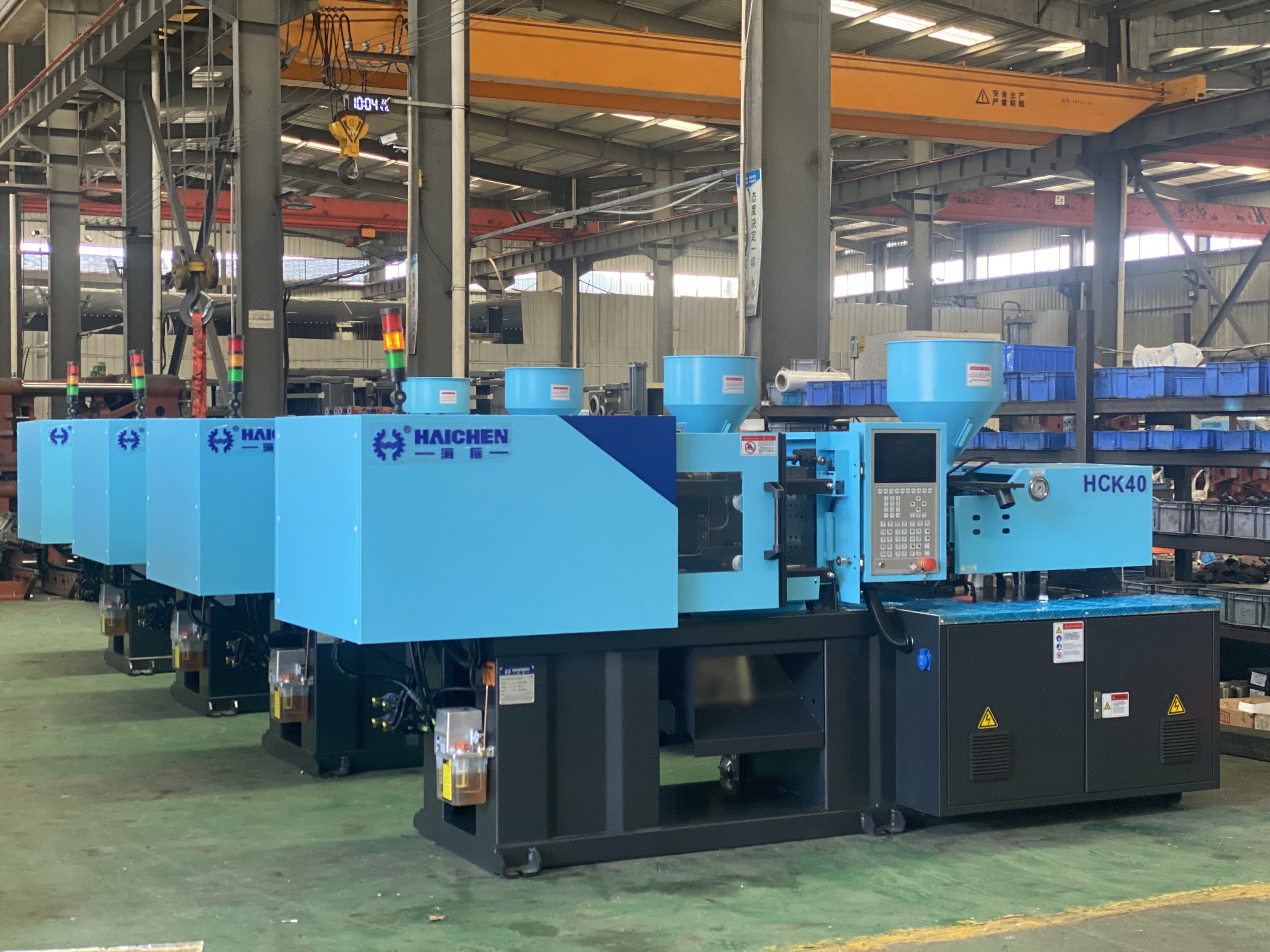
Haichen has positioned its compact HCK machines for laboratory, precision, gear, and small-part applications. Its published HCK30 specifications show a 30-ton hydraulic machine with automatic operation, two screw options, and high-precision injection capability.
Haichen’s broader injection molding machine range starts at 30 tons and extends to much larger machines, allowing the company to cover both small-part and large-scale production requirements.
For a small-part project, Haichen can evaluate:
- Product drawing
- Product weight
- Resin grade
- Mold cavity number
- Mold dimensions
- Required cycle
- Target output
- Automation requirements
This approach helps the buyer select the injection unit and clamping force from the actual product rather than from a machine label.
Frequently Asked Questions
What is a small injection molding machine used for?
A small injection molding machine can produce laboratory samples, color cards, small gears, connectors, electronic parts, medical components, and other small plastic products.
What is the smallest Haichen injection molding machine?
Haichen’s current compact machine range starts with the HCK30, a 30-ton model. The published HCK30 specifications show two screw options with PS shot weights of 28.2 g and 33.6 g.
Is a 30-ton injection molding machine enough for small parts?
It can be, depending on the product projected area, cavity number, shot size, and mold.
A 30-ton machine suits some very small products and laboratory applications, but it cannot replace a larger machine when the mold requires more clamping force or injection capacity.
What is the difference between a mini and a small injection molding machine?
The terminology varies by manufacturer.
“Mini” often describes a compact machine with very low clamping force or shot capacity, while “small” can include a wider range of machines.
Always compare actual specifications instead of relying on the naming.
How much does a small injection molding machine cost?
Prices vary according to clamping force, injection unit, drive system, screw and barrel, automation, and configuration.
Current online listings show a broad range, so buyers should request a quotation based on the actual mold and product.
Can a small machine produce precision parts?
Yes, when the machine, mold, material, and process controls match the application.
Precision depends on the complete molding system, not simply on the machine’s clamping force.
Can a small machine run PP, ABS and PC?
Many compact injection molding machines can process common thermoplastics, but the screw, barrel, temperature settings, and processing conditions should match the material grade.
Haichen’s HCK30 published product information lists PP, PC, ABS and several other thermoplastics among supported materials.
Does a small injection molding machine need a robot?
Not always.
Manual removal can work for low-volume production or simple parts. However, automatic part removal becomes more valuable when the cycle is short or the factory needs consistent handling and higher output.
How do I choose between HCK30, HCK50 and HCK80?
Start with product weight, projected area, cavity number, mold dimensions, cycle time, and target output.
Then select the machine that provides sufficient clamping force, shot capacity, mold space, and plasticizing capacity without unnecessary oversizing.
Can Haichen provide a complete small-part molding solution?
Yes. Depending on the application, the solution can include the HCK machine, mold, material-loading equipment, cooling equipment, robot handling, conveyors, and other auxiliary systems.
Contact Haichen with your product drawing, part weight, material, cavity number, mold dimensions, and target output. The engineering team can use those figures to recommend a suitable small-machine configuration.
Author: Yang, Senior Engineer, Haichen Machinery


