
Choosing the right ballpoint pen injection molding machine is important for stable, high-volume pen production. Ballpoint pens may look simple, but their plastic components can require thin-wall molding, long flow paths, multi-cavity molds, fast filling and consistent dimensional control.
A complete pen production system may include injection molding machines, molds, material handling equipment, mold temperature control, chillers, robots, conveyors and assembly equipment. However, the injection molding machine remains the core of the process.
This guide explains how to choose a ballpoint pen injection molding machine, how to match the machine with the mold, what materials are commonly used, how to estimate production capacity, and which auxiliary equipment can improve production efficiency.
What Is a Ballpoint Pen Injection Molding Machine?
A ballpoint pen injection molding machine is an injection molding machine configured to produce plastic pen components such as barrels, caps, clips, grips and internal holders.
Most plastic pen components are produced with injection molding because the process can create large quantities of consistent parts from thermoplastic materials.
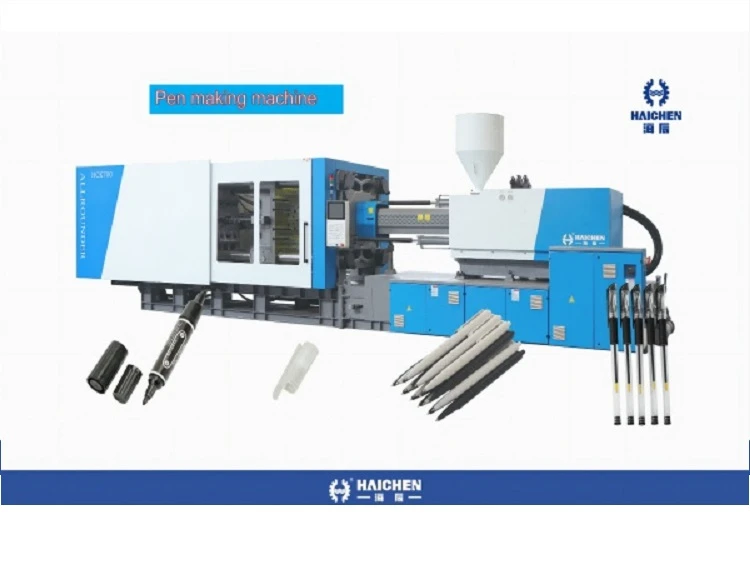
For a typical production project, the machine selection depends on several factors:
- Plastic material
- Part size and weight
- Mold dimensions
- Number of cavities
- Projected area
- Required injection pressure
- Required production output
- Cycle time
- Automation level
There is no single machine size that fits every ballpoint pen. A small clip mold and a long pen barrel have very different molding requirements.
For this reason, the machine should be selected together with the mold rather than by tonnage alone.
What Parts of a Ballpoint Pen Are Injection Molded?
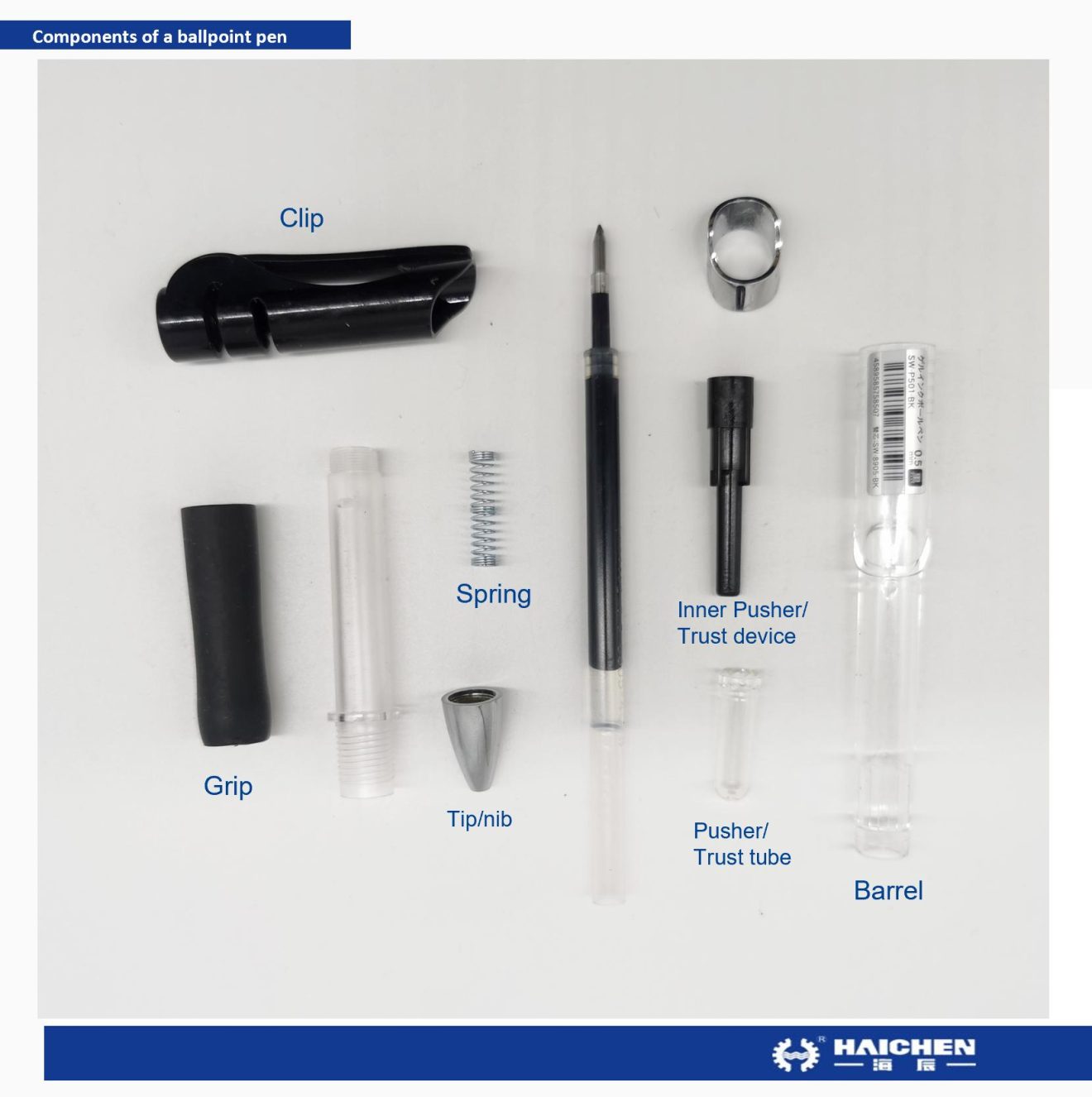
A ballpoint pen can contain several plastic components. Depending on the product design, different parts may require separate molds and molding conditions.
Pen Barrel
The barrel is the main outer body of the pen.
Many barrels are relatively long compared with their wall thickness. This makes filling and cooling important. Poor mold design or unsuitable processing conditions can lead to short shots, warpage, weld lines or inconsistent dimensions.
For high-volume production, manufacturers may use multi-cavity molds to increase output.
Pen Cap
The cap protects the writing tip and is usually smaller than the barrel.
Because of its smaller size, a cap mold can often use more cavities than a barrel mold. The required machine size still depends on the actual projected area, cavity layout and mold dimensions.
Pen Clip
The clip is usually a small injection molded component. Its design requires a balance between stiffness and flexibility.
PP and other suitable thermoplastics can be considered depending on the product design and required performance.
Pen Grip
Some pens use a separate plastic grip around the barrel.
The grip may require a different surface texture, material or color from the main barrel. Mold surface treatment and temperature control can affect the final appearance.
Internal Plastic Components
Some pen designs contain plastic holders, supports or other internal components.
These parts are often small enough to use high-cavity molds. The correct machine must still provide enough injection capacity and mold space for the complete mold system.
What Materials Are Used for Ballpoint Pen Injection Molding?
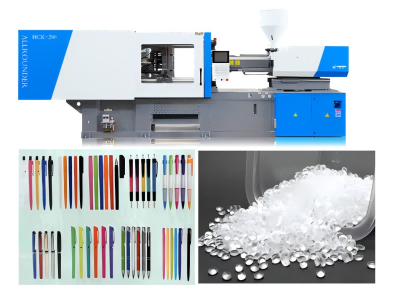
Material selection depends on the pen design, required appearance, flexibility, strength and cost.
PP for Ballpoint Pens
Polypropylene is commonly considered for flexible or lightweight pen components.
Its advantages can include:
- Low material cost
- Good chemical resistance
- Good flexibility
- Easy processing
- Low density
PP may be suitable for caps, clips and selected internal components.
ABS for Pen Components
ABS is widely used for plastic products that require a balance of appearance, rigidity and impact resistance.
For pen production, ABS can be considered for barrels, caps, grips and other visible components when its properties match the product requirements.
ABS processing conditions should follow the resin supplier’s recommendations, especially for drying and melt temperature.
PS for Pen Parts
Polystyrene can be used for selected low-cost plastic pen components.
It is relatively easy to process and can provide a good surface finish. However, the final material choice should consider the required impact resistance and flexibility of the component.
PC for Transparent or High-Performance Parts
Polycarbonate can be used when a pen component needs higher impact resistance or transparency.
Because PC is moisture-sensitive, proper drying is important before molding. The exact drying temperature and time should always follow the material manufacturer’s technical data sheet.
How to Choose a Ballpoint Pen Injection Molding Machine
Selecting a pen injection molding machine starts with the mold and product requirements.
The following factors should be checked before ordering a machine.
Calculate the Required Clamping Force
Clamping force must be sufficient to keep the mold closed during injection.
A basic concept is:
Required clamping force = projected area × required clamping pressure
The actual calculation should also consider the material, mold design, injection pressure and an appropriate safety margin.
Do not select a machine only because another pen manufacturer uses the same tonnage.
A 32-cavity clip mold and a 32-cavity barrel mold can have very different requirements.
Check the Number of Mold Cavities
Cavity number has a direct effect on production capacity.
For example:
- 8 cavities produce 8 parts per cycle
- 16 cavities produce 16 parts per cycle
- 32 cavities produce 32 parts per cycle
- 48 cavities produce 48 parts per cycle
More cavities can increase output without increasing the number of machines. However, a larger cavity count also increases mold complexity and can increase the required machine capacity.
Check Mold Dimensions
The machine must accommodate the mold dimensions.
Before selecting the machine, check:
- Tie-bar spacing
- Platen dimensions
- Minimum mold height
- Maximum mold height
- Mold opening stroke
- Ejector stroke
- Mold weight
The mold should fit the machine mechanically as well as hydraulically.
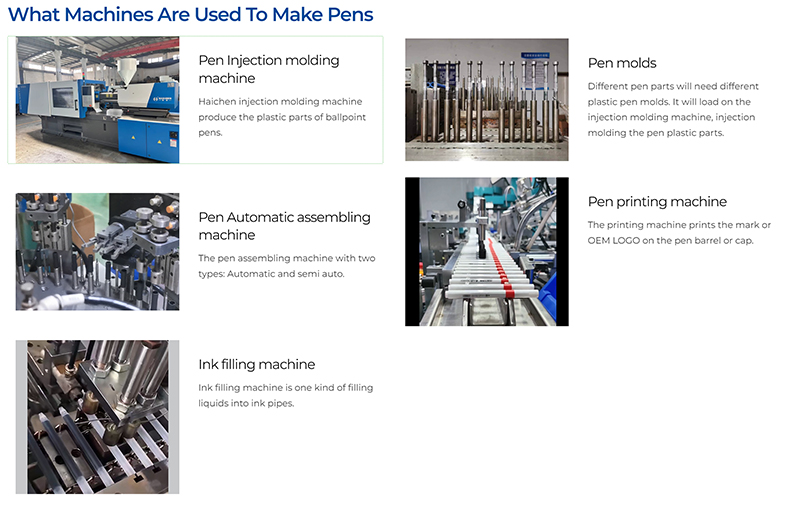
Check Injection Capacity
The injection unit must provide enough shot capacity for the complete molding cycle.
The required shot includes the weight of the molded parts and the runner system where applicable.
For a multi-cavity mold, calculate the total shot requirement rather than looking only at the weight of one pen component.
Check Injection Speed
Thin and relatively long components may require controlled filling speed.
A higher injection speed can help reduce premature freezing during filling, but simply increasing speed does not solve every molding problem.
Gate design, runner design, melt temperature, mold temperature, material selection and venting all affect filling performance.
The ideal injection profile should therefore be developed during mold trials.
Check Control and Repeatability
Pen components are small, and high-cavity production requires consistent molding conditions.
Important machine controls include:
- Injection speed control
- Pressure control
- Screw position control
- Holding pressure control
- Temperature control
- Mold opening and closing control
- Ejection control
Stable process control helps reduce variation between cycles and between cavities.
What Tonnage Injection Molding Machine Do You Need for Pens?
There is no universal tonnage for ballpoint pen production.
A machine suitable for a pen clip may be too small for a high-cavity barrel mold. Likewise, choosing a much larger machine than necessary can increase equipment cost and operating costs.
As a starting point, pen manufacturers may evaluate machines across a range of approximately 100 to 300 tons for different pen components. The final selection should be based on the actual mold design and projected area.
A practical selection process looks like this:
| Pen Component | Typical Production Consideration | Machine Selection |
|---|---|---|
| Pen clip | Small part, high cavity count | Smaller machine may be suitable |
| Pen cap | Small-to-medium part | Medium machine depending on cavity count |
| Pen grip | Medium part, appearance-sensitive | Medium machine depending on mold |
| Pen barrel | Long, relatively thin part | Machine selected according to projected area and mold design |
| Multi-component production | Multiple molds and high output | Several machine sizes may be required |
These ranges should be treated as project starting points rather than fixed specifications.
The mold supplier and injection molding machine supplier should confirm the final machine size after reviewing the part drawings, material, cavity number and mold design.
How Many Cavities Should a Pen Mold Have?
Cavity number depends mainly on the required production output and the economics of the project.
A low-cavity mold has a lower initial mold investment and can be easier to develop. However, it produces fewer parts per cycle.
A high-cavity mold costs more and requires tighter mold manufacturing control, but it can significantly increase production output.
For example, consider a 32-cavity mold running at a 20-second cycle:
32 × 3600 ÷ 20 = 5,760 parts per hour
This is a theoretical calculation before accounting for machine downtime, rejects, mold maintenance and other production interruptions.
Therefore, actual output will normally be lower than the theoretical maximum.
The correct cavity number should be selected according to:
- Daily production target
- Number of working hours
- Target cycle time
- Mold investment
- Machine investment
- Expected product demand
- Required production flexibility
Ballpoint Pen Injection Molding Process
The basic plastic pen injection molding process follows several stages.
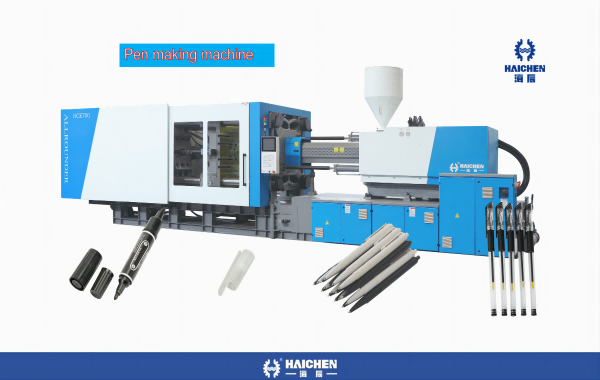
Step 1: Material Preparation
Plastic pellets are prepared according to the resin supplier’s requirements.
Materials such as ABS and PC may require drying because moisture can cause molding defects.
Material handling should also prevent contamination and excessive exposure to humidity.
Step 2: Plasticizing
The screw rotates and moves the plastic material through the heated barrel.
The material melts and becomes ready for injection.
Barrel temperatures depend on the selected resin. Operators should use the material supplier’s recommended processing window instead of applying one temperature setting to every material.
Step 3: Injection
The screw moves forward and pushes the molten plastic into the mold.
For long or thin pen components, filling conditions are important because the melt can cool while traveling through the cavity.
Injection speed, pressure and position can be controlled in multiple stages to improve filling and reduce defects.
Step 4: Holding Pressure
After the cavity is filled, holding pressure can compensate for material shrinkage while the gate is still open.
Correct holding pressure can help maintain dimensions and reduce certain appearance defects.
Step 5: Cooling
The molded component remains in the mold until it reaches sufficient rigidity for ejection.
Cooling system design has a major effect on cycle time.
Uneven cooling can contribute to warpage, especially in long and thin components.
Step 6: Ejection
The mold opens and the ejector system removes the molded parts.
Pen barrels and other slender parts should be ejected carefully to avoid deformation.
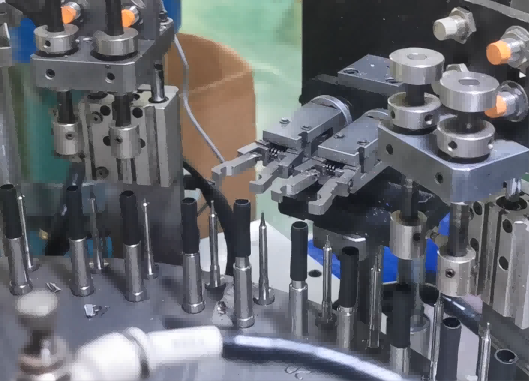
Step 7: Inspection and Assembly
After molding, the components can be inspected and transferred to assembly.
Depending on the product, the process may include:
- Gate removal
- Flash inspection
- Dimensional inspection
- Logo printing
- Refill insertion
- Cap assembly
- Clip installation
- Final inspection
How to Calculate Ballpoint Pen Production Capacity
We suggest estimate production capacity using a simple formula:
Hourly output = Number of cavities × 3600 ÷ Cycle time
For example:
A 24-cavity mold with a 20-second cycle:
24 × 3600 ÷ 20 = 4,320 parts per hour
A 48-cavity mold with the same cycle:
48 × 3600 ÷ 20 = 8,640 parts per hour
These figures represent theoretical molded-part output.
Actual production capacity depends on:
- Machine availability
- Mold maintenance
- Material changes
- Color changes
- Quality rejects
- Operator availability
- Automation
- Assembly capacity
This is why the molding machine output should always be considered together with the downstream assembly and packaging capacity.
What Auxiliary Equipment Does a Pen Production Line Need?
An injection molding machine is only one part of a complete ballpoint pen production line.
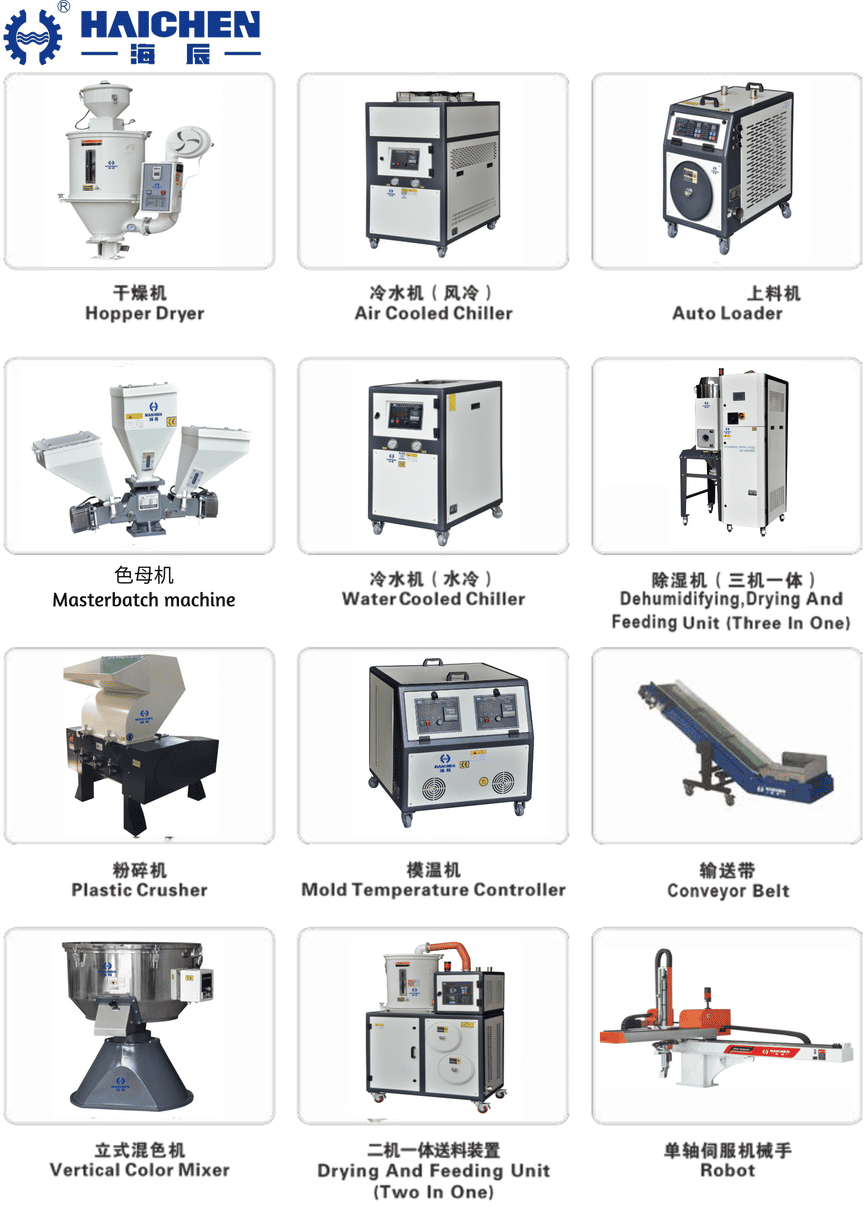
Material Dryer
A dryer can remove moisture from hygroscopic materials such as ABS and PC.
The correct drying temperature and time should come from the resin manufacturer’s technical data.
Auto Loader
An automatic loader transfers material to the machine hopper.
This reduces manual material handling and helps maintain a continuous production process.
Chiller
A chiller supplies cooling water for the molding process.
Stable cooling conditions can help maintain cycle consistency.
Mold Temperature Controller
A mold temperature controller maintains the required mold temperature.
This can be especially useful when the material and product design require tighter temperature control.
Take-Out Robot
A robot can remove molded parts automatically.
For high-volume production, automation can improve cycle consistency and reduce manual handling.
Conveyor
A conveyor can transfer molded components to inspection, decoration or assembly stations.
The complete automation system should be designed around the required production volume rather than added simply because automation is available.
How to Set Up a Ballpoint Pen Production Line
A typical high-volume setup may include separate molding processes for different pen components.
For example:
Material storage → Drying → Injection molding → Part removal → Inspection → Decoration → Assembly → Packaging
If production volume is high, manufacturers may use separate machines for barrels, caps and clips.
This approach reduces the need to frequently change molds and allows different components to run at the same time.
However, the number of machines depends on the production target.
A small factory may start with fewer machines and add equipment as demand increases.
A larger factory may use several dedicated molding machines with automated material handling and part removal.
How Much Does a Ballpoint Pen Injection Molding Machine Cost?
The price of a ballpoint pen injection molding machine depends on several factors.
These include:
- Machine clamping force
- Injection unit size
- Machine configuration
- Servo or hybrid system
- Automation requirements
- Auxiliary equipment
- Mold requirements
- Quantity ordered
- Installation and commissioning requirements
For this reason, comparing machine prices without comparing the complete configuration can lead to an inaccurate investment estimate.
For a production project, the supplier should normally review:
- Pen component drawings
- Plastic material
- Mold cavity number
- Target output
- Expected cycle time
- Required automation
- Factory power conditions
- Required auxiliary equipment
A more accurate quotation can then be prepared based on the actual production requirements.
Why Consider Haichen for Ballpoint Pen Injection Molding?
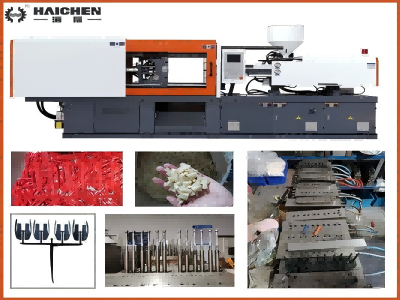
Haichen focuses on injection molding machine manufacturing and provides equipment for different plastic production applications. Its current product range includes standard, energy-saving and hybrid injection molding machine solutions.
For a pen production project, we need to match the machine should with the customer’s mold, material and production target.
Haichen can help evaluate the required machine configuration based on:
- Product drawings
- Mold specifications
- Material
- Cavity number
- Target production capacity
- Automation requirements
For customers planning a complete production line, the project can also include auxiliary equipment and production process support.
The best starting point is not simply asking for the largest available machine. Instead, provide the pen component drawing, material, cavity number and target output so the machine can be selected around the actual production requirements.
Frequently Asked Questions
What machine is used to make ballpoint pens?
Injection molding machines are commonly used to manufacture plastic ballpoint pen components such as barrels, caps, clips and grips. The required machine size depends on the component, mold and production target.
What injection molding machine is maining using for pen barrels?
Pen barrel production requires a machine that can accommodate the barrel mold dimensions, cavity number, shot size and required injection conditions. The exact clamping force should be calculated from the mold and projected area rather than selected from the product name alone.
How many tons of injection molding machine will be using for pens?
There is no single tonnage for all pen components. Different pen parts may require different machine sizes. A practical project may evaluate machines from around 100 to 300 tons, but you should confirm the actual mold design before final selection.
How many cavities should a ballpoint pen mold have?
The correct cavity number depends on production demand, mold investment and machine capacity. High-volume manufacturers may use multi-cavity molds to increase output, while lower-volume production may use fewer cavities.
What plastic is main material to make ballpoint pens?
PP, ABS, PS and PC can all be used for different pen components depending on the required flexibility, strength, appearance, transparency and cost.
How many pens can an injection molding machine produce per hour?
The answer depends on the number of mold cavities and cycle time. The basic formula is:
Hourly output = Cavities × 3600 ÷ Cycle time
For example, a 32-cavity mold running a 20-second cycle has a theoretical output of 5,760 molded parts per hour.
Can one injection molding machine produce different pen parts?
Yes. One machine can produce different components by changing the mold, provided that the molds are compatible with the machine. For high-volume production, manufacturers may use dedicated machines for different components to reduce mold-change downtime.
What information should I provide when buying a pen injection molding machine?
Provide the supplier with the product drawing, material, part weight, mold cavity number, target production output and mold dimensions. These details allow the supplier to recommend a suitable machine configuration.
Final Checklist for Choosing a Pen Injection Molding Machine
Before purchasing a machine, confirm the following:
- Product material
- Product dimensions
- Product weight
- Mold cavity number
- Mold dimensions
- Projected area
- Required clamping force
- Injection capacity
- Injection speed
- Cycle time
- Target hourly output
- Automation requirements
- Dryer and material handling
- Chiller and mold temperature control
- Robot requirements
- Factory power and installation conditions
The right ballpoint pen injection molding machine is the one that matches the product, mold and production target—not simply the machine with the highest tonnage.
If you are planning a new pen production line, send your pen component drawing, material, mold cavity number and target output. Haichen can evaluate the required machine configuration and production setup based on your actual project.
Author: Yang, Senior Engineer, Haichen Machinery


