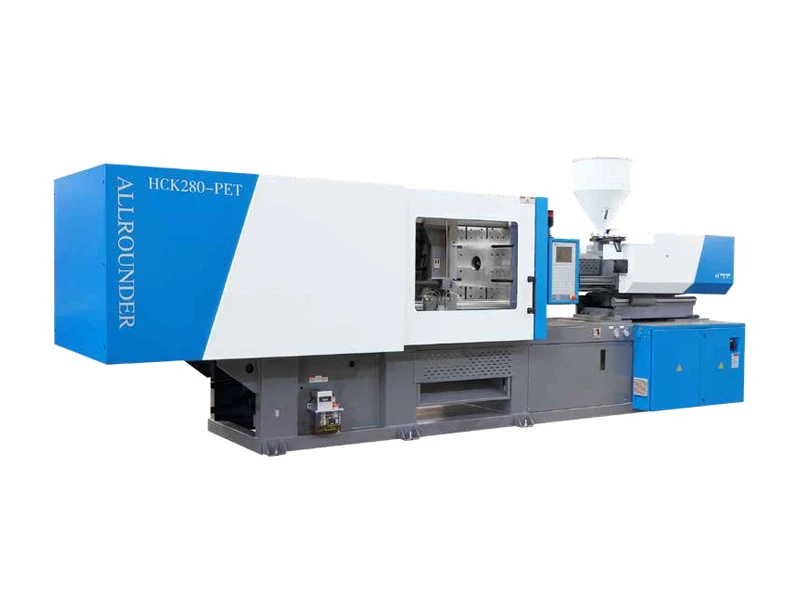
PVC pipe fittings (elbows, tees, wyes, couplings, and valves) are produced by injection molding under processing conditions that differ fundamentally from general-purpose plastics. PVC releases corrosive hydrochloric acid gas during heating, has a narrow thermal stability window, and requires mold designs that accommodate high shrinkage and thick-wall cooling. A manufacturer that cannot address these specific challenges will deliver a machine that corrodes, produces burnt parts, and generates high scrap rates.
A professional PVC pipe fitting injection molding machine manufacturer must provide five core capabilities: corrosion-resistant screw and barrel (hard chrome-plated or alloy steel), independently zoned temperature control, low-shear screw design, sufficient mold space for core-pulling mechanisms, and PVC-specific injection parameter support. These capabilities address PVC’s thermal degradation, HCl gas corrosion, and thick-wall cooling challenges.
This guide provides a capabilities assessment framework, technical verification checklists, and machine selection criteria for PVC pipe fitting production.
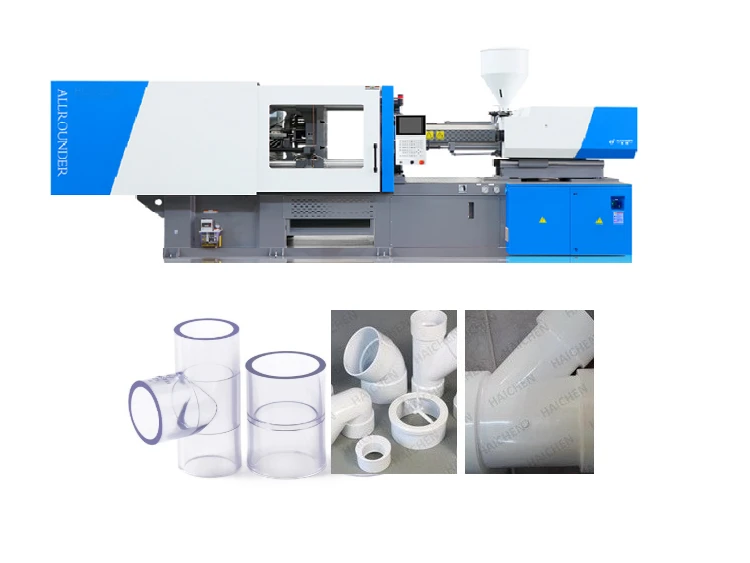
Why Is PVC Different from Other Plastics in Injection Molding?
PVC differs from other plastics in three critical ways: it releases corrosive HCl gas when overheated (attacking standard screws and barrels), it has a narrow thermal stability window (degradation above 200°C), and it requires longer cooling cycles for thick-wall fittings. These characteristics demand dedicated machine design.
The Three Processing Challenges of PVC
| Challenge | Root Cause | Impact on Machine Design |
|---|---|---|
| Corrosive gas release | HCl gas generated above degradation temperature | Requires corrosion-resistant screw, barrel, and nozzle |
| Narrow thermal window | Thermal degradation above 200°C | Requires precise multi-zone temperature control |
| Slow cooling | Thick-wall fittings store more heat | Requires enhanced cooling circuits and larger mold water channels |
PVC is a thermoplastic material that can be classified into rigid and flexible PVC. In construction applications, rigid PVC is predominantly used for pipes, elbows, tees, and various connection fittings. PVC’s processing challenges include poor thermal stability — overheating can cause decomposition and release of corrosive gases such as HCl — susceptibility to bubbles and burning, and long cooling cycles especially for thick-walled fittings.
These characteristics place stringent demands on injection molding machines, especially in terms of corrosion resistance, thermal stability, and process control. Selecting the right injection molding machine is a decisive factor in achieving stable production, high yields, and consistent product quality.
What Corrosion-Resistant Capabilities Should a PVC Machine Manufacturer Provide?
A PVC injection molding machine manufacturer should provide hard chrome-plated or alloy steel screws, reinforced barrels with corrosion-resistant liners, bimetallic barrel construction, and dual blower cooling to suppress degradation. Standard nitrided screws will corrode within months when processing PVC.
Screw and Barrel Requirements
PVC releases acidic gases (e.g. HCl) during heating, causing screw and barrel corrosion. Solutions include hard chrome-plated or alloy steel screws, reinforced barrels, and dual blower cooling to suppress degradation and carbonization. PVC pipe fitting manufacturing machines need special plasticizing screw designs, and the barrel and nozzle also need strong corrosion resistance.
JETEL’s PVC injection molding machine is specifically engineered to address the challenges of PVC processing, including corrosion, thermal degradation, and process instability. It features a bimetallic corrosion-resistant barrel and specialized screw design, ensuring long-term stable operation at processing temperatures between 160-200°C.
Verification Checklist for Corrosion Resistance
| Feature | What to Verify | Red Flag |
|---|---|---|
| Screw material | Hard chrome-plated, alloy steel, or bimetallic | Standard nitrided steel |
| Barrel liner | Corrosion-resistant alloy or bimetallic | Standard carbon steel |
| Nozzle | Chrome-plated, enlarged for PVC flow | Standard nozzle |
| Cooling system | Dual blower or independent fan zones | No dedicated cooling |
Corrosion-Resistant Component Specifications
-
Screw: Hard chrome-plated or bimetallic (alloy steel base with corrosion-resistant surface layer)
-
Barrel: Reinforced with corrosion-resistant liner; bimetallic construction preferred
-
Nozzle: Chrome-plated, enlarged diameter to reduce shear and flow restriction
-
Cooling: Dual blower cooling system with independently controlled zones to prevent overheating and carbonization
A manufacturer that cannot specify the exact screw material and barrel construction for PVC processing is not a PVC specialist.
What PVC processing required temperature control capabilities?
PVC injection molding requires independently zoned temperature control with accuracy of ±1°C. Typical PVC processing temperatures range from 150-190°C (barrel) and 20-70°C (mold). A PVC-specific machine needs separate fan cooling for each barrel zone to prevent localized overheating.
PVC Processing Temperature Ranges
| Zone | Standard PVC Range | CPVC Range (DN400 elbow example) | Notes |
|---|---|---|---|
| Rear barrel zone | 150-160°C | 150-155°C | Feed zone |
| Middle barrel zones | 160-170°C | 162-173°C | Multiple zones |
| Front barrel zone | 170-180°C | 155-165°C | Metering zone |
| Nozzle | 180-190°C | — | Slightly higher than front |
| Mold temperature | 20-40°C | 60-70°C | Depends on fitting size |
For a CPVC DN400 elbow produced by single-shot injection molding, the material tube heating position is divided into seven sections, each heated separately by heating collar, with temperature ranges of 150~155°C, 168~173°C, 162~167°C, 160~165°C, 155~160°C, 150~155°C, and 145~150°C, and mold temperature controlled between 60~70°C. The injection pressure is divided into three sections: 58MPa, 65MPa, and 80MPa.
Temperature Control System Requirements
PVC is highly sensitive to thermal fluctuation. A PVC-specific machine should feature a low-shear screw design with independently zoned temperature control. Each barrel zone must have separate temperature control and fan cooling. JETEL’s PVC machine uses intelligent temperature control and high-precision metering to effectively minimize material degradation and improve product yield.
Key verification points:
-
Number of independently controlled barrel zones (minimum 4 for PVC)
-
Temperature control accuracy (±1°C or better)
-
Separate fan cooling for each zone
-
Alarm and shutdown protection for over-temperature conditions
What Injection Parameters Should a PVC Machine Manufacturer Provide?
PVC injection molding requires lower screw speeds (35-50 RPM), moderate injection pressures (58-80 MPa for standard fittings, up to 135 MPa plasticizing pressure), and low shear rates. The screw L/D ratio should be 20-22 for PVC. Higher shear rates cause degradation and burnt parts.
Recommended PVC Injection Parameters
| Parameter | Recommended Range | Notes |
|---|---|---|
| Screw L/D ratio | 20-22 | PVC pipe fitting machines typically use 22 L/D |
| Screw speed | 35-50 RPM | Low speed to minimize shear heating |
| Injection pressure | 58-80 MPa (standard) | Multi-stage pressure profile |
| Plasticizing pressure | Up to 135 MPa | For large fittings |
| Injection rate | Moderate | High shear causes degradation |
| Screw compression ratio | 2.0-2.15 | Isometric non-deep full thread screw |
For most PVC applications, a rotation speed of 35-50 RPM should be satisfactory. The plasticizing pressure of the screw in injection molding machine top material is 135MPa.
Why Low Shear Matters for PVC
PVC injection molding has constrained temperature and shear rate owing to its temperature sensitivity and high viscosity. High screw speeds generate frictional heat that can push localized material temperatures above the degradation threshold, causing burn marks and discoloration.
A machine manufacturer that cannot explain the relationship between screw speed, shear rate, and PVC degradation is not providing adequate technical support.
What Mold Space and Clamping Capabilities Are Needed for PVC Fittings?
PVC fitting molds typically require more mold space than standard molds because of core-pulling mechanisms for hollow fittings. The machine needs sufficient tie-bar spacing and mold height range to accommodate these mechanisms, typically 200mm extra safety door clearance per side.
Mold Space Requirements
Because PVC pipe fitting molds typically have many core-pulling actions, at the same clamping force or injection volume, fitting molds require more space compared to ordinary molds. For example, Dakumar’s PVC injection molding machines have an extra 200mm safety door clearance per side.
Clamping Force Calculation for PVC Fittings
Required Clamp Force = Total Projected Area × Material Factor × (1.1 to 1.2)
| Material | Material Factor (tons/cm²) | Notes |
|---|---|---|
| PVC (rigid) | 3.5-5 | Higher viscosity than PP |
| CPVC | 4-5.5 | Higher processing temperature |
| UPVC | 3.5-5 | Standard rigid PVC |
Worked example: A 4-cavity PVC elbow mold with 40 cm² projected area per fitting and 12 cm² runner area:
Total projected area = (40 × 4) + 12 = 172 cm²
Required clamp force = 172 × 4.5 × 1.15 = 890 tons
A 900-1000 ton machine would be suitable.
Machine Configuration Guide for PVC Fittings
| Fitting Type | Recommended Tonnage | Screw Diameter | Typical Cavities | Cycle Time |
|---|---|---|---|---|
| D40 elbow (90°) | 150-200 T | 40-45 mm | 4 | 20-30 s |
| D110 tee | 300-500 T | 45-55 mm | 2-4 | 30-45 s |
| D160 coupling | 500-800 T | 55-65 mm | 2-4 | 40-60 s |
| Large diameter fitting | 800-1600 T | 60-80 mm | 1-2 | 60-120 s |
FCS’s PVC infrastructure solution demonstrates the D40 elbow 90° produced on an HT-150PVC machine with a 4-cavity mold and 52g part weight per cavity.
What Mold Design Support Should a PVC Machine Manufacturer Provide?
A PVC machine manufacturer should provide guidance on gate design (fan gates for PVC to reduce warpage), mold steel selection (stainless steel 420SS or plated tool steel), cooling channel design (independent circuits per mold half), and venting specifications (0.0006-0.0010 inch depth for rigid PVC).
Gate Design for PVC
PVC’s higher viscosity means it needs larger or multiple gates to ensure smooth filling. Fan gates are effective for reducing warpage and maintaining flatness. Gates should be positioned in thicker sections, away from cosmetic surfaces, and designed to minimize shear and stress. Edge gates, fan gates, or submarine gates are preferred for PVC; avoid pinpoint gates if possible due to shear heat.
Mold Steel Selection
PVC’s corrosive byproducts can quickly damage ordinary steel. Stainless steel (420SS) or plated tool steels are commonly used for their resistance to corrosion and wear. For areas that are difficult to cool, beryllium copper inserts help improve heat transfer and reduce cycle time.
Cooling System Design
Cooling channels should be well distributed and independent for each mold half. Using conductive inserts in hot zones improves temperature balance. The goal is to maintain consistent mold temperature, preventing differential shrinkage and improving cycle efficiency. PVC typically requires mold temperatures of 30-60°C; cooling channels of sufficient diameter must be arranged around the cavity to achieve uniform cooling.
Venting Requirements
Without proper venting, PVC is prone to burn marks, voids, and short shots. Vent depths are typically 0.0006-0.0010 inch for rigid PVC. Vents should be placed opposite gates and near ejector pins to allow trapped air to escape without weakening the part.
What Certifications and Quality Standards Should You Verify?
Verify ISO 9001 (quality management) and CE marking (EU safety compliance). For PVC pipe fittings exported to regulated markets, additional product certifications may be required: NSF, UPC, KITEMARK, WATERMARK, or DVGW depending on the destination market.
Required Machine Certifications
| Certification | What It Confirms | Verification Method |
|---|---|---|
| ISO 9001 | Quality management system | Check certificate number with issuing body |
| CE Marking | EU safety compliance | Verify with notified body |
| EN ISO 20430 | Injection molding machine safety | Request test report |
PVC pipe fitting injection molding machines are typically certified with ISO9001 and CE. Bole Machinery’s BL530EKH-PVC machine carries CE and ISO certification. Haituo’s HTF-300/PVC lists CE, ISO9001:2008, GMP, and QS certifications.
Product Certifications for PVC Pipe Fittings
Depending on the destination market, PVC pipe fittings may require additional product certifications. PVC pipes and fittings certificate requirements include PN10/PN16: DVGW; SCH40/SCH80: NSF, UPC; BS4346: KITEMARK; AS/NZS 1477: WATERMARK, CE. A machine manufacturer that understands these end-product certification requirements can help buyers avoid costly rework and market access delays.
How Do You Evaluate a PVC Machine Manufacturer’s Technical Support?
Evaluate technical support across three areas: PVC-specific parameter recommendations (temperature profiles, injection pressure, screw speed), mold design consultation (gate location, cooling layout, venting), and on-site commissioning with mold trial support.
Technical Support Evaluation Checklist
| Support Area | What a Capable Manufacturer Provides | Red Flag |
|---|---|---|
| PVC parameter recommendations | Documented temperature profiles, injection pressures, screw speeds for different PVC grades | Generic settings only |
| Mold design consultation | Gate design, cooling channel layout, venting specifications for PVC | No mold design support |
| Material trial support | On-site or remote support during first production run | No trial support offered |
| Operator training | Training on PVC-specific processing, machine maintenance, defect troubleshooting | Documentation only |
| Spare parts | Regional stock of PVC-specific components (screws, barrels, nozzles) | Order-on-demand only |
What to Ask Before Purchase
-
Can the manufacturer provide documented PVC processing parameters for your specific fitting type and material grade (PVC, CPVC, UPVC)?
-
Does the manufacturer offer mold design consultation for PVC-specific requirements (gate design, cooling, venting)?
-
What is the spare parts lead time for corrosion-resistant screws and barrels?
-
Does the manufacturer provide on-site commissioning with mold trial support?
-
Can the manufacturer provide references from existing PVC pipe fitting producers?
FAQ
What makes a PVC injection molding machine different from a standard machine?
PVC injection molding machines require corrosion-resistant screws and barrels (hard chrome-plated or bimetallic), independently zoned temperature control with fan cooling, low-shear screw design, and sufficient mold space for core-pulling mechanisms. Standard machines will corrode rapidly and produce degraded parts when processing PVC.
What injection molding temperature should PVC process?
PVC processing temperatures typically range from 150-190°C for the barrel and 20-70°C for the mold. CPVC requires slightly different ranges. The temperature window is narrow — exceeding 200°C causes thermal degradation and HCl gas release.
What commended for PVC injection molding screw L/D ratiore?
PVC pipe fitting machines typically use a screw L/D ratio of 20-22. The recommended screw speed is 35-50 RPM to minimize shear heating and prevent degradation.
What is the clamping force required for PVC pipe fitting molds?
Use the formula: Required Clamp Force = Total Projected Area × Material Factor × Safety Factor. For rigid PVC, the material factor is typically 3.5-5 tons/cm². A 4-cavity D40 elbow mold with 40 cm² projected area per cavity typically requires 800-1000 tons.
What certifications should a PVC injection molding machine manufacturer have?
At minimum, ISO 9001 (quality management) and CE marking (EU safety compliance). Verify certificate numbers with issuing bodies. For pipe fittings exported to regulated markets, it may also require end-product certifications such as NSF, UPC, KITEMARK, or WATERMARK.
What causes burn marks in PVC injection molding?
Burn marks are caused by thermal degradation from excessive melt temperature, poor mold venting, or high injection speed generating frictional heat. Solutions include lowering barrel temperature, improving mold venting, and optimizing injection speed.
How much PVC pipe fitting molds space need?
PVC fitting molds typically require more space than standard molds because of core-pulling mechanisms. A machine with an additional 200mm safety door clearance per side is recommended for most PVC fitting applications.