
A PVC pipe fittings injection molding machine produces plastic fittings such as elbows, tees, couplings, reducers, and connectors. These parts need the right shape, wall thickness, and connection size to fit a piping system. For manufacturers, choosing the right machine means matching the plastic material, mold, clamping force, injection unit, and production target.
PVC also needs careful process control. Unlike many common thermoplastics, PVC can break down when heat and shear become excessive. As a result, the screw and barrel design, temperature settings, and material residence time all affect product quality.
In this guide, we explain how to choose an injection molding machine for PVC pipe fittings, how to match the machine with the mold, and how to plan an efficient production line. We also cover common molding problems and the information you should prepare before requesting a machine quotation from Haichen.
What Makes PVC Pipe Fittings Injection Molding Different?
PVC pipe fittings can have simple or complex shapes. However, every fitting needs a mold that controls its dimensions and a machine that fills the mold in a stable way.
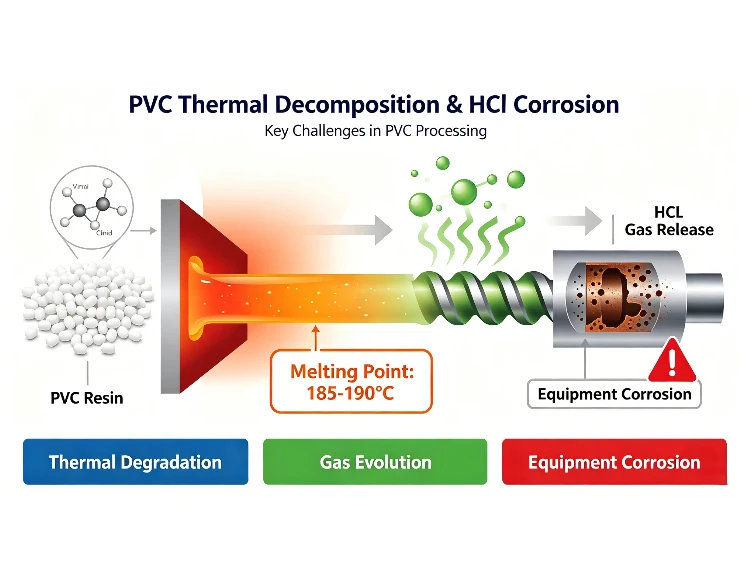
The material creates an extra challenge. PVC has limited thermal stability, so manufacturers need to control temperature, shear, and residence time. If the material stays too hot for too long, it may change color, lose quality, or release harmful decomposition gases.
Therefore, machine selection should begin with the exact PVC compound and the finished fitting.
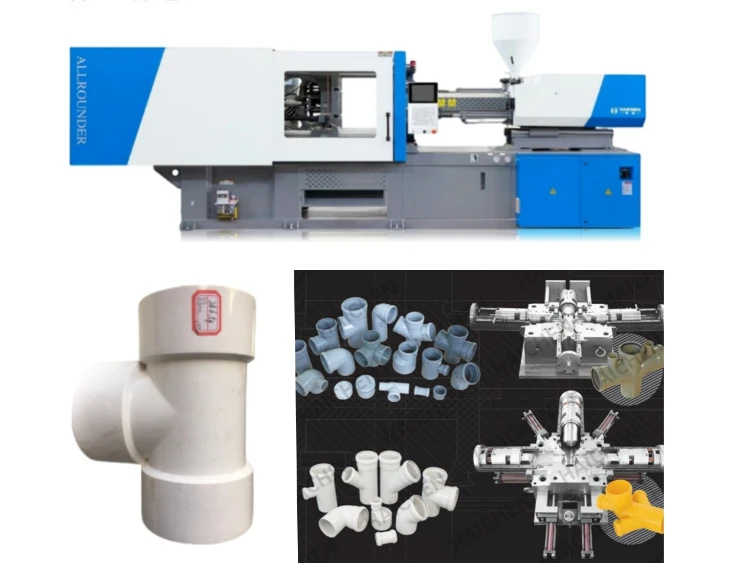
PVC, UPVC, and CPVC Material Differences
Material PVC is used for many pipe and fitting products. However, different formulations can have different processing needs.
- PVC: The processing conditions depend on the compound, including its stabilizers, lubricants, and other additives.
- UPVC or uPVC: This means unplasticized PVC. It is widely used for rigid pipe and fitting products.
- CPVC: Chlorinated PVC has different heat and material properties from standard PVC. It may need a different processing window.
Because these materials are not interchangeable in every application, the machine supplier needs to know the exact resin or compound before selecting the screw, barrel, and process settings.
For example, a machine setup that works well for one rigid PVC compound may not give the same result with a different formulation. Always follow the compound supplier’s processing data and confirm the settings through molding trials.
Why PVC Needs Careful Temperature Control
PVC processing requires a suitable temperature range. If the melt overheats, the material can degrade. If the material does not melt and flow well enough, the mold may not fill correctly.
For this reason, manufacturers should control:
- Barrel temperature by zone
- Screw speed
- Back pressure
- Injection speed
- Residence time
- Melt condition
The correct values depend on the actual PVC compound and machine configuration. Therefore, do not use one fixed temperature range for every PVC pipe fitting.
In addition, stable temperature control helps reduce color changes, black specks, and inconsistent filling. Operators should also follow the safety procedures for ventilation and the handling of any decomposition gases.
Screw and Barrel Protection for PVC Injection Molding
The screw and barrel have direct contact with the material throughout production. Their design therefore matters for both process stability and service life.
When selecting a PVC injection molding machine, check the following features:
- Screw geometry suited to the PVC compound
- Suitable shear and compression characteristics
- Barrel and screw materials or coatings suited to the material
- Stable temperature control
- Proper wear and corrosion protection
- Easy access for inspection and maintenance
A corrosion-resistant coating, such as chrome plating, may be offered for a particular machine configuration. However, the correct choice depends on the compound, equipment design, and supplier recommendation.
The same principle applies to barrel cooling. Suitable cooling can help control unwanted heat, but the system must work with the barrel design and the selected processing conditions.
Key Features of a PVC Pipe Fittings Injection Molding Machine
Once the material is clear, the next step is to match the machine with the part and mold.
A good selection should cover the clamping unit, injection unit, screw and barrel, control system, and mold space. In addition, the machine must support the required output without forcing the mold to run outside its suitable process window.
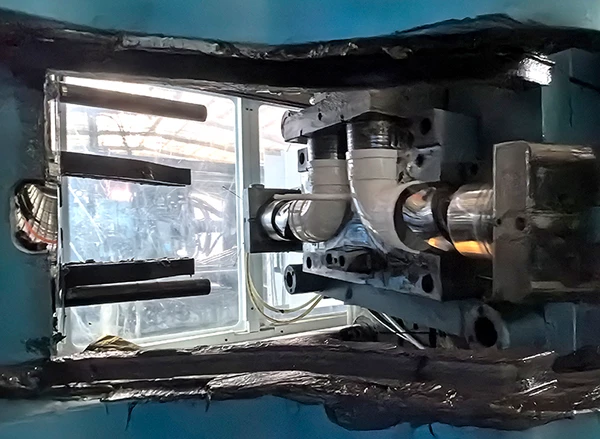
Clamping Force and Total Projected Area
Clamping force keeps the mold closed while the machine injects plastic into the cavities.
The required force depends mainly on the total projected area, estimated cavity pressure, and a suitable safety factor. It does not depend on pipe diameter alone.
For a multi-cavity mold, the projected areas of the parts must be considered together. The runner layout may also affect the total projected area.
A simplified starting formula is:
Required clamping force = Total projected area × Estimated cavity pressure × Safety factor
Make sure the units match during the calculation. The mold designer or machine supplier should confirm the final result using the actual mold data.
If clamping force is too low, the mold may open slightly during injection and produce flash. On the other hand, choosing a much larger machine than necessary can increase equipment cost without improving the fitting.
For a detailed calculation, see How to Calculate Injection Molding Machine Clamping Force.
Injection Unit and Shot Size
The injection unit must provide enough material for every cavity and the runner system, where applicable.
Before choosing the machine, calculate the total shot weight from the number of cavities, part weight, and runner weight. Then compare that figure with the usable injection capacity of the proposed machine.
Also check the plasticizing capacity. The screw must prepare enough melt before the next injection cycle. If the unit cannot keep up with the target cycle time, output may fall even when the clamping force is sufficient.
For this reason, machine selection should check both units:
- Clamping unit: Can it keep the mold closed and fit the mold?
- Injection unit: Can it supply the required shot with suitable pressure, speed, and plasticizing capacity?
PVC Screw Design and Corrosion Resistance
A suitable screw should melt and move the PVC compound without creating unnecessary shear heat.
The exact design depends on the material formulation and the required output. Ask the supplier to confirm the screw diameter, geometry, material, coating, and barrel specification for PVC use.
Do not assume that every standard-purpose screw is suitable for a PVC project. Likewise, do not assume that a single screw design works equally well for PVC, UPVC, CPVC, PP, and other materials.
If a factory plans to change materials, it should ask whether the proposed screw and barrel can handle each material and whether a different configuration is needed.
Temperature Control and Residence Time
Temperature control is especially important when processing PVC.
A multi-zone control system lets the operator adjust different barrel zones instead of treating the entire barrel as one temperature area. Depending on the machine, cooling fans or other cooling features may help prevent unwanted heat build-up.
Residence time also matters. If the machine holds PVC in the barrel too long, especially under unsuitable heat conditions, the material may degrade.
To manage this risk, match the shot size to the injection unit, avoid unnecessary pauses with hot material in the barrel, and use a process window supported by material data and production trials.
Mold Dimensions and Core-Pulling Requirements
The mold must fit the machine mechanically. Before ordering, check:
- Tie-bar spacing
- Platen size
- Minimum and maximum mold height
- Mold opening stroke
- Ejector stroke
- Mold weight
- Core-pulling requirements
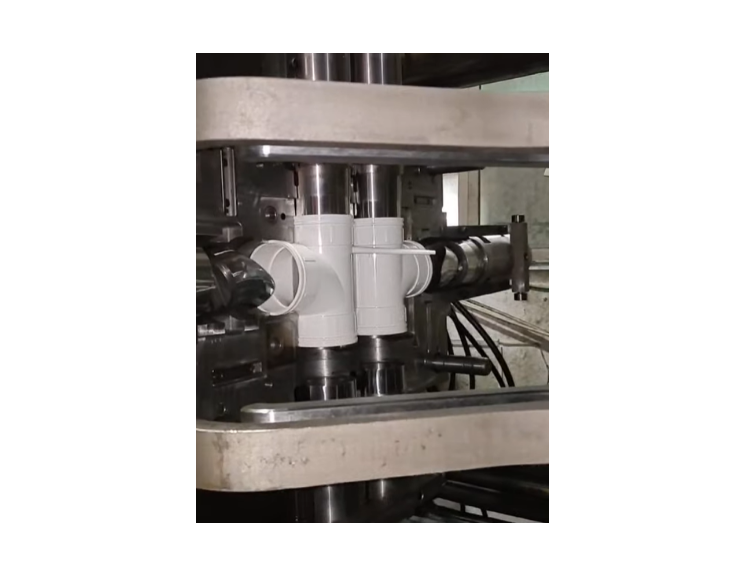
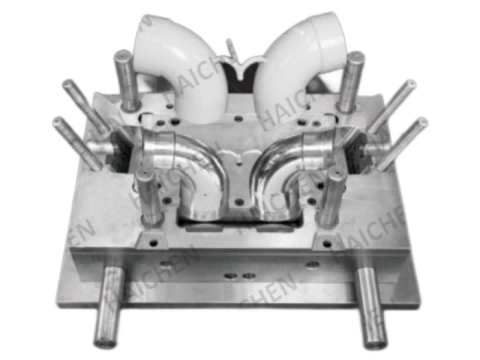
Some PVC elbows, tees, and other fittings have internal shapes that require sliding cores or other mold actions. In those cases, the machine and mold must have the correct interfaces and movement.
Therefore, send the mold drawing to the supplier before finalizing the machine model. A machine with enough clamping force may still be unsuitable if the mold does not fit or the required core-pulling system cannot work with the setup.
How to Choose a PVC Pipe Fitting Injection Molding Machine
The best machine depends on the fitting type, material, mold layout, and output target. Start with the part drawing, then review the following points.
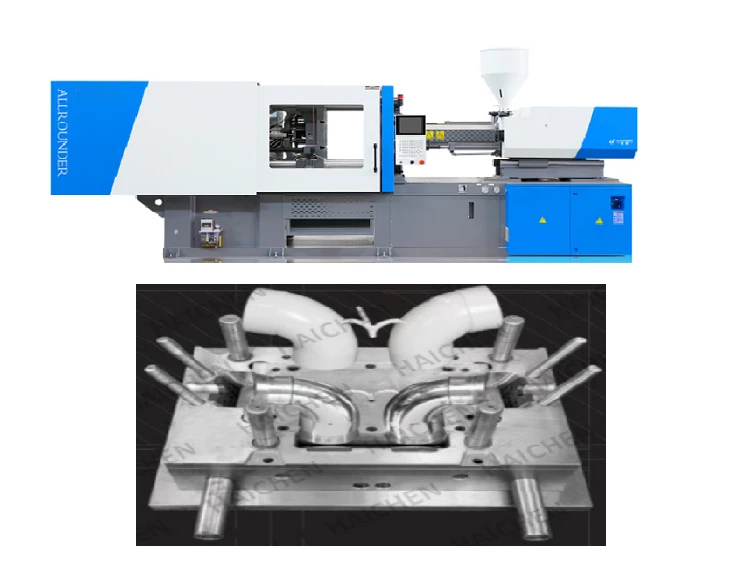
Machine Selection for PVC Elbows and Tees
Elbows and tees can have complex flow paths and internal shapes. Their mold design may also need core-pulling actions.
When choosing a machine for these products, check the part weight, projected area, number of cavities, gate layout, and mold dimensions.
In addition, ask how the proposed setup handles filling and cooling around the fitting’s thicker sections. Those areas may need careful process tuning to limit sink marks, incomplete filling, or dimensional changes.
Machine Selection for Couplings and Reducers
Couplings and reducers vary in size, wall thickness, and shape. A small coupling does not automatically require a small machine, particularly when the mold uses several cavities.
The machine needs enough shot capacity and clamping force for the complete mold. It also needs sufficient mold space and opening stroke.
For a range of fitting sizes, compare the largest and smallest molds that the factory plans to run. Then confirm whether one machine can cover the full range or whether different machines would give better production results.
Machine Selection for Multi-Cavity PVC Pipe Fitting Molds
Multi-cavity molds can increase output because each cycle produces several fittings. However, they also increase the total shot weight and projected area.
For that reason, do not select a machine only from the number of cavities.
A proper check should include:
- Total shot weight
- Total projected area
- Cavity layout
- Mold size
- Cooling demand
- Target cycle time
- Part quality requirements
A multi-cavity mold also needs balanced filling. If the cavities do not fill in a similar way, some fittings may show different weights or dimensions.
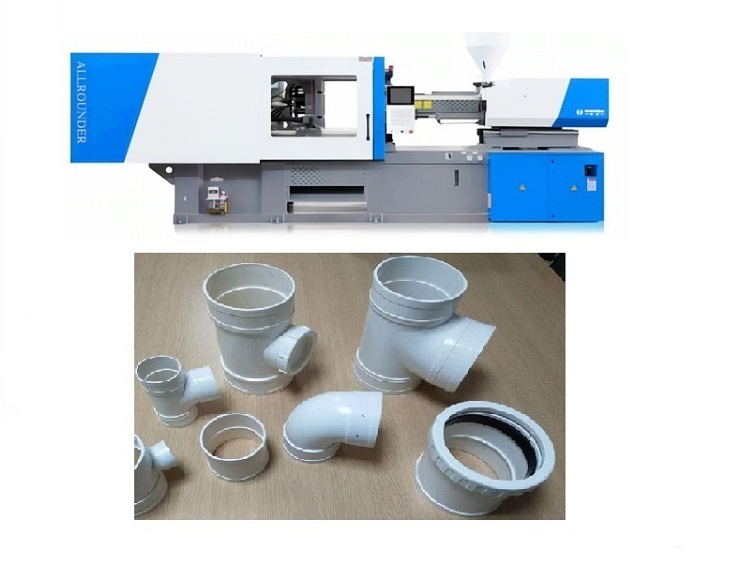
How to Calculate Clamping Force for PVC Pipe Fittings
The fitting’s nominal diameter, such as DN25 or DN50, does not give enough information to select clamping force.
Instead, start with the projected area of the complete mold layout. Then estimate the required cavity pressure based on the material, part design, and process. Finally, apply an appropriate safety factor.
The machine supplier should review the calculation and confirm that the selected machine provides enough rated clamping force.
Consider a multi-cavity mold as an example. Each fitting may be small, but the combined projected area can be much larger than that of a single-cavity mold. The runner layout may add to the area as well.
Therefore, a small fitting made in a high-cavity mold can need a different machine from the same fitting made in a single-cavity mold.
For the final selection, also check injection capacity and mold dimensions. Clamping force is important, but it is only one part of the machine specification.
How to Match a PVC Fitting Mold With the Right Machine
The mold and machine should be selected together.
First, check that the mold fits the tie-bar spacing, platen, mold-height range, and opening stroke. Next, confirm that the injection unit can supply the total shot weight. Then check the clamping force against the total projected area and expected cavity pressure.
Finally, review any core-pulling, ejection, or automation needs.
A mold trial can help the team confirm whether the machine and mold work well together. During the trial, check filling, part weight, surface condition, dimensions, cycle time, and signs of material degradation.
If the fitting shows a short shot, flash, black specks, or color change, the team should review the full process. Increasing pressure or temperature without checking the cause may create another problem.
Haichen HCK Series for PVC Pipe Fitting Production
Haichen’s current PVC pipe fitting article describes HCK series configurations for PVC-related applications. It lists features such as a corrosion-resistant screw and barrel configuration, multi-zone PID temperature control, and a robot interface for automation. The exact configuration and availability should be confirmed for the selected model.
For a PVC pipe fitting project, Haichen should evaluate the material, fitting drawing, mold cavity number, total shot weight, projected area, mold dimensions, and target output before recommending a machine.
The final machine selection should not come from DN size alone. Instead, the engineering team should check the clamping unit and injection unit together and confirm that the screw and barrel suit the selected compound.
If the production line needs a robot, loader, chiller, or mold temperature controller, include those requirements in the quotation request. This makes it easier to plan a complete setup rather than choosing the injection molding machine as a separate item.
You can review Haichen’s PVC pipe fittings injection molding machine page and oil-electric hybrid machine for more information about the company’s machine platforms.
Common PVC Pipe Fitting Injection Molding Problems
PVC molding problems can come from the material, mold, machine, or process settings. Check the cause before changing the settings.
Black Specks and Material Discoloration
Black specks or yellow-brown color changes may indicate material degradation or contamination.
Check the barrel temperature, residence time, screw condition, material cleanliness, and cleaning procedure. Also review whether the material stayed in the barrel during a long stop.
If the problem continues, ask the material supplier and machine supplier to review the compound and processing conditions.
Short Shots
A short shot occurs when the plastic does not fill the mold completely.
Possible causes include a restricted gate, poor venting, unsuitable material temperature, insufficient injection capacity, or an unsuitable injection profile.
Check the full filling path rather than increasing pressure at once. In addition, confirm that the machine can provide the shot size and speed the mold requires.
Flash
Flash is excess plastic at the parting line.
It can occur when the clamping force is too low for the process, when the mold is worn or damaged, or when pressure settings are unsuitable.
Check the mold condition and verify the clamping-force calculation. Then review the injection and holding settings.
Warpage and Dimensional Variation
A fitting may change shape or size because of uneven cooling, unstable packing, mold design, or material changes.
Check the cooling system, mold temperature, holding conditions, and cavity balance. Also compare the material lot and machine process data.
A stable process depends on the full system, not only the injection molding machine.
How to Improve PVC Pipe Fitting Production Efficiency
Improving output does not always mean making the machine run faster. The factory should first make sure that each cycle produces acceptable parts.
Match Cavity Number to Demand
More cavities can increase output, but they also raise mold cost and machine requirements. Choose a cavity count that fits the annual demand, mold budget, and required cycle time.
Control Material Residence Time
Avoid long pauses with PVC compound in the heated barrel. If production stops, follow the machine and material supplier’s shutdown and restart instructions.
Improve Cooling and Ejection
Stable cooling helps the fitting keep its shape after ejection. A well-designed cooling system can also prevent unnecessary time in the mold.
At the same time, reliable ejection and core-pulling actions help the machine complete each cycle without avoidable delays.
Use Automation Where It Helps
A robot can remove parts and move them to a conveyor or inspection station. An auto loader can reduce manual material handling. However, the automation should match the product, mold, factory layout, and target output.
Plan these items together with the machine so the complete production line can run in a balanced way.
How Much Does a PVC Pipe Fittings Injection Molding Machine Cost?
The total cost depends on the machine specification and the complete production setup.
Important factors include:
- Required clamping force
- Injection unit and shot capacity
- PVC screw and barrel configuration
- Mold cost and cavity number
- Core-pulling requirements
- Robot or other automation
- Chiller and temperature control
- Installation and training needs
A machine with a lower purchase price may not be the best option if it cannot run the required mold or cannot meet the production target.
For a fair comparison, ask suppliers to quote against the same product, mold, material, output target, and auxiliary equipment list. This makes it easier to compare both the initial investment and the expected cost per acceptable fitting.
What Information Should You Send for a PVC Injection Molding Machine Quotation?
Haichen can review a project more accurately when the inquiry includes the following details:
- PVC compound name or technical data
- Fitting drawings or samples
- Part weight
- Fitting dimensions and nominal diameter
- Mold cavity number
- Mold dimensions
- Core-pulling requirements
- Target cycle time
- Daily or annual output
- Automation and auxiliary equipment needs
With these details, the team can check the required clamping force, shot capacity, mold space, and PVC screw and barrel configuration.
Frequently Asked Questions
What injection molding machine is used for PVC pipe fittings?
The machine should match the PVC compound, fitting design, mold, and production target. Check clamping force, shot size, mold dimensions, temperature control, and screw and barrel compatibility before selecting a model.
How many tons are needed for PVC pipe fittings?
There is no fixed tonnage based only on DN size. The required clamping force depends on total projected area, estimated cavity pressure, mold cavity number, and the safety factor used in the calculation.
Does PVC need a special injection molding screw?
PVC processing can need a screw and barrel configuration suited to the compound’s heat sensitivity and processing behavior. Ask the machine supplier to confirm the screw geometry, materials, and coating for the exact formulation.
What temperature should be used for PVC injection molding?
The correct processing temperature depends on the PVC compound and supplier recommendations. Use the material’s processing window and confirm the settings through trials instead of applying one temperature to every PVC product.
Can one machine produce different PVC pipe fittings?
Yes, if the machine can accommodate the molds and meet the injection and clamping requirements for each product. Check mold dimensions, shot size, projected area, opening stroke, and core-pulling needs before changing molds.
How can manufacturers reduce PVC fitting defects?
Start with the material and process data. Check temperature control, residence time, screw and barrel condition, mold venting, cavity balance, cooling, and the injection profile. Change settings only after identifying the likely cause.
Request a PVC Pipe Fitting Machine Recommendation
If you are planning a new PVC pipe fitting project, send Haichen your fitting drawings or samples, material information, mold cavity number, mold dimensions, and target output.
The team can use this information to review the required clamping force, injection capacity, PVC screw and barrel configuration, and auxiliary equipment for your production needs.
📩 Contact Haichen for a customized PVC pipe fitting injection molding machine solution based on your specific product specifications and output requirements.
Author: Yang, Senior Engineer, Haichen Machinery


