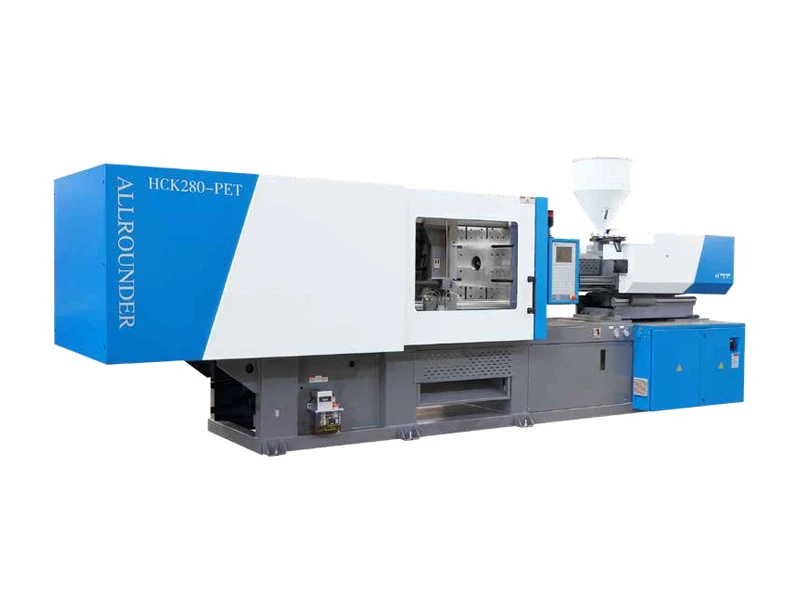
The cooling phase takes up the largest share of the coffee capsule injection molding cycle. For thin-wall coffee capsules, cooling time often accounts for more than 60% of total cycle time. Shortening cooling time directly raises hourly output.
Many factories focus only on clamping force and injection speed when buying a coffee capsule injection molding machine. They ignore cooling system design. After the machine arrives, the actual cycle time far exceeds the catalog data.
This article analyzes the composition of cooling time in coffee capsule injection molding. It provides practical optimization methods. The content targets technical managers and equipment procurement staff at coffee capsule manufacturing companies.
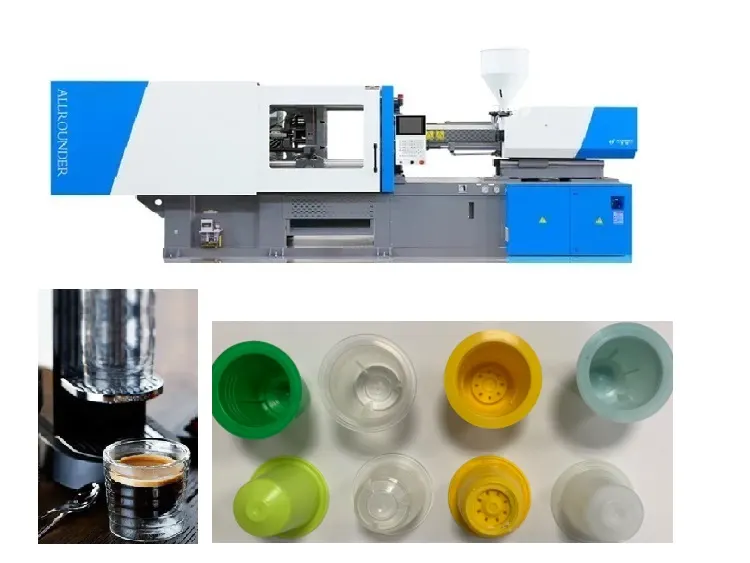
The Share of Cooling Time in the Coffee Capsule Molding Cycle
What is a coffee capsule injection molding machine?
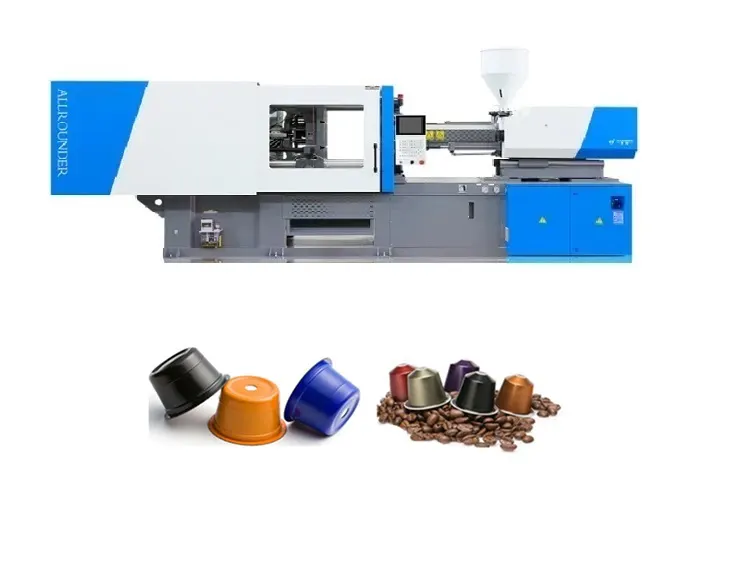
A coffee capsule injection molding machine produces plastic coffee capsules. The machine melts PP or PLA plastic, injects it into a precision mold, and cools it to form the capsule body. Clamping force usually ranges from 80 to 150 tonnes. Molds range from 4 to 32 cavities.
Cooling Characteristics of Thin-Wall Capsules
Coffee capsule wall thickness usually ranges from 0.4 to 0.65 mm. The cooling time of thin-wall parts is proportional to the square of wall thickness. When wall thickness halves, cooling time theoretically drops by three quarters.
But thin-wall cooling is not just about wall thickness. The melt begins cooling during filling. If fill time is too long, the melt solidifies before reaching the mold end, causing short shots. If fill time is too short, shear heat increases, which then requires longer cooling time.
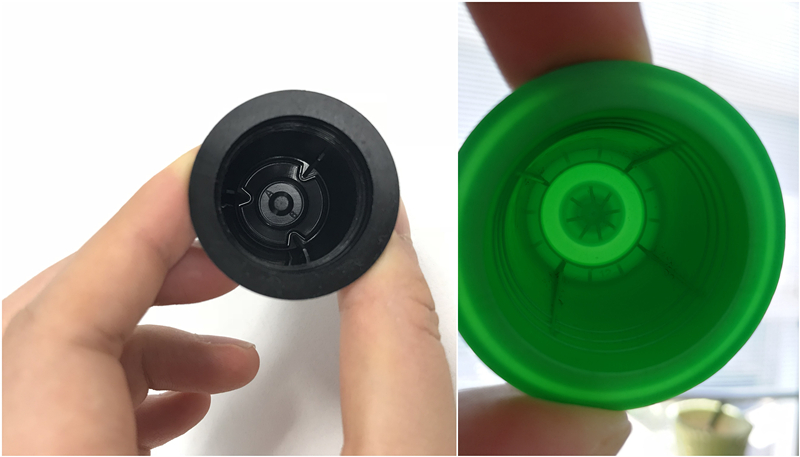
The Relationship Between Cooling Time and Cycle Time
A complete injection cycle includes injection, holding, cooling, mold opening, and part removal. The cooling phase starts when holding ends and ends when the mold opens.
Cooling time cannot be compressed independently. Insufficient cooling causes capsule deformation during demolding. Capsules exit the machine in a warm state with insufficient strength. Robot removal may cause wall dents or opening deformation.
Coffee capsule industry cases show that 32-cavity PP capsule molds can achieve cycle times of 6.5 to 7 seconds. Some supplier 32-cavity systems even reach 3.8 second cycles. This data comes from optimized mold cooling systems, not from simply increasing injection speed.
HAICHEN Coffee Capsule Machine Cooling Matching Capability
HAICHEN coffee capsule injection molding machine features multi-stage cooling time settings. Operators can control the cooling process in stages based on capsule wall thickness and material type. The HAICHEN 110-ton model achieves a stable 12-second cycle with PP/PLA material, 3.1 g part weight, 0.65 mm wall thickness, and an 8-cavity mold. Our servo-hydraulic system provides repeatable injection and holding control, which forms the basis for consistent cooling time.
Optimization Methods for Mold Cooling System Design
The Difference Between Conformal Cooling and Conventional Cooling
Conventional mold cooling uses straight drilled channels. Straight channels cannot follow the curved contour of the capsule. The capsule body has a curved shape. The bottom and side walls cool at different rates. The side wall cools faster than the bottom. The bottom remains soft during demolding.
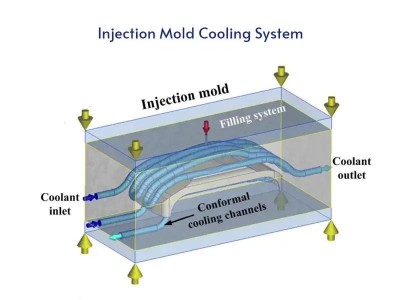
Conformal cooling uses 3D printing or SLM technology to create cooling channels. The channels curve along the capsule contour and stay at a uniform distance from the mold surface. This design cools all capsule areas simultaneously.
HRS Flow uses SLM-manufactured conformal cooling circuits for coffee capsule applications. The company provides such mold solutions for 16 to 32-cavity systems.
Cooling Water Flow Rate Matters More Than Water Temperature
O.C.S.A. found a key point when optimizing coffee capsule cooling. General Manager Marco Milan noted that for packaging parts, “cooling water volume is more important than its temperature”.
The O.C.S.A. initially used hoses to deliver cooling water. After switching to pipes, water flow increased and cycle time dropped immediately. Hoses were not durable enough for the fast rotary platen movements. Pipes solved this problem.
This experience shows: increasing cooling water flow rate is a direct way to shorten cooling time. Larger pipe diameters and fewer elbows can raise flow rate.
HAICHEN Mold Cooling Matching Support
HAICHEN supports customers in providing mold drawings for cooling system evaluation. We recommend cooling channel layouts based on capsule wall thickness distribution and surface contour. For multi-cavity molds, we help confirm cooling uniformity across cavities to avoid part weight variation caused by cooling differences.
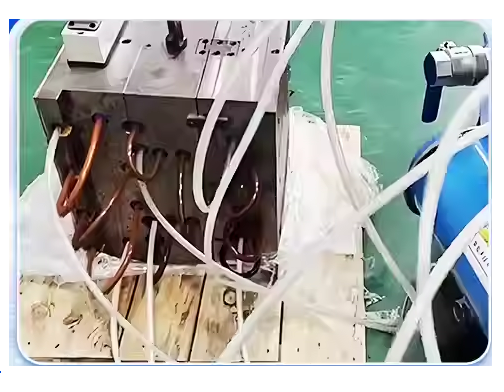
How Process Parameters Affect Cooling Efficiency
The Relationship Between Melt Temperature and Cooling Time
Higher melt temperature means more heat to remove. Cooling time increases as melt temperature rises.
The recommended melt temperature for PP coffee capsules is 200 to 250°C. Within this range, choose a lower temperature to reduce cooling load. But too low a temperature increases melt viscosity and requires higher injection pressure, which may cause incomplete filling.
PLA and compostable materials have narrower processing windows. The recommended melt temperature for PLA is 165 to 195°C. Temperature deviation causes material degradation or poor filling. Bio-Caps uses about 15°C cooling water for bioplastic capsules with a cooling time of only 0.9 seconds.
Balancing Holding Time and Cooling Time
Holding time counts toward total cycle time but partially overlaps with the cooling phase. After holding ends, the cooling phase continues.
Excessive holding time extends the cycle. Insufficient holding causes capsule shrinkage and dimensional deviation. For PP capsules, holding pressure should decrease gradually to avoid stress concentration near the gate.
Set cooling time so the capsule does not deform after demolding. Touch the capsule by hand. Warm but not hot is the right demolding temperature. The O.C.S.A. experience shows that capsules “come out only slightly warm to the touch,” which helps downstream handling.
HAICHEN Injection Machine Process Parameter Control
HAICHEN injection machines support multi-stage holding pressure settings. Operators can switch holding pressure by time or position. The PID temperature control system maintains each barrel zone within ±1°C of the set value. Stable temperature control reduces material flow variation, so cooling time can stay at a stable value without frequent adjustment.
| HCK110 PLASTIC INJECTION MOLDING MACHINE | ||||
| INJECTION UNIT | ||||
| ITEM | UNIT | A | B | C |
| INJECTION UNIT | ||||
| Screw diameter | mm | 32 | 36 | 40 |
| Screw L/D ratio | L/D | 24.7 | 22.0 | 19.8 |
| Shot volume(theoretical) | cm3 | 145 | 183 | 226 |
| Injiection weight(ps) | g | 132 | 167 | 206 |
| oz | 4.7 | 5.9 | 7.3 | |
| Injection pressure | Bar | 2393 | 1890 | 1531 |
| Injection rate | cm3/s | 94 | 118 | 146 |
| Plasticizing capacity | g/s | 8 | 12 | 19 |
| Screw speed (Max.) | r/min | 250 | ||
| CLAMPING UNIT | ||||
| Clamping force | Kn | 1100 | ||
| Space between tie bars(W×H) | mm | 410*360 | ||
| Platens size | mm | 595*545 | ||
| Opening stroke | mm | 350 | ||
| Min.Mold height | mm | 170 | ||
| Max.Mold height | mm | 420 | ||
| Distance between platens(daylight) | mm | 770 | ||
| Ejector stroke | mm | 110 | ||
| Ejector force | Kn | 40 | ||
| OTHERS | ||||
| Systerm pressure | Bar | 175 | ||
| Pump motor | Kw | 15 | ||
| Heating power | Kw | 9.4 | ||
| Oiltank cubage | L | 160 | ||
| Machine dimension(L×W×H) | m | 4.3*1.2*1.6 | ||
| Machine weight | t | 3.6 | ||
Cooling Time Differences Across Materials
What is the typical cooling time for coffee capsule injection molding?
Cooling time depends on wall thickness and material. A 32-cavity PP capsule mold has a cycle time of 6.5 to 7 seconds, with cooling time of about 3 to 4 seconds. Bioplastic capsules can cool in 0.9 seconds with 90 to 100 millisecond injection times. Cooling water temperature usually stays between 15 and 40°C.
Cooling Characteristics of PP Capsules
PP is the mainstream material for coffee capsules. PP has a moderate crystallization rate. PP gradually crystallizes during cooling. Part strength increases as crystallinity rises.
PP capsule cooling time depends on wall thickness and mold temperature. Typical mold temperature is 20 to 40°C. Cooling water temperature can be lower than mold temperature, but too low causes surface condensation.
Cooling Challenges of PLA and Bioplastics
PLA and bioplastics cool differently from PP. These materials have fast crystallization rates and narrow processing windows. Bio-Caps Chief Technical Officer Norbert Kuhl notes that bioplastics “harden extremely quickly” and require injection times of 90 to 100 milliseconds to complete filling.
Fast crystallization means cooling time can be shortened, but temperature control requirements are higher. Cooling water temperature needs to stay stable at around 15°C. Fluctuation causes inconsistent capsule dimensions.
What is conformal cooling?
Conformal cooling is a mold cooling channel design method. Cooling channels curve along the product contour and stay at a uniform distance from the mold surface. This design cools all product areas simultaneously, reducing cooling time and deformation. Conformal cooling channels are made through 3D printing or SLM technology.
HAICHEN Cooling Adaptation for Multiple Materials
HAICHEN coffee capsule injection machines support PP, PLA, and compostable materials. We provide cooling parameter recommendations for different materials. The servo-hydraulic system provides repeatable injection speed profiles that work with the mold cooling system to achieve stable cycle times. HAICHEN engineers help set cooling time and holding parameters based on the customer’s material and mold.
Cycle Time Calculation and Output Improvement
Calculating Cycle Time from Cooling Time
Cycle time = injection time + holding time + cooling time + mold opening time + part removal time.
Take a PP capsule as an example: injection 0.3 sec + holding 2 sec + cooling 5 sec + mold opening 0.5 sec + removal 1.5 sec = 9.3 sec.
Cooling time accounts for 54% of total cycle. If cooling time drops from 5 seconds to 3 seconds, total cycle falls to 7.3 seconds, and output rises by 27%.
In the HAICHEN coffee capsule case, an 8-cavity mold, 3.1 g part, 0.65 mm wall thickness achieves a 12-second cycle. This cycle includes cooling and removal time. By optimizing cooling water flow and mold cooling channels, this cycle still has room for compression.
The Real Effect of Output Improvement
Take a 32-cavity mold as an example. At a 7-second cycle, hourly output is about 16,457 pieces. At a 6-second cycle, hourly output is about 19,200 pieces. This adds 2,743 pieces per hour.
With 20 hours per day, daily output rises from 329,143 pieces to 384,000 pieces. Monthly output (30 days) rises from 9.87 million to 11.52 million pieces.
For factories producing tens of millions of pieces per month, a 1-second cycle difference directly affects millions of pieces in output.
How do I shorten the cycle time for coffee capsule injection molding?
The main way to shorten cycle time is optimizing cooling. Increasing cooling water flow rate is more effective than lowering water temperature. Using conformal cooling channels cools the curved capsule wall evenly. Shortening injection time reduces heat in the mold. Holding time should be as short as possible while maintaining dimensional stability.
HAICHEN Machine Support for Cycle Stability
HAICHEN injection machines feature servo-hydraulic systems. The servo motor reduces speed or stops during the cooling phase, cutting unnecessary energy use. Injection speed and pressure repeatability is high, so cycle time variation between batches is small. The machine supports robot and conveyor integration, keeping part removal time at a stable set value.
HAICHEN has over ten years of injection machine manufacturing experience. Our 110-ton model achieves a stable 12-second cycle with PP/PLA material, 3.1 g part weight, 0.65 mm wall thickness, and an 8-cavity mold. Furthermore, We provide cooling system matching advice and process parameter optimization support.
Contact HAICHEN for a cooling optimization solution for your coffee capsule injection molding. Send your capsule specifications and material type. We will help you match the right configuration.