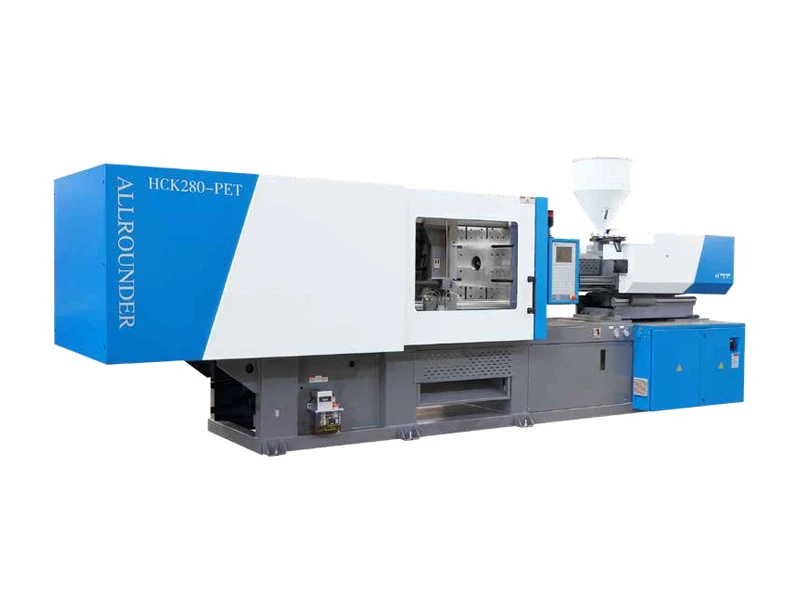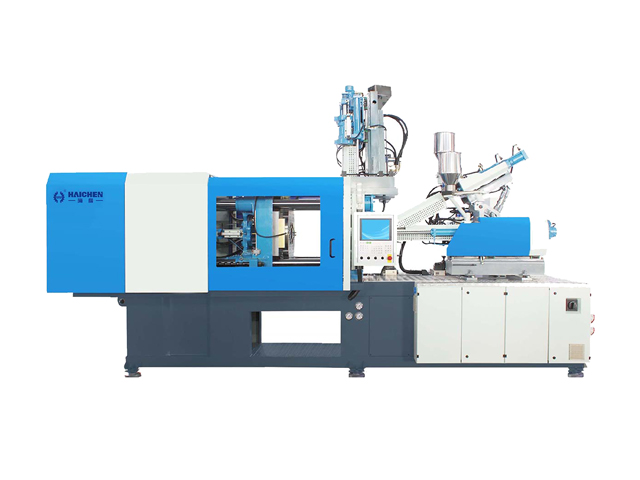
A warning triangle is a safety product required in every car. The European ECE R27 standard requires all new cars to carry one. China’s GB 19151 standard has the same requirement. Global car ownership keeps growing, and aftermarket replacement demand is stable.
If you are considering entering the warning triangle manufacturing business, the first thing you need to understand is the equipment. The injection molding machine is the core equipment for producing warning triangle plastic parts.
Many first-time investors know little about injection molding machines. They are not sure what tonnage they need, what the production process includes, or how long the payback period is. This article answers these questions in simple language.
This article targets small and medium investors and entrepreneurs. It helps you understand the basics of an emergency triangles injection molding machine, the production process, and how to choose the right machine.
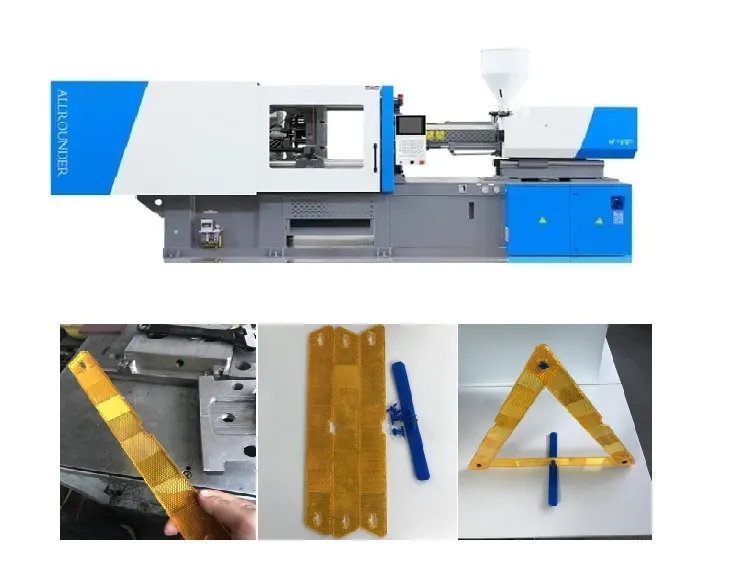
What Is an Emergency Triangles Injection Molding Machine?
An emergency triangles injection molding machine produces plastic parts for car warning triangles. The machine melts PMMA and ABS plastic, injects it into a precision mold, and cools it to form the reflective panel, frame, and base. Reflective panel wall thickness is usually 1.0 to 2.0 mm. Mold temperature must stay above 80°C.
How an Injection Molding Machine Works?
The injection molding process can be understood in three simple steps.
Step one: plastic pellets are heated and melted. Pellets enter the heated barrel from the hopper. A screw rotates and pushes the pellets forward. The pellets gradually melt and become a thick liquid as they move.
Step two: the melted plastic is injected into the mold. The screw pushes forward and presses the molten plastic into the closed mold cavity. The mold has an empty space shaped like the warning triangle part.
Step three: the plastic cools and hardens, then releases from the mold. Cooling channels inside the mold remove heat. After the plastic hardens, the mold opens and the part is pushed out.
The whole process runs automatically and repeats every few dozen seconds.
What Plastic Parts Make Up a Warning Triangle?
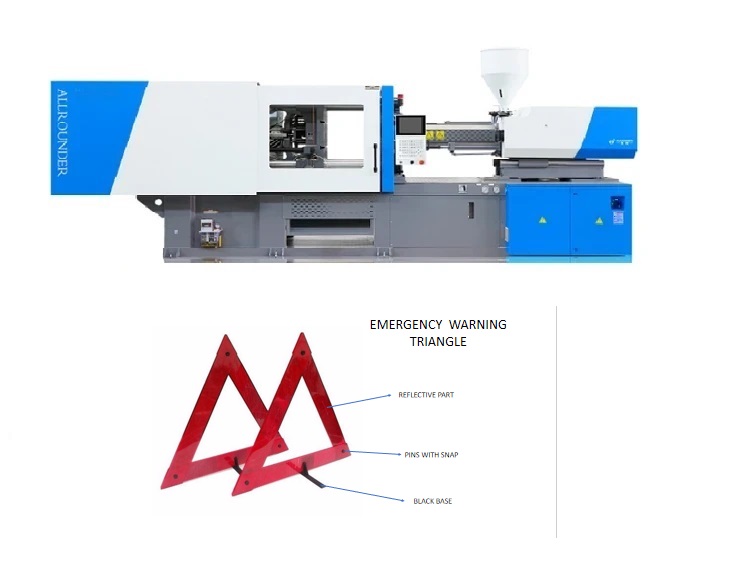
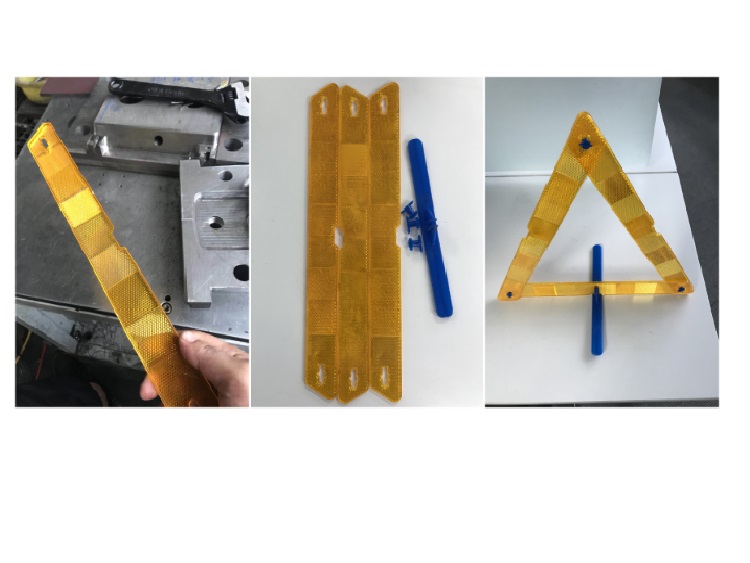
A folding car warning triangle contains several plastic parts.
The reflective panel is the core part. It uses PMMA material with a micro-prism structure on the surface. The micro-prisms reflect headlights so other drivers can see your car. The reflective panel wall thickness is usually 1.0 to 2.0 mm.
The frame uses ABS material. The frame supports the reflective panel and has folding hinges. The hinges let the warning triangle fold for storage.
The base connects to the frame and keeps the warning triangle standing. The base can use plastic or metal material.
HAICHEN Machine Positioning for Warning Triangle Production
HAICHEN has over ten years of injection machine manufacturing experience. We offer injection machines from 80 to 300 tons. This range covers the production needs for warning triangle frames and reflective panels. The HAICHEN technical team recommends the right machine based on your mold drawings and product specifications.
Main Steps in Warning Triangle Injection Molding Production
Step 1 — Material Drying
Plastic pellets absorb moisture from the air. Moisture turns into steam during injection and causes bubbles and silver streaks on the product.
PMMA drying temperature is 80 to 100°C with a drying time of 3 to 4 hours. ABS drying temperature is around 80°C with a drying time of 2 to 3 hours.
Insufficiently dried PMMA produces bubbles during injection. Bubbles on the reflective panel affect reflection performance.
Step 2 — Injection Molding
Reflective panel molding has three key control points.
Mold temperature must stay above 80°C. Too low a mold temperature causes flow marks on the reflective panel surface. Flow marks reduce reflection efficiency.
Cold material cannot be used during injection. Cold material means plastic that is not hot enough. Cold material scratches the reflective surface. Scratches cannot be repaired, and the part must be scrapped.
Regrind material cannot be used for reflective panel production. The molecular chains in recycled material have partly degraded. Reflection performance cannot be guaranteed.
Frame molding has different requirements. The frame needs stable clamping force to ensure folding hinge dimensional precision. Hinge dimensional deviation causes folding difficulty or sticking.
Step 3 — Cooling and Demolding
The part cools and hardens inside the mold before release. The reflective panel needs careful handling during demolding to avoid scratches from robots or ejector pins.
After demolding, the part needs gate trimming and deburring. The reflective panel surface cannot have oil or fingerprints.
Step 4 — Assembly and Inspection
The assembly step combines the reflective panel, frame, and base. Some products use ultrasonic welding. Others use snap-fit assembly.
Inspection items include: reflection value testing, folding function check, and appearance check. Reflection value is measured with a special instrument and must meet ECE R27 requirements.
HAICHEN Machine Support in the Production Process
HAICHEN injection machines feature a PID temperature control system that maintains each barrel zone within ±1°C of the set value. Stable temperature control reduces material flow variation, which helps maintain reflective panel and frame dimensional consistency. HAICHEN supports removal robot integration to reduce manual contact with the reflective panel and lower scratch risk.
How to Choose the Right Machine for Your Production Scale?
Small Batch Production (Startup Stage)
If you are just entering warning triangle production, start small.
Recommended setup: 2-cavity or 4-cavity reflective panel mold, 80 to 120 ton injection machine. Daily output is about 2,000 to 5,000 pieces.
This setup has lower investment. The injection machine price is about $15,000 to $25,000. It suits sampling and trial production, and it suits supplying the local market.
Medium Batch Production (Stable Supply)
When monthly orders stay steady at 50,000 to 200,000 pieces, upgrade to a medium setup.
Recommended setup: 8-cavity reflective panel mold, 150 to 200 ton injection machine. Daily output is about 15,000 to 25,000 pieces.
This setup suits supplying regional markets or auto parts distributors. Equipment investment is about $25,000 to $40,000.
Large Batch Production (Scaled Operation)
When daily orders exceed 1,000 sets, you need a large batch setup.
Recommended setup: 16-cavity or more mold, 250 ton or higher injection machine with removal robot. Daily output can reach 50,000 pieces or more.
Industry reference: Yuyao Jiada Plastic has three warning triangle production lines with daily output of 30,000 sets and annual capacity of 10 million sets.
What tonnage should I choose for a warning triangle injection molding machine?
Small batch production uses 80 to 120 ton machines with 4-cavity molds. Medium batch production uses 150 to 200 ton machines with 8-cavity molds. Large batch production uses 250 ton or higher machines with 16-cavity or more molds and removal robots. Reflective panel production usually uses 150 to 250 ton machines.
HAICHEN Machine Adaptation for Different Production Scales
HAICHEN offers a complete machine range from 80 to 300 tons. For small batch production, choose the HCK80 or HCK110 model. For medium batch production, we recommend the HCK150 or HCK200 model. For large batch production, choose HCK250 or higher with robot and conveyor integration. The HAICHEN servo-hydraulic system saves 30% to 60% electricity compared to standard hydraulic machines. Factories running long hours can significantly reduce electricity costs.
| HCK230 PLASTIC INJECTION MOLDING MACHINE | ||||
| INJECTION UNIT | ||||
| ITEM | UNIT | A | B | C |
| INJECTION UNIT | ||||
| Screw diameter | mm | 45 | 50 | 55 |
| Screw L/D ratio | L/D | 24.4 | 22.0 | 20.0 |
| Shot volume(theoretical) | cm3 | 398 | 491 | 594 |
| Injiection weight(ps) | g | 362 | 447 | 541 |
| oz | 12.8 | 15.8 | 19.1 | |
| Injection pressure | Bar | 2299 | 1862 | 1539 |
| Injection rate | cm3/s | 192 | 237 | 286 |
| Plasticizing capacity | g/s | 23 | 27 | 33 |
| Screw speed (Max.) | r/min | 200 | ||
| CLAMPING UNIT | ||||
| Clamping force | Kn | 2300 | ||
| Space between tie bars(W×H) | mm | 570×520 | ||
| Platens size | mm | 820×770 | ||
| Opening stroke | mm | 520 | ||
| Min.Mold height | mm | 220 | ||
| Max.Mold height | mm | 570 | ||
| Distance between platens(daylight) | mm | 1090 | ||
| Ejector stroke | mm | 150 | ||
| Ejector force | Kn | 80 | ||
| OTHERS | ||||
| Systerm pressure | Bar | 175 | ||
| Pump motor | Kw | 30 | ||
| Heating power | Kw | 16.4 | ||
| Oiltank cubage | L | 200 | ||
| Machine dimension(L×W×H) | m | 5.8×1.4×1.9 | ||
| Machine weight | t | 7.3 | ||
Investment Cost and Return Calculation
Equipment Investment List
Warning triangle production equipment investment includes the following items.
The injection machine is the main investment. A 150-ton servo injection machine costs about $15,000 to $25,000. Mold cost: reflective panel mold is about $3,000 to $8,000. Frame mold is about $2,000 to $5,000. Auxiliary equipment: dryer is about $1,000 to $3,000. Removal robot is about $2,000 to $5,000.
Total investment range is about $23,000 to $46,000.
Production Cost Structure
The production cost per warning triangle set includes: plastic material cost (PMMA and ABS), electricity, labor, mold depreciation, and packaging.
Plastic material is the main cost. PMMA and ABS price changes affect unit cost. Electricity depends on machine energy consumption. Servo models save 30% to 60% electricity compared to standard models.
Simple Return Calculation
Take the medium batch setup as an example. An 8-cavity reflective panel mold has daily output of about 23,000 pieces. If one warning triangle set contains one reflective panel and one frame, daily output corresponds to about 2,880 sets.
Market wholesale price reference: an ECE R27 certified folding warning triangle costs about $2.31 per piece.
Assume profit per set is $0.05. Daily profit is about $144. Monthly profit is about $4,320. After electricity, labor, and material loss, net return is about $2,500 to $3,000 per month.
Equipment payback period is about 8 to 12 months. Actual payback depends on order volume and automation level.
HAICHEN Machine ROI Advantage
HAICHEN servo-hydraulic injection machines save 30% to 60% electricity compared to standard hydraulic machines. For a 24-hour production line, annual electricity savings can reach several thousand dollars. HAICHEN provides full warranty and remote debugging support to reduce downtime loss. Our machines support removal robot integration to lower labor costs.
Warning triangle injection molding is a business with stable demand. Mandatory equipment laws guarantee the market base. Aftermarket replacement provides continuous orders.
Warning triangle production requires attention to three points. Reflective panels need high mold temperature and high injection speed. Cold material and regrind are forbidden. Frames need stable clamping force to ensure folding hinge dimensional precision. PMMA and ABS have different drying and temperature control requirements.
Choose your injection machine based on production scale. For startup, use 80 to 120 ton machines. For stable supply, use 150 to 200 ton machines. For scaled operation, use 250 ton or higher machines with automation systems.
We provide selection consulting and sample testing for warning triangle injection machines. Our servo energy-saving system lowers operating costs. The temperature control system meets the precision injection requirements for reflective panels. Please send your product specifications and output goals. We will help you match the right warning triangle machine.