Two main process routes exist for plastic food container production: injection molding and thermoforming. Both routes can make acceptable products. But equipment investment, mold cost, product structure, and unit cost differ greatly. Choosing the wrong route makes later machine selection meaningless.
This article compares the two processes in food container production. It helps buyers make the right process decision before selecting equipment.
How Do Injection Molding and Thermoforming Differ in Food Container Production?
Injection molding injects molten plastic into a closed mold cavity under high pressure. The part cools into a complete three-dimensional structure. Thermoforming heats a plastic sheet until soft, then pulls it onto a mold surface with vacuum or pressure. Injection suits containers with snaps, hinges, and precise seal surfaces. Thermoforming suits large, shallow, thin-wall containers.
What is the injection molding process path?
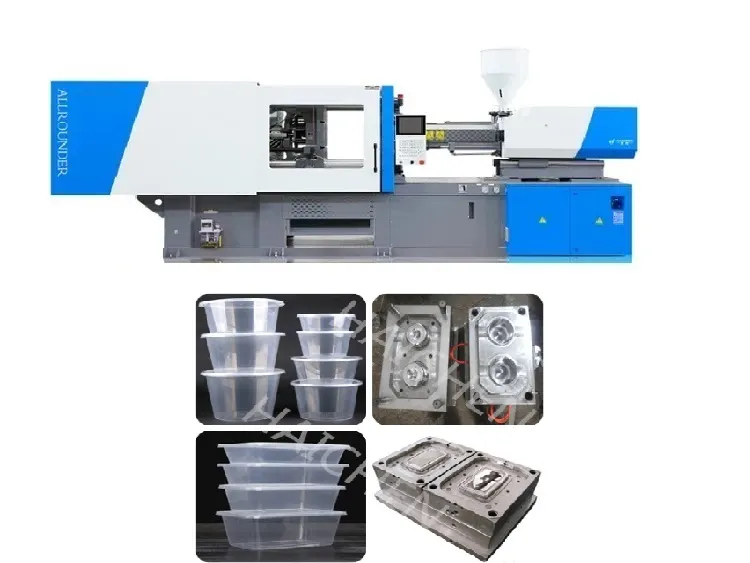
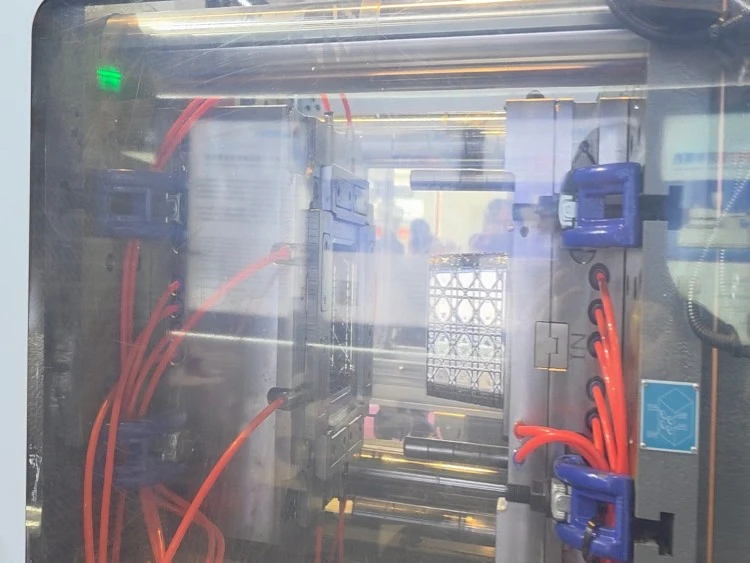
Injection molding uses pellet raw material. Plastic melts in the barrel, and the screw injects the melt into the mold. The mold closes, holds pressure, cools, opens, and ejects. One cycle produces one or more parts. Wall thickness comes from the mold cavity gap. It can range from 0.5 mm to 4 mm. Injection molding can form snaps, hinges, ribs, and seal rims in one shot. Parts usually need only gate trimming after demolding. No secondary die cutting is required.
What is the thermoforming process path?
Thermoforming uses plastic sheet. The sheet heats to softening temperature, then pulls onto the mold surface. After cooling, the sheet sets and a die cuts out individual parts. Thermoformed parts are usually shallow, large, and thin-wall. Wall thickness depends on the original sheet thickness and the stretch ratio. Thermoforming cannot directly form complex snaps or hinges. Parts need edge trimming after demolding, and the trim creates scrap.
How do Haichen food container machines fit the injection process?
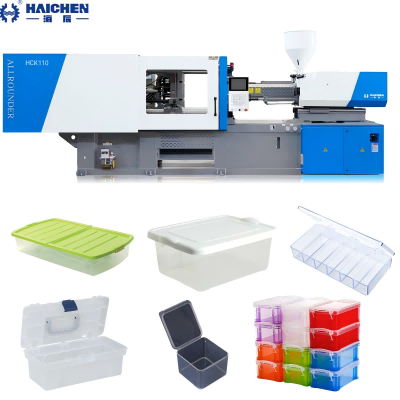
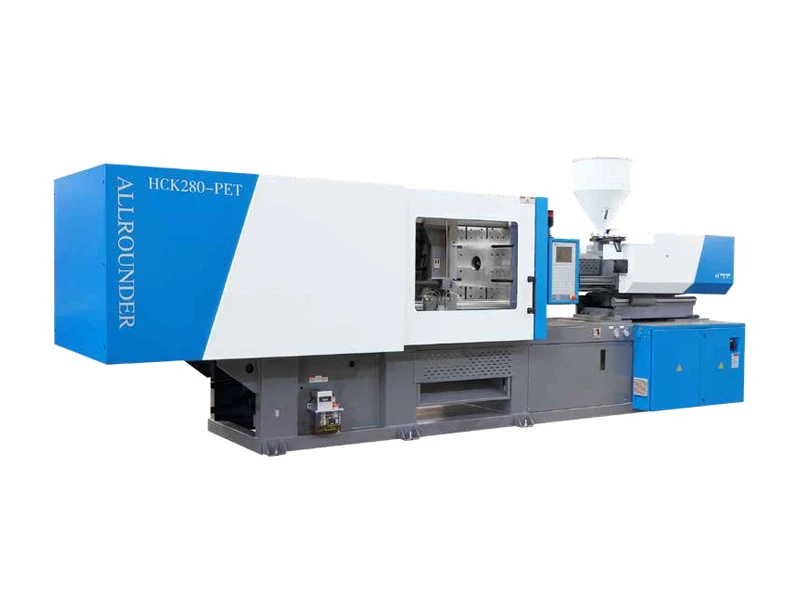
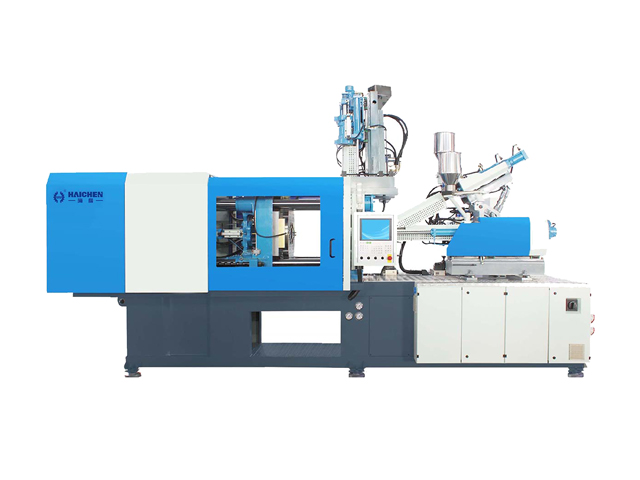
Haichen builds thin-wall food container injection machines with clamping force from 2,300 kN to 4,100 kN. The HCS250-H uses a 45 mm screw with a 300 g/s injection rate and 361 g injection weight. The HCK250-H provides 2,500 kN clamping force and 354 g/s injection rate. The 410-ton servo model provides 4,100 kN clamping force and 770 mm × 720 mm tie bar spacing. Haichen machines use a servo-hydraulic system with multi-stage holding pressure. This suits fast filling and seal rim molding for thin-wall food containers.
Takeout food containers usually target thin walls, fast cycles, and low cost. Thermoforming has lower unit cost for large, shallow takeout containers. Injection molding has the advantage when the container needs a precise seal surface, leak-proof snaps, or stacking ribs. The choice depends on structural complexity and leak requirements.
How do thin-wall and speed needs affect process choice?
Takeout container wall thickness usually ranges from 0.5 mm to 1.0 mm. Thermoforming uses 0.5 mm to 1.2 mm sheet, which thins during stretching and suits shallow containers. Thin-wall injection molding needs high injection speed. Industry cases show injection speeds above 300 mm/s with cycle times of 1.8 to 3 seconds. Injection molding controls the transition between thick and thin areas more precisely. Thermoforming is faster and cheaper per part on very large, shallow containers.
How do leak prevention and stacking needs affect process choice?
Takeout containers need leak prevention and stacking stability. Leak prevention depends on seal surface flatness and lid fit. Injection molding can form a precise seal rim and snap structure in one shot. Lid-to-body fit tolerance is easier to control. Thermoformed seal surfaces come from sheet die cutting. Edge flatness depends on cutting precision. Stacking stability depends on stacking ribs. Injection molding can form ribs. Thermoforming usually relies on wall draft and stacking bosses.
How do Haichen food container machines support takeout container production?
Haichen HCS250-H and HCK250-H models are designed for thin-wall takeout containers. The servo-hydraulic system provides fast filling during injection and stable pressure during holding. The PID temperature control system holds each barrel zone within ±1°C, reducing melt flow variation. Haichen supports multi-cavity and family molds. Takeout container lids and bodies can run in the same mold. The machines support EUROMAP robot interfaces for automatic part removal.
Which Process Better Suits Reusable Food Storage Containers?
Reusable food storage containers usually have thicker walls, hinges, snaps, and gasket grooves. Injection molding forms these features in one shot. Thermoforming cannot directly produce them. For containers that need repeated opening and closing with reliable sealing, injection molding is the better process route.
What structural needs do reusable containers have?
Reusable food storage containers usually have wall thickness from 1.5 mm to 3.0 mm. Containers need one-piece hinges or separate snaps. Lids need gasket grooves or press-fit edges. Bodies need ribs to resist stacking pressure. These features require injection molding. Thermoforming can only make shallow bodies and simple lids. It cannot form hinges and precision snaps. Reusable containers also need a longer service life than single-use takeout boxes.
How do seal reliability and heat resistance affect process choice?
Reusable containers need repeated sealing and must withstand dishwasher temperatures. Injection molded seal surfaces are easier to control for flatness. Injection molding can use heat-resistant PP grades that hold dimensions. Thermoformed sheet deforms after repeated heating and cooling, and seal surface flatness drops. Injection molded containers also have better wall thickness uniformity. Uniform thickness means more stable heat resistance and seal reliability.
How do Haichen food container machines support reusable container production?
Haichen machines support thicker-wall container molding. The HCS250-H provides 2,500 kN clamping force for single-cavity or multi-cavity reusable container molds. The servo-hydraulic system holds stable pressure across multi-stage holding, reducing shrinkage in thick sections. Haichen recommends dedicated cooling channels at the seal edge when reviewing mold designs. Haichen also supplies dryers to keep PP moisture below 0.02%, reducing flatness deviation caused by moisture.
What Are the Mold Cost and ROI Differences Between Injection Molding and Thermoforming?
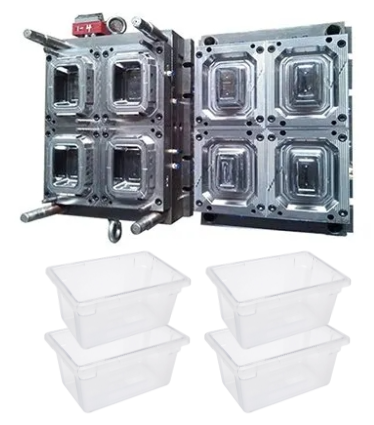
Injection molds cost more than thermoforming molds. Injection molds need cavities, cores, hot runners, and ejector systems. Thermoforming molds need only a male or female form, so cost is lower. Injection machine investment is also higher. The injection advantage is lower unit cost at high volume and functional features that remove secondary assembly steps. ROI depends on order volume and structural complexity.
How large is the mold cost difference?
Injection molds need machined cavities and cores, cooling channels, gate systems, and ejector mechanisms. Multi-cavity injection molds cost more to machine. Thermoforming molds are simpler. They usually need one forming mold and one trim die. Thermoforming mold lead time is also shorter. For simple shallow takeout containers, thermoforming has a clear initial investment advantage. For containers with snaps and hinges, the injection mold costs more but removes secondary assembly molds and steps.
How do machine investment and unit cost compare?
Injection machines cost more than thermoforming machines. An injection machine needs a clamping unit, injection unit, and hydraulic system. A thermoforming machine is simpler. On unit cost, injection molding uses material efficiently. Gates and runners can be reground. Thermoforming creates trim scrap. Injection unit cost drops as cavity count and automation rise. Thermoforming has lower unit cost on large shallow products. For high-volume functional containers, injection molding has the total cost advantage.
How do Haichen food container machines help shorten payback?
Haichen servo-hydraulic injection machines save 30% to 60% electricity compared to standard hydraulic machines. For a 24-hour takeout container line, annual electricity savings can reach several thousand dollars. Haichen machines support multi-cavity molds and automatic part removal, reducing labor cost. Haichen provides full warranty and remote debugging support to reduce downtime loss. The Haichen technical team recommends the right machine based on order volume and product structure, avoiding over-investment or capacity shortage.
How Should a Buyer Choose the Process Route Based on Product Mix?
A buyer should first list the product mix: single-use takeout containers, reusable storage containers, meal prep containers. Simple, shallow, high-volume products can start with thermoforming. Products with snaps, hinges, precise seal surfaces, or repeated opening and closing should use injection molding. A mixed product mix can run both processes or choose injection molding to cover all products.
How to decide by product structural complexity?
Structural complexity is the first criterion. If the container needs only a basic body and lid, thermoforming can meet the need. If the container needs snaps, hinges, gasket grooves, ribs, or precise stacking features, injection molding is the only choice. If a takeout container needs leak prevention and stacking stability, injection molding gives more reliable seal surface control. Reusable containers and meal prep containers almost always choose injection molding. A buyer should draw the product structure, mark the functional features, and then judge the process route.
How to decide by order volume and capacity planning?
Order volume determines payback speed. Thermoforming has lower initial investment and suits small to medium batches with frequent product changes. Injection molding has higher initial investment, but multi-cavity molds and automation lower unit cost at high volume. When order volume stays at a high level, injection molding has a shorter payback period. A buyer needs to calculate unit cost under each process at their own order volume. This includes material, electricity, labor, and mold depreciation.
How does Haichen help buyers decide process route and machine model?
Haichen reviews the customer’s product structure drawings, order volume, and mold plan before recommending a machine. Haichen offers a thin-wall food container injection machine range from 2,300 kN to 4,100 kN. This covers takeout containers, reusable containers, and meal prep containers. The Haichen technical team compares unit cost between injection molding and thermoforming to help the buyer judge the process route. For buyers who choose injection molding, Haichen recommends clamping force, screw size, and automation configuration based on the product mix.
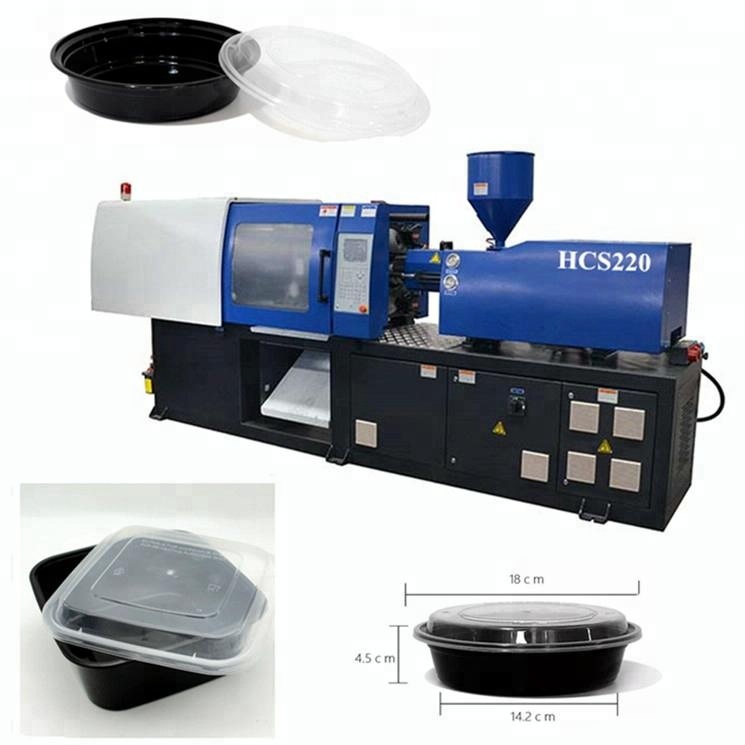
Haichen builds thin-wall food container injection machines with clamping force from 2,300 kN to 4,100 kN. The HCS250-H, HCK250-H, and 410-ton servo model cover takeout containers, reusable containers, and meal prep containers. Haichen reviews product structure drawings, order volume, and mold plans before recommending a machine. The servo-hydraulic system and PID temperature control support stable molding.
Contact Haichen for food container process route and injection machine selection advice. Send your product structure drawings, target material, and order volume. We will help you judge the process route and match the right machine.