
Ballpoint Pen Injection Molding Machine Selection: Tonnage, Shot Size, and Drive System Guide. Ballpoint pen manufacturing requires injection molding machines that can produce small, thin-wall parts at high speed with consistent quality. Pen barrels, caps, and refill casings typically weigh 2–8 grams each, and mold cavity counts range from 8 to 64. Choosing the wrong machine leads to short shots, flash, warped parts, and unnecessary energy costs.
To choose a ballpoint pen injection molding machine, calculate required clamping force from the mold’s projected area (typically 3–5 tons per cm² for pen parts), match shot size so total part weight is 15–80% of machine capacity, and verify tie-bar spacing and mold height fit. For pen production, 110–180 ton machines with 30–45mm screw diameters are most common.
This guide covers the key parameters, calculation formulas, and selection criteria for ballpoint pen injection molding machines, including tonnage, shot size, screw design, drive system, and energy cost analysis.
The ballpoint pen market continues to grow steadily. Schools, offices, and promotional product companies all need pens. Manufacturers must produce high-quality pens at competitive costs to stay in business.
Choosing the right plastic ballpoint pen injection molding machine affects product quality, production speed, and operating costs. Many buyers find the technical specifications confusing. They may select the wrong equipment and face production problems later.
This guide explains the key parameters for selecting a ballpoint pen injection molding making machine. It also provides practical purchasing advice for pen manufacturers.
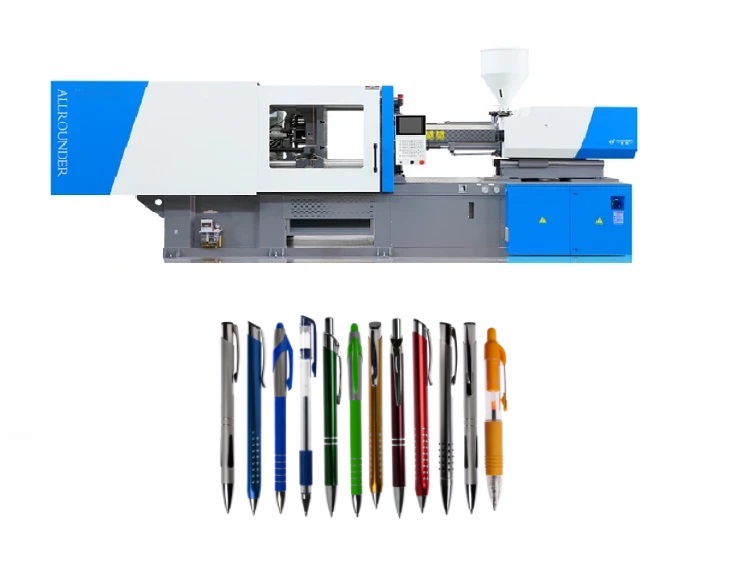
Understanding Ballpoint Pen Production Requirements
What is a ball point pen injection molding machine?
A ballpoint pen injection making molding machine is a device that produces plastic pen parts like barrels, caps, and clips. The machine melts plastic pellets, injects the molten plastic into a mold, and cools the material to form
solid components. These machines process materials like PP, PE, ABS, and PC to produce all plastic parts for pens.
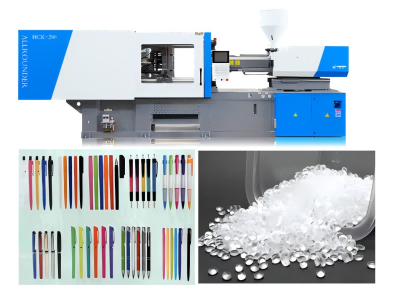
What is the typical production process for ballpoint pens?
The ballpoint pen production process has five main stages. Material preparation involves drying the plastic pellets to remove moisture. Injection molding produces the pen parts in the machine. Cooling solidifies the parts in the mold. Ejection removes the finished parts. Assembly combines the parts with the ink refill to complete the plastic ballpoint pens.
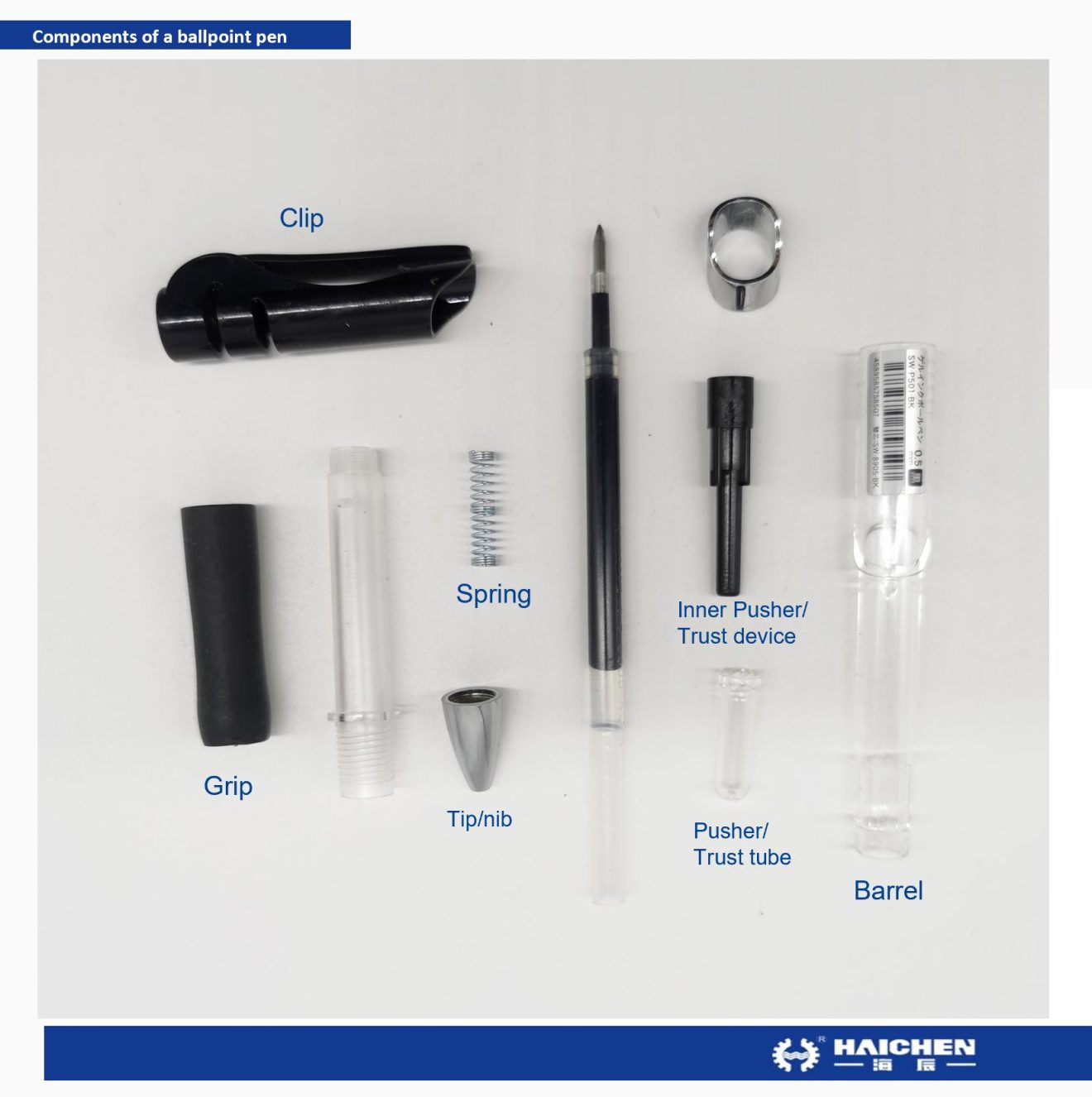
Ballpoint Pen Components and Material Selection
A ballpoint pen has several plastic parts. The main components include the pen barrel, pen cap, pen clip, and internal mechanical parts. Each part has different material requirements.
Pen barrels use PP or PE plastic. These materials are affordable and flexible. They resist breaking during normal use. PP works well for pens that need good elasticity.
Pen clips and internal parts need more precision and durability. Manufacturers use ABS or PC for these components. These engineering plastics hold tight dimensions and withstand repeated use.
The material choice affects your machine selection. Different plastics have different processing temperatures and flow characteristics. Make sure your ballpoint pens injection molding machine can handle your target materials.
Production Volume and Cavity Count
Production volume determines the mold cavity count you need. Pen parts are small. A single mold can produce 8 to 48 parts per cycle. Higher cavity counts increase output but require larger machines.
For small production runs, 8 to 16 cavity molds work well. For high-volume production, 32 to 48 cavity molds are more efficient. Consider your sales volume when selecting cavity count.
More cavities need higher clamping force and larger injection capacity. A 48-cavity mold needs a larger machine than an 8-cavity mold. HAICHEN provides machine options for different production scales. Our HCE120 model supports 48-cavity molds for high-volume pen production.
What Are the Key Parameters for Selecting a Ballpoint Pen Injection Molding Machine?
The five critical parameters are clamping force (tonnage), shot size (injection weight), tie-bar spacing and platen size, mold height range and opening stroke, and drive system type. Each parameter must be matched to your pen part weight, mold dimensions, material, and target output.
efore comparing machine models, collect the data that directly affects selection:
| Parameter | Why It Matters | Typical Value for Pen Molding |
|---|---|---|
| Part weight | Determines shot size | 2–8 g per barrel/cap |
| Projected area | Calculates clamp force | Varies by mold layout |
| Wall thickness | Affects filling pressure | 0.8–1.5 mm |
| Material | Impacts viscosity, drying, screw design | ABS, PS, PP, PC |
| Number of cavities | Increases total shot weight | 8–64 cavities |
| Mold dimensions | Must fit platen and tie bars | Depends on cavity count |
| Target output | Determines cycle time and automation | 5,000–30,000 pcs/h |
A machine that works for large household products will not be suitable for thin-wall pen parts. The application should guide the machine, not the other way around
How Do You Calculate the Required Clamping Force for Pen Molding?
Required clamping force = total projected area × material factor × safety factor. For pen parts (ABS/PS), material factor is typically 3–5 tons per cm² of projected area. Add 10–20% safety margin. A 24-cavity pen cap mold with 4 cm² projected area per cavity requires approximately 288–576 tons.
Clamping force holds the mold closed during injection. If the force is too low, the mold opens slightly. This creates flash on the pen parts. Flash is thin plastic that leaks out between mold halves. Removing flash adds labor costs and reduces product quality.
For standard pen production, clamping force typically ranges from 110 to 180 tons (1100 to 1800 kN). The exact requirement depends on the mold design and part size. A single-cavity pen barrel mold needs less clamping force than a 32-cavity mold.
Consider future production needs when selecting clamping force. A machine with extra capacity allows you to add more cavities later. The HAICHEN HCK150 model provides 1500 kN clamping force. This covers most pen production applications .
Injection Weight and Shot Size
Injection weight is the amount of plastic the machine can inject per cycle. Pen parts are small. Each part weighs only a few grams. The total shot weight includes all parts in the mold plus the runner system.
For an 8-cavity pen barrel mold, the total shot weight is about 20-30 grams. A 32-cavity mold needs 80-120 grams per shot. Check the machine’s injection weight specification against your mold requirements.
Choose a machine with injection capacity slightly above your current needs. Operating near maximum capacity reduces consistency. Operating well below capacity wastes energy.
Screw Design and Material Compatibility
The screw melts and mixes the plastic before injection. Different plastics need different screw designs. Standard screws may not work well with all materials.
PP and PE flow easily and need general-purpose screws. ABS and PC need screws with better mixing capability. The screw L/D ratio (length to diameter) affects melting quality. A higher L/D ratio provides better plasticizing.
HAICHEN provides screw options for different pen materials. Our machines are designed for the specific requirements of pen production. This ensures consistent melt quality and smooth injection.
Temperature Control Accuracy
Temperature control is critical for pen production. Different materials need different processing temperatures. PP melts at about 160-220°C. PC needs 260-300°C. The machine must maintain the set temperature within narrow limits.
Poor temperature control causes defects. Too hot and the plastic degrades. This creates yellow or brittle parts. Too cold and the plastic does not fill the mold completely. The result is short shots or flow marks.
The barrel has multiple heating zones. Each zone has a separate temperature controller. Good machines maintain temperature within ±1°C. This ensures consistent part quality across long production runs.
| HCK180 PLASTIC INJECTION MOLDING MACHINE | ||||
| INJECTION UNIT | ||||
| ITEM | UNIT | A | B | C |
| INJECTION UNIT | ||||
| Screw diameter | mm | 40 | 45 | 50 |
| Screw L/D ratio | L/D | 24.7 | 22.0 | 19.8 |
| Shot volume(theoretical) | cm3 | 283 | 358 | 442 |
| Injiection weight(ps) | g | 257 | 326 | 402 |
| oz | 9.1 | 11.5 | 14.2 | |
| Injection pressure | Bar | 2231 | 1763 | 1428 |
| Injection rate | cm3/s | 157 | 199 | 245 |
| Plasticizing capacity | g/s | 16 | 22 | 26 |
| Screw speed (Max.) | r/min | 220 | ||
| CLAMPING UNIT | ||||
| Clamping force | Kn | 1800 | ||
| Space between tie bars(W×H) | mm | 520×470 | ||
| Platens size | mm | 740×690 | ||
| Opening stroke | mm | 460 | ||
| Min.Mold height | mm | 200 | ||
| Max.Mold height | mm | 550 | ||
| Distance between platens(daylight) | mm | 1010 | ||
| Ejector stroke | mm | 130 | ||
| Ejector force | Kn | 50 | ||
| OTHERS | ||||
| Systerm pressure | Bar | 175 | ||
| Pump motor | Kw | 25 | ||
| Heating power | Kw | 14.0 | ||
| Oiltank cubage | L | 160 | ||
| Machine dimension(L×W×H) | m | 5.2×1.3×1.8 | ||
| Machine weight | t | 6.0 | ||
ballpoint pen Energy Efficiency and Operating Costs
Understanding Energy Consumption
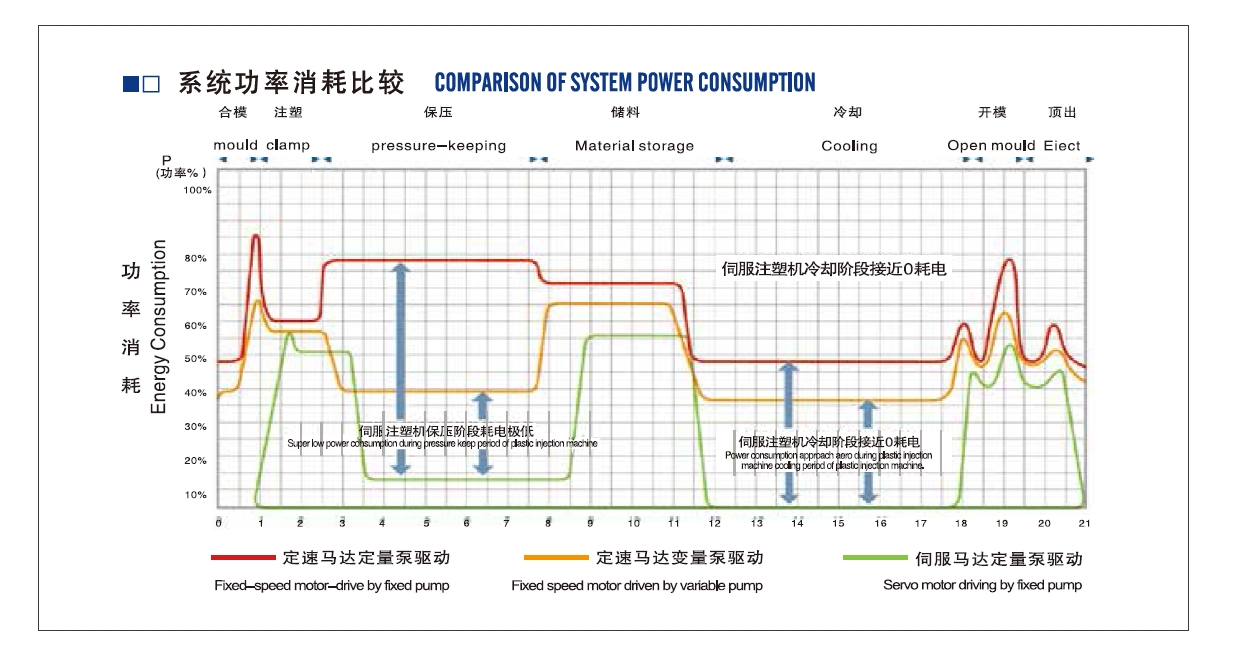
Injection molding machines consume significant electricity. The hydraulic pump runs during injection and clamping. It also runs during idle periods in standard machines. This wastes energy.
Standard hydraulic machines use a fixed displacement pump. The motor runs at full speed continuously. Excess oil returns to the tank through relief valves. This creates heat and wastes power.
Servo-hydraulic machines reduce energy consumption. The servo motor adjusts speed based on actual demand. During cooling and idle phases, the motor slows down or stops. This cuts energy use by 30%-80%.
Calculating Long-Term Savings
Energy costs add up over years of operation. A standard machine running 24 hours per day consumes about 60,000 kWh annually. At $0.13 per kWh, that is $7,800 per year.
A servo-hydraulic machine with 50% energy saving uses 30,000 kWh per year. The annual cost drops to $3,900. This saves $3,900 per machine each year.
The additional cost of servo-hydraulic technology pays back in 18-24 months. After that, the savings continue for the machine’s service life. HAICHEN servo-hydraulic pen injection machines deliver 30%-60% energy savings.
Our high-response servo system reaches maximum output in 0.05 seconds. This shortens cycle time and improves production efficiency .
Auxiliary Equipment and Production Line Integration
Material Drying and Handling
Plastic pellets absorb moisture from the air. This moisture causes problems during injection. The water turns to steam at high temperature. This creates bubbles and silver streaks on the pen surface.
A dryer removes moisture before the pellets enter the machine. For pen production, drying temperature is typically 80-100°C. Drying time is 2-3 hours. Dry material produces clear, strong pen parts.
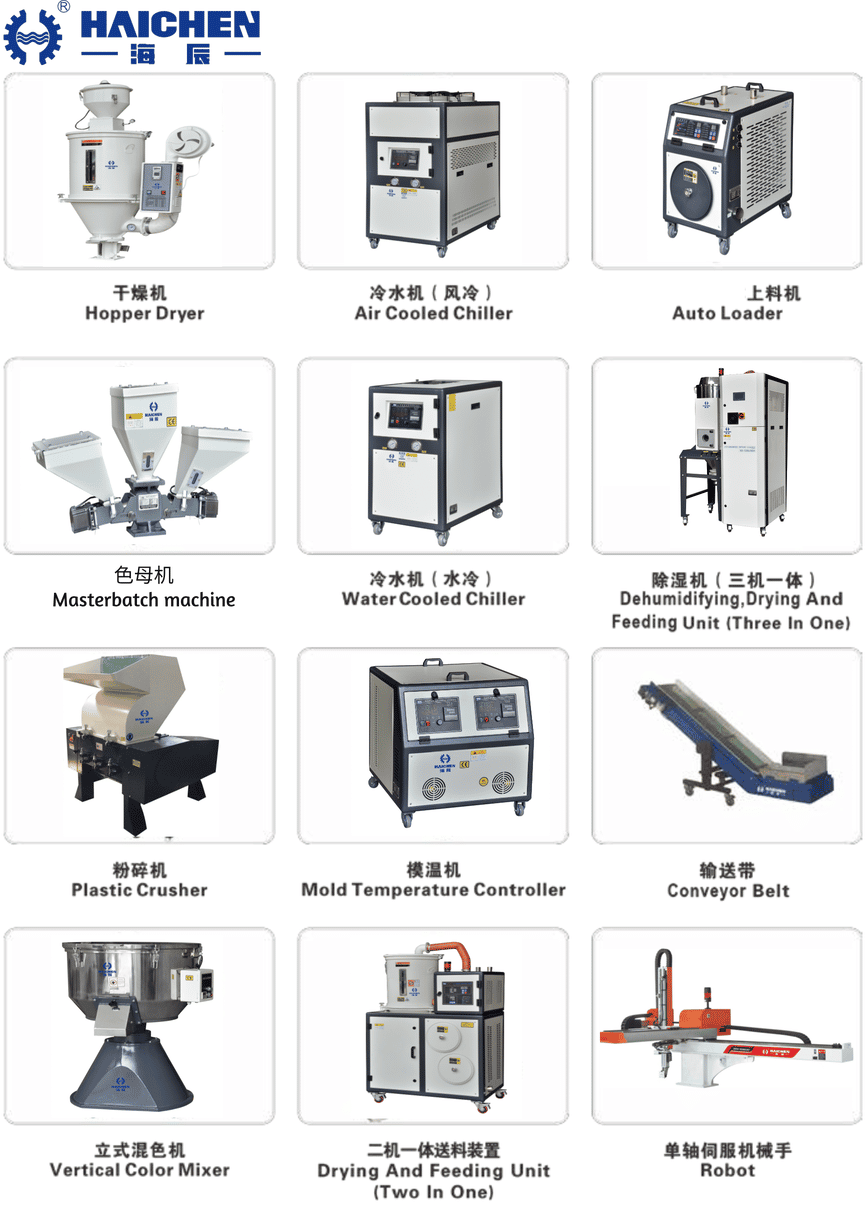
HAICHEN’s production line includes a vacuum suction hopper with photoelectric sensing. This device automatically feeds material to the drying system . Proper drying prevents surface defects and ensures consistent quality.
Crushing and Recycling
Scrap and waste are unavoidable in production. The sprue, runner, and defective parts all create waste. Throwing away this material increases costs.
A crusher recycles this waste material. It grinds the plastic into small pieces. These pieces can go back into production. This reduces raw material costs by 10%-20%.
A complete pen production line includes the injection machine, dryer, crusher, auto loader, chiller, and conveyor system. HAICHEN provides integration support for all these components. This creates a complete solution for pen manufacturers.
Automation for Higher Output
Automation reduces labor costs and improves consistency. Robots remove parts from the mold. Conveyors move parts to the next station. Automated inspection checks part quality.
For pen production, automation is especially valuable. Pen parts are small and produced in high volume. Manual handling slows production and introduces defects.
HAICHEN machines support robot and conveyor integration. Our pen production systems can achieve 24-hour uninterrupted operation . The production efficiency is 10-15 times higher than manual labor.
Factory Tour and Quality Verification
How do I choose the right injection molding machine for pen production?
Selecting a pen making machine requires evaluating several factors. Consider your target materials first. PP and PE need general-purpose screws. ABS and PC need screws with better mixing. Consider your production
volume. Higher output needs higher cavity counts and larger injection capacity. Consider clamping force. Standard pen production needs 110-150 tons. Consider energy efficiency. Servo-hydraulic machines save 30%-60%
electricity compared to standard machines.
Machine Testing and Inspection
Before buying a machine, verify its quality. Request machine testing reports. These show injection accuracy, clamping stability, and energy consumption data.
If possible, visit the factory. Check the production floor. Observe the machine building process. See how the machines are assembled and tested.
For international buyers, video inspection is an option. Watch the machine run with your target material. Check the cycle time and part quality. HAICHEN welcomes factory visits and video inspections for pen making machines.
Certification and Compliance
International buyers need certified machines. CE certification is required for European markets. ISO 9001 confirms quality management. These certifications show the manufacturer meets international standards.
Ask for certification documents. Check if the machine meets your local safety regulations. Some countries have specific electrical requirements.
HAICHEN provides full certification documentation for all pen injection machine models. Our equipment meets international safety and quality standards. We supply test reports with each machine .


