
The global injection molded toilet seat market is growing. The global urea molded toilet seat market was valued at $656.6 million in 2024 and is expected to reach $1.2 billion by 2035. Demand for injection molding equipment for plastic toilet seats and covers is growing at the same time.
Toilet seats and covers are large flat plastic parts. These products must withstand humid environments, frequent opening and closing, and load-bearing use. This requires high clamping rigidity, cooling uniformity, and temperature control precision from the injection machine.
Many buyers focus only on clamping force when choosing a toilet seat injection molding machine. They ignore shot size matching, mold configuration, and material compatibility. After the machine starts production, they find problems like warping, sink marks, or hinge hole misalignment.
This article explains the core parameters and purchasing points for toilet seat injection molding machines.
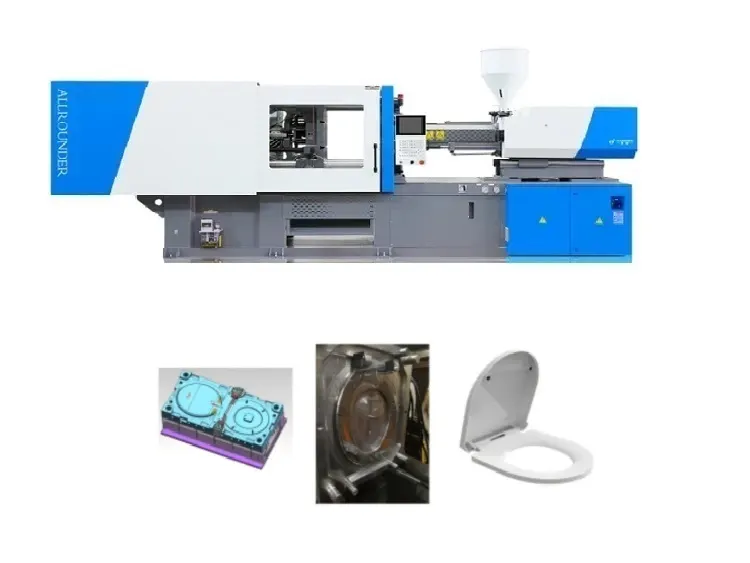
How to select Clamping Force ?— Match Tonnage to Product Type
How much clamping force does a toilet seat injection molding machine need?
Standard toilet seat and cover production uses 300 to 550 tons clamping force. A seat-ring-only mold fits a 300 to 400 ton machine. A cover-only mold fits a 450 to 550 ton machine. A family mold for both seat ring and cover needs 700 tons or higher. The Chen Hsong EM480-SVP/3+ uses 480 tons clamping force for 527 g PC/ABS toilet seats.
Clamping Force Range for Toilet Seats and Covers
Toilet seats and covers are large flat parts. Required clamping force is higher than for small parts.
Industry cases provide reference data. The Chen Hsong EM480-SVP/3+ produces PC and ABS toilet seats with 527 g shot weight, 6 mm wall thickness, 480 tons clamping force, and 55 second cycle time in semi-automatic mode. The AMAN 1+1 family mold (seat ring and cover molded together) runs on an AM-700 with 7000 kN clamping force and 55 to 70 second cycle time. A seat-ring-only mold fits a 300 to 400 ton machine. A cover-only mold fits a 450 to 550 ton machine.
ARBUEO offers a precision series of toilet seat injection machines from 180T to 550T, compatible with PP and ABS material.
How Clamping Structure Affects Part Precision?
Clamping structure directly affects part precision and flash. The Bole EKH series uses a center clamping structure. This structure has 10% to 20% higher clamping force utilization than traditional toggle structures. It produces less flash and saves 2% to 5% material.
Haichen toilet seat injection machines use reinforced machine frames and clamping structures. This design reduces the risk of slight mold opening or local misalignment when molding large platens. It ensures stable temperature and pressure parameters during long continuous production.
HAICHEN Toilet Seat Injection Machine Clamping Force Configuration
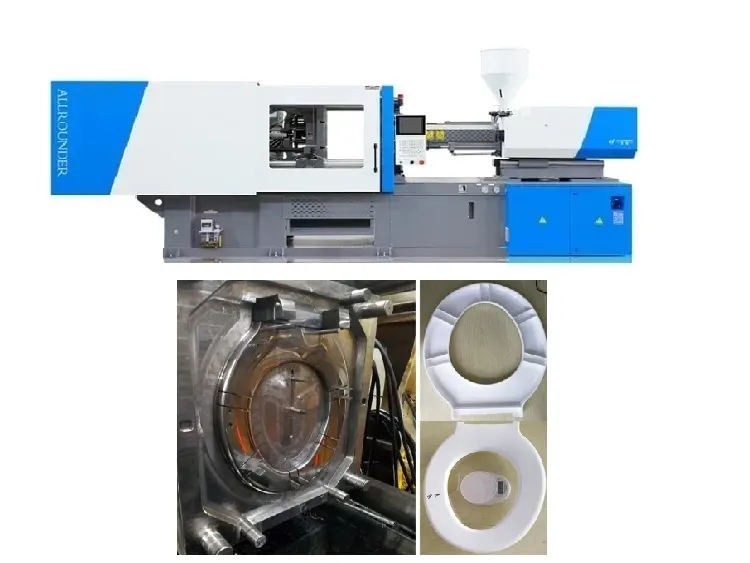
HAICHEN offers injection machines from 30 tons to 3000 tons. This range covers different production needs for toilet seats and covers. Our HCK series uses high-rigidity platen structures with finite element optimized design. This suits long-term batch production of large flat parts. The HAICHEN technical team recommends clamping force based on customer mold drawings and product specifications.
| HCK360 PLASTIC INJECTION MOLDING MACHINE | ||||
| INJECTION UNIT | ||||
| ITEM | UNIT | A | B | C |
| INJECTION UNIT | ||||
| Screw diameter | mm | 65 | 70 | 75 |
| Screw L/D ratio | L/D | 23.7 | 22.0 | 20.5 |
| Shot volume(theoretical) | cm3 | 1161 | 1347 | 1546 |
| Injiection weight(ps) | g | 1057 | 1226 | 1407 |
| oz | 37.3 | 43.2 | 49.6 | |
| Injection pressure | Bar | 2071 | 1786 | 1556 |
| Injection rate | cm3/s | 352 | 408 | 468 |
| Plasticizing capacity | g/s | 49 | 58 | 72 |
| Screw speed (Max.) | r/min | 190 | ||
| CLAMPING UNIT | ||||
| Clamping force | Kn | 3600 | ||
| Space between tie bars(W×H) | mm | 720×670 | ||
| Platens size | mm | 1020×970 | ||
| Opening stroke | mm | 680 | ||
| Min.Mold height | mm | 270 | ||
| Max.Mold height | mm | 720 | ||
| Distance between platens(daylight) | mm | 1400 | ||
| Ejector stroke | mm | 170 | ||
| Ejector force | Kn | 90 | ||
| OTHERS | ||||
| Systerm pressure | Bar | 175 | ||
| Pump motor | Kw | 60 | ||
| Heating power | Kw | 26.5 | ||
| Oiltank cubage | L | 600 | ||
| Machine dimension(L×W×H) | m | 7.3×2.0×2.1 | ||
| Machine weight | t | 13.0 | ||
How to Select Injection Unit?— Precision Determines Hinge Assembly Quality
Matching Shot Size with Part Weight
Toilet seats and covers typically weigh 200 to 600 grams each. The PC/ABS toilet seat in the Chen Hsong case has a 527 g shot weight.
The injection unit shot size should stay between 30% and 80% of machine capacity. Too low a shot size causes long residence time and material degradation. Too high causes incomplete filling and unstable part dimensions.
How Injection Repeatability Affects Hinge Holes
Toilet seat hinge holes and damper mounting points need to fit the cover precisely. Injection repeatability directly affects the dimensional consistency of these assembly features.
ARBUEO toilet seat injection machines use balanced and stable clamping force output. This reduces dimensional deviations for hinge pin holes, damper mounting points, and snap-fit features. It improves hole coaxial alignment. This helps minimize sticking, loose assembly, and abnormal noise during operation.
HAICHEN Injection Unit Technical Features
HAICHEN injection machines feature servo-hydraulic injection systems. Injection speed can be set in multiple stages to match the filling needs of different wall thicknesses. We offer multiple screw diameter options to match precision requirements for different part weights. HAICHEN engineers recommend the right injection unit based on customer toilet seat specifications.
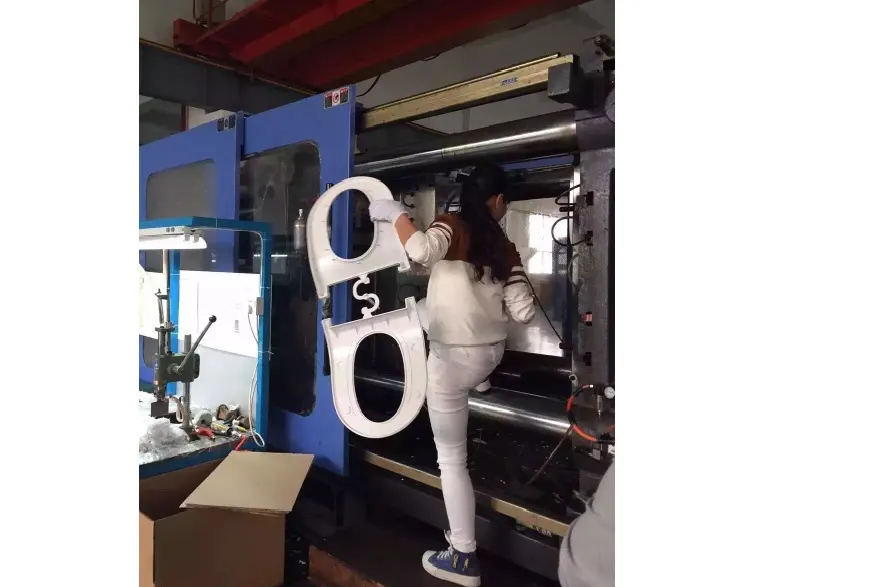
What’s Toilet Seat Mold Configuration? — Family Molds and Cooling Optimization
What are the advantages of a family mold?
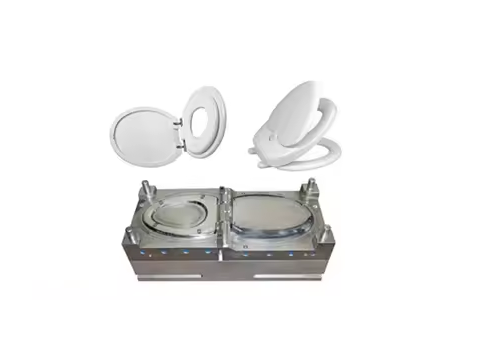
A family mold molds the toilet seat ring and cover together in one shot. A 1+1 family mold uses a 700 ton injection machine with 55 to 70 second cycle time. A 2+2 family mold uses a 1080 ton machine for higher output. Family molds eliminate separate production steps and improve matching efficiency.
Family Molds and Output Matching
Toilet seats and covers are usually produced as matching sets. A family mold can mold the seat ring and cover together in one shot.
The AMAN 1+1 family mold runs on an AM-700. It molds one cover and one seat ring per shot. Cycle time is 55 to 70 seconds, depending on part design. Mold delivery time is 40 to 60 days.
For higher output, AMAN offers a 2+2 family mold on an AM-1080.
What is the typical cycle time for toilet seat injection molding?
Toilet seat cycle time depends on wall thickness and mold design. A PC/ABS toilet seat with 6 mm wall thickness has about 55 second cycle time. A PP toilet seat and cover family mold has 55 to 70 second cycle time. A 1+1 family mold for both seat ring and cover uses a 700 ton machine.
How the Cooling System Affects Cycle Time
Toilet seat wall thickness is usually 6 mm, which is a medium wall thickness. Cooling time takes up a large share of the injection cycle.
In the Chen Hsong case, the PC/ABS toilet seat cycle time is 55 seconds. The AMAN PP toilet seat and cover family mold cycle time is 55 to 70 seconds.
Cooling water flow rate matters more than water temperature. Larger pipe diameters and fewer elbows raise flow rate and shorten cooling time. Uniform mold cooling channel layout is critical for dimensional stability of large flat parts.
HAICHEN Mold Matching and Cooling Support
HAICHEN supports customers in providing mold drawings for matching confirmation. We recommend cooling channel layouts based on toilet seat and cover wall thickness distribution and mold cavity count. For family molds, we help confirm cooling uniformity across cavities to reduce warping and dimensional deviation from cooling differences. The HAICHEN servo energy-saving system reduces motor speed or stops the motor during the cooling phase to cut energy use.
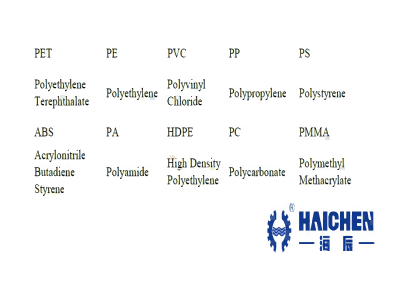
How to know the Material Compatibility — Different Requirements for PP, PC, and ABS
What materials are common for toilet seat injection molding?
Common materials include PP, PC, and ABS. PP has good toughness and chemical resistance for bathroom environments. PC has high transparency and impact resistance for high-end products. ABS has stable dimensions and good surface gloss. PC and ABS have higher processing temperatures and need precise temperature control.
Processing Points for PP Material
PP is a common material for toilet seats and covers. It has good toughness and chemical resistance, suiting bathroom environments. Moreover, it has a wide processing temperature range, usually 200 to 300°C.
The PP shrinkage rate is 1.0% to 2.5%. Toilet seats and covers are large flat parts, so shrinkage control is critical. Holding pressure and time directly affect PP shrinkage.
Processing Points for PC and ABS Material
PC and ABS are used for high-end toilet seats and smart toilet covers. PC has high transparency and impact resistance. ABS has stable dimensions and good surface gloss.
The Chen Hsong case uses PC and ABS material for toilet seats with 527 g shot weight and 6 mm wall thickness. PC and ABS have higher processing temperatures and need sufficient heating power and precise temperature control.
HAICHEN Material Compatibility
HAICHEN injection machines process PP, PC, ABS, and other materials. We provide dedicated screw configurations for different materials. For PC and ABS processing, our PID temperature control system maintains each barrel zone within ±1°C of the set value. For PP processing, our servo-hydraulic system provides repeatable injection speed profiles to reduce weight variation between batches.
Choosing a toilet seat injection molding machine requires attention to four core parameters: clamping force, injection unit, mold configuration, and material compatibility.
Clamping force typically ranges from 300 to 550 tons. Family molds need 700 tons or higher. Injection repeatability directly affects hinge hole and damper mounting point assembly quality. Family molds improve matching efficiency. Cooling system optimization shortens cycle time. For materials, PP has a mature process, while PC and ABS need higher temperature control precision.
HAICHEN has over ten years of injection machine manufacturing experience. We provide selection consulting, mold matching confirmation, and sample testing for toilet seat injection machines. Our servo energy-saving system lowers operating costs. Multiple screw configurations suit PP, PC, and ABS materials.
Contact HAICHEN for toilet seat injection machine selection advice. Send your product specifications, target material, and mold parameters. We will help you match the right machine.


