Warning triangles are safety products required by law. The European ECE R27 standard requires every new car to carry a warning triangle. China’s GB 19151 standard has similar rules. Replacement demand in the aftermarket is also stable.
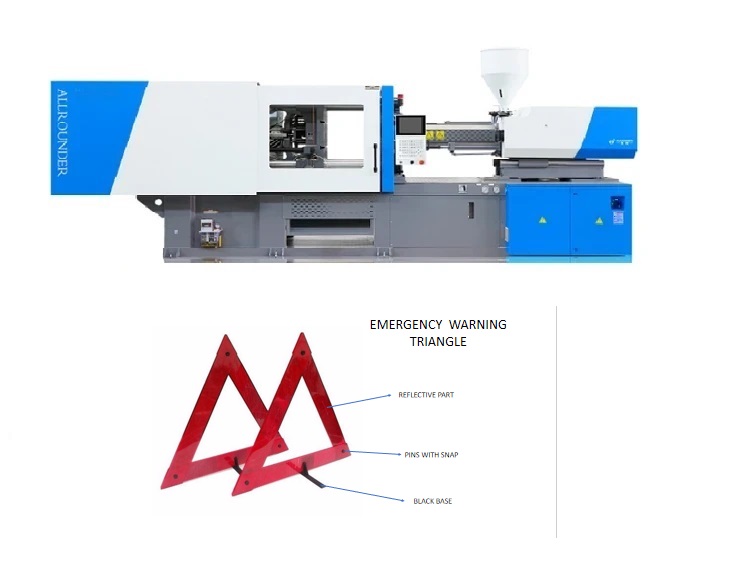
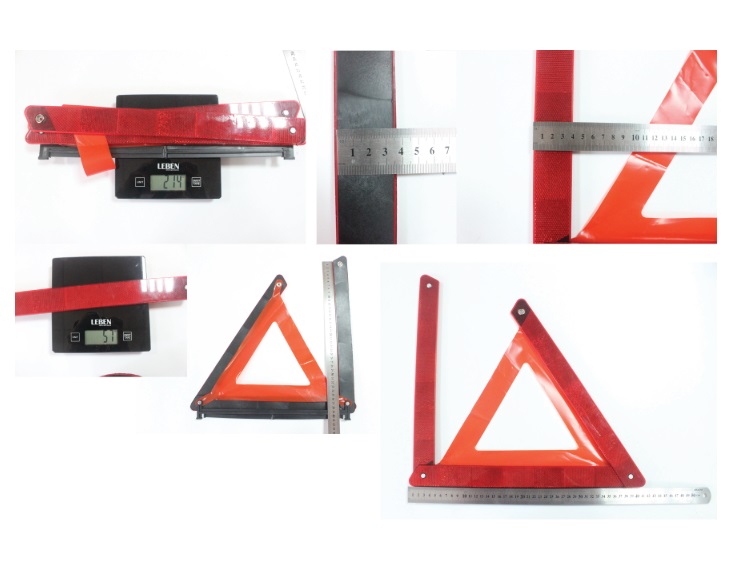
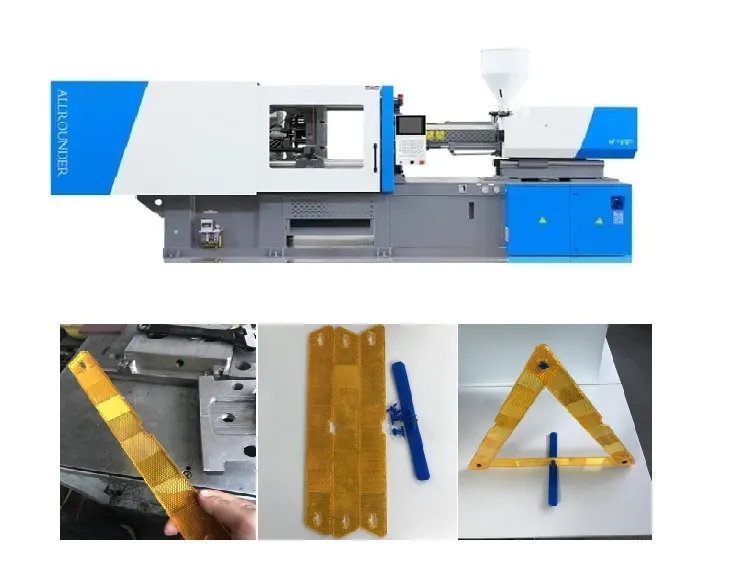
A folding car warning triangle usually consists of an ABS plastic frame, a PMMA reflective panel, and a folding base. The reflective panel quality directly determines warning performance. The injection molding machine is the core equipment for producing these plastic parts.
Many buyers focus only on clamping force when choosing a warning triangle injection molding machine. They ignore the thin-wall filling requirements of the reflective panel, the folding structure precision of the frame, and material compatibility. After production starts, they find problems like flow marks on the reflective surface and dimensional deviation in the folding hinge.
This article explains the core parameters and purchasing points for warning triangle injection molding machines.
Structure Features and Molding Challenges of Warning Triangles
Different Molding Requirements for Reflective Panels and Frames
A warning triangle consists of several plastic parts. The reflective panel uses PMMA material with a wall thickness of 1.0 to 2.0 mm. The back of the reflective panel has a micro-prism structure to reflect headlights. The frame uses ABS material with a wall thickness of 2.5 to 4.0 mm. It needs enough strength to support the folding structure.
The two products have different molding requirements. The reflective panel needs high injection speed, high mold temperature, and precise holding pressure control. The frame needs stable clamping force and good dimensional repeatability.
Special Process Requirements for Reflective Panel Production
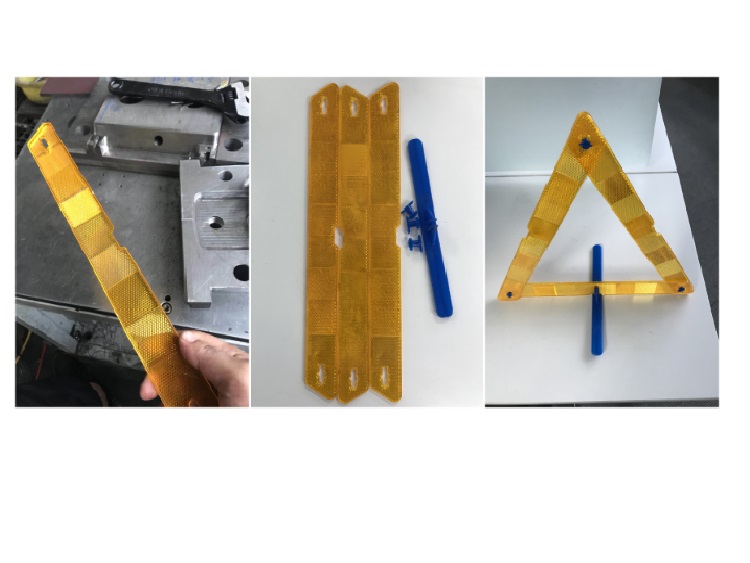
Reflective panel molding has three key control points.
First, mold temperature must stay above 80°C. Too low a mold temperature causes flow marks on the reflective panel surface and reduces reflection efficiency.
Second, cold material is strictly forbidden during injection. Cold material scratches the reflective surface. Scratches from cold material cannot be repaired, and the part must be scrapped.
Third, regrind and secondary material are forbidden for reflective panel production. The molecular chains in recycled material have partly degraded. Reflection performance cannot be guaranteed.
HAICHEN Machine Compatibility for Warning Triangle Production
HAICHEN offers injection machines from 80 to 300 tons. This range covers the production needs for warning triangle frames and reflective panels. Our servo-hydraulic system provides stable injection speed control for thin-wall precision filling of reflective panels. The HAICHEN technical team recommends clamping force and screw selection based on customer mold drawings and product specifications.
Core Parameters for Buying a Warning Triangle Injection Molding Machine
How much clamping force does a warning triangle injection molding machine need?
Reflective panel production usually uses 150 to 250 ton machines. ABS frame production uses 80 to 150 ton machines. A family mold that molds both the reflective panel and frame together needs 250 tons or higher. The specific choice depends on mold cavity count and part projection area.
Clamping Force Selection
The clamping force needed for warning triangle plastic parts depends on mold cavity count and part projection area.
Reflective panels are usually about 420 mm × 420 mm, which are flat thin-wall parts. An 8-cavity reflective panel mold has a large projection area and needs higher clamping force. The ABS frame folding structure includes hinges and snaps. Its single-part projection area is smaller, but it needs stable clamping force to ensure hinge dimensional precision.
Industry experience shows that reflective panel production usually uses 150 to 250 ton machines. ABS frame production uses 80 to 150 ton machines. A family mold that molds both the reflective panel and frame together needs 250 tons or higher.
Send your mold drawings to the supplier for clamping force matching confirmation before purchase.
What should I note when injection molding reflective panels?
Reflective panels use PMMA material with 1.0 to 2.0 mm wall thickness. Mold temperature must stay above 80°C. Cold material is strictly forbidden during injection. Cold material scratches the reflective surface and cannot be repaired. Regrind and secondary material are forbidden for reflective panel production. Dry PMMA at 80 to 100°C for 3 to 4 hours before processing.
Injection Unit and Reflective Panel Filling
The reflective panel wall thickness is only 1.0 to 2.0 mm. High injection speed is needed to complete filling before the material cools. Unstable injection speed causes uneven filling, leading to wall thickness deviation and reflection value fluctuation.
Shot size should stay between 30% and 80% of machine capacity. A reflective panel weighs about 30 to 60 grams each. The total shot weight for an 8-cavity mold (including runner) is about 300 to 500 grams. A machine with 500 to 800 grams shot capacity leaves enough margin.
HAICHEN Injection Unit Technical Features
HAICHEN injection machines feature a high-response servo injection system. Injection speed can be set in multiple stages. This suits the different needs of thin-wall filling for reflective panels and thick-wall holding for frames. Our PID temperature control system maintains each barrel zone within ±1°C of the set value. This reduces material flow variation and helps maintain reflective panel dimensional consistency.
| HCK230 PLASTIC INJECTION MOLDING MACHINE | ||||
| INJECTION UNIT | ||||
| ITEM | UNIT | A | B | C |
| INJECTION UNIT | ||||
| Screw diameter | mm | 45 | 50 | 55 |
| Screw L/D ratio | L/D | 24.4 | 22.0 | 20.0 |
| Shot volume(theoretical) | cm3 | 398 | 491 | 594 |
| Injiection weight(ps) | g | 362 | 447 | 541 |
| oz | 12.8 | 15.8 | 19.1 | |
| Injection pressure | Bar | 2299 | 1862 | 1539 |
| Injection rate | cm3/s | 192 | 237 | 286 |
| Plasticizing capacity | g/s | 23 | 27 | 33 |
| Screw speed (Max.) | r/min | 200 | ||
| CLAMPING UNIT | ||||
| Clamping force | Kn | 2300 | ||
| Space between tie bars(W×H) | mm | 570×520 | ||
| Platens size | mm | 820×770 | ||
| Opening stroke | mm | 520 | ||
| Min.Mold height | mm | 220 | ||
| Max.Mold height | mm | 570 | ||
| Distance between platens(daylight) | mm | 1090 | ||
| Ejector stroke | mm | 150 | ||
| Ejector force | Kn | 80 | ||
| OTHERS | ||||
| Systerm pressure | Bar | 175 | ||
| Pump motor | Kw | 30 | ||
| Heating power | Kw | 16.4 | ||
| Oiltank cubage | L | 200 | ||
| Machine dimension(L×W×H) | m | 5.8×1.4×1.9 | ||
| Machine weight | t | 7.3 | ||
Material Compatibility for Warning Triangle Injection Molding
What is the difference between PMMA and ABS in warning triangle production?
PMMA is used for reflective panels. Processing temperature is 230 to 260°C. Melt viscosity is high, requiring higher injection pressure. ABS is used for frames. Processing temperature is 210 to 250°C. Shrinkage is 0.4% to 0.7%. PMMA needs a high-temperature screw. ABS uses a general-purpose screw.
Processing Points for PMMA Reflective Panels
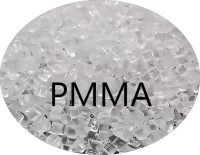
PMMA has excellent optical performance and weather resistance. It is the preferred material for reflective panels. PMMA processing temperature is higher, usually 230 to 260°C. PMMA has high melt viscosity and needs higher injection pressure.
PMMA absorbs moisture easily. Dry it at 80 to 100°C for 3 to 4 hours before processing. Insufficiently dried PMMA produces bubbles and silver streaks during injection.
Processing Points for ABS Frames
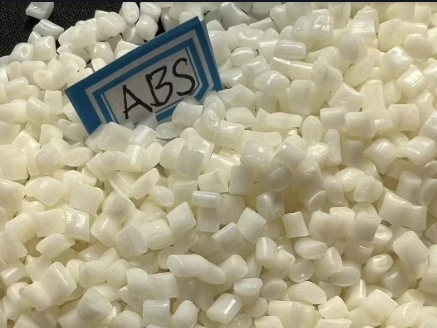
ABS frames need good toughness and dimensional stability. ABS processing temperature is usually 210 to 250°C. ABS shrinkage is about 0.4% to 0.7%, lower than PP.
The folding hinge dimensional precision requires good holding pressure control for ABS. Insufficient holding causes hinge hole dimensional deviation and affects folding function.
HAICHEN Configuration for PMMA and ABS
HAICHEN injection machines support both PMMA and ABS processing. We provide high-temperature screw configurations for PMMA and general-purpose screw configurations for ABS. The HAICHEN servo-hydraulic system provides repeatable injection speed profiles to reduce part weight variation between batches. HAICHEN engineers recommend drying parameters and temperature settings based on the customer’s material type.
Output Calculation and ROI Analysis
What is the cycle time for warning triangle injection molding?
Cycle time depends on wall thickness and mold design. Reflective panels (1.0 to 2.0 mm wall thickness) have a cycle time of about 20 to 30 seconds. ABS frames (2.5 to 4.0 mm wall thickness) have a cycle time of about 25 to 35 seconds. An 8-cavity reflective panel mold has daily output of about 23,000 pieces.
Output Calculation Using an 8-Cavity Reflective Panel Mold
Industry data serves as a reference. Yuyao Jiada Plastic has three warning triangle production lines with daily output of 30,000 sets and annual capacity of 10 million sets. Ningbo Yongjia Auto Parts has annual warning triangle capacity exceeding 10 million pieces. Its products pass European E-Mark certification.
Take an 8-cavity reflective panel mold as an example. Assume part weight is 40 grams and cycle time is 25 seconds including cooling and removal. Hourly output is about 1,152 pieces. With 20 hours per day, daily output is about 23,040 pieces. Monthly output (30 days) is about 690,000 pieces.
If one warning triangle set contains one reflective panel and one frame, the daily output of an 8-cavity mold corresponds to about 2,880 sets.
Equipment Investment and Payback Period
Warning triangle injection machine investment includes the main machine, mold, dryer, and removal robot. Take a 150-ton servo injection machine as an example. Equipment investment is about $15,000 to $25,000.
At daily output of 2,880 sets, assume profit per set is $0.05. Daily profit is $144. Monthly profit is about $4,320. After electricity, labor, and material loss, net return is about $2,500 to $3,000 per month. Equipment payback period is about 8 to 12 months.
Actual payback depends on order volume and automation level.
HAICHEN Machine ROI Advantage
HAICHEN servo-hydraulic injection machines save 30% to 60% electricity compared to standard hydraulic machines. For a 24-hour warning triangle production line, annual electricity savings can reach several thousand dollars. HAICHEN provides full warranty and remote debugging support to reduce downtime loss. Our machines support removal robot integration to lower labor costs.
Supplier Evaluation Checklist
Technical Capability Verification
Confirm the following before purchase: whether the supplier provides mold matching confirmation, whether they support sample testing with customer molds, and whether they provide injection repeatability and platen parallelism data.
During sample testing, run at least 30 cycles and record part weight variation and dimensional deviation. For reflective panels, also check for flow marks and cold material marks on the surface.
HAICHEN After-Sales Support and Spare Parts Supply
HAICHEN has over ten years of injection machine manufacturing experience. We provide a wear parts list and recommended stock suggestions. For overseas customers, HAICHEN offers remote debugging guidance and spare parts supply support. Our technical team helps customers optimize injection process parameters for reflective panels and frames.