
Artificial plants—Christmas tree needles, ficus leaves, flower stems, and bonsai branches—demand different material properties than most injection-molded products. A Christmas tree needle requires UV stability and realistic surface texture. A flower stem needs stiffness and snap-fit assembly capability. A large outdoor ficus leaf demands weather resistance and color fastness. Material selection directly determines how a finished artificial plant looks, feels, and survives in its intended environment.
PE dominates high-end artificial Christmas tree needles because it injection-molds with realistic vein texture and resists UV fading. PVC remains the standard for low-cost needle film and branches. PP suits flower stems and structural connectors. ABS provides rigidity for large tree trunks and heavy branch assemblies. Each material requires different processing parameters.
This guide compares PE, PVC, PP, and ABS across the properties that matter for artificial plant injection molding, provides recommended processing parameters for each, and explains which material fits which plant component.
What Properties Matter Most for Artificial Plant Materials?
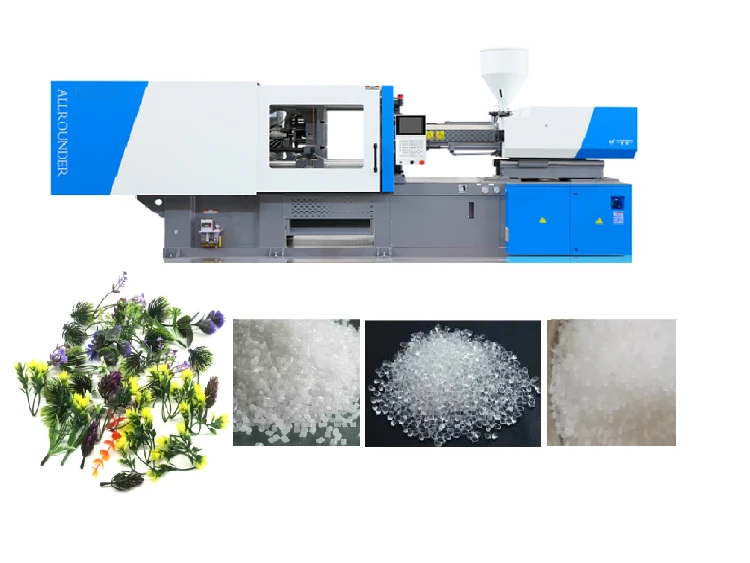
The four critical properties for artificial plant injection molding are UV resistance (fade resistance under sunlight), surface texture capability (ability to mold realistic veins and needle details), flexibility vs. rigidity balance (needles vs. structural parts), and processing stability (thermal window for thin-wall parts).
Application-Driven Property Requirements
| Plant Component | Critical Property | Secondary Requirement |
|---|---|---|
| Christmas tree needles | Realistic texture, UV stability | Flexibility without permanent deformation |
| Flower stems | Stiffness, snap-fit precision | Color consistency |
| Large outdoor leaves | UV resistance, color fastness | Weather resistance |
| Tree trunk and branch hub | Rigidity, load-bearing strength | Dimensional stability |
| Small decorative leaves | Surface finish, thin-wall flowability | Low cost |
A material that excels in one application may fail in another. PE produces the most realistic needle texture, but it lacks the rigidity needed for a large tree trunk. ABS provides that rigidity, yet it cannot match PE’s outdoor UV performance without additives.
How Does PE Perform in Artificial Plant Injection Molding?
PE is the preferred material for high-end artificial Christmas tree needles. It injection-molds with realistic vein patterns, resists UV fading, and tolerates bending without permanent creases. PE processes at melt temperatures of 180–240°C with mold temperatures of 20–60°C.
Why PE Dominates Premium Needle Production?
PE needles set the standard for realism in the artificial tree industry. Manufacturers cast actual conifer branch patterns into molds, then inject PE to replicate the thickness and mass of a real branch. The resulting needles feel substantial and hold their shape when bent. A 100% PE injection-molded tree from Håvn demonstrates a lifelike trunk and dense branches that closely mimic a fresh Nordmann fir.
Consumers recognize this difference at the point of purchase. Malaysian climate guides recommend PE trees over PVC for tropical environments because PE resists the high heat and humidity that causes PVC to degrade. PE needles also outperform PVC in rebound memory—bend a PE branch and it returns to shape; bend a PVC branch repeatedly and it develops permanent creases.
Recommended PE Processing Parameters
| Parameter | Recommended Range | Notes |
|---|---|---|
| Melt temperature | 180–240°C | Higher end for thin-wall needles |
| Mold temperature | 20–60°C | Lower temperature for faster cycle |
| Injection pressure | 60–100 MPa | Moderate; PE flows easily |
| Drying | Usually not required | PE absorbs minimal moisture |
| Shrinkage rate | 1.5–3.5% | Requires mold compensation |
When PE Falls Short?
PE offers excellent toughness and UV resistance, but it lacks stiffness. A large tree trunk molded from PE alone will flex under load. Manufacturers address this by combining PE needles with an ABS or PP trunk structure, or by inserting steel wire cores into PE branches for structural support.
How Does PVC Perform in Artificial Plant Injection Molding?
PVC is the traditional low-cost material for artificial Christmas tree needles and branch film. It offers good flexibility and anti-break properties. PVC requires careful temperature control at 160–200°C to avoid thermal degradation and HCl gas release. Mold temperatures range from 20–60°C.
The Cost Advantage of PVC
PVC Christmas tree film remains the most common raw material for artificial trees in the low to mid-price segment. PVC film processes economically, produces a voluminous appearance, and accepts color pigments readily. A 220cm PVC tree with injection-molded needles and PVC branches delivers acceptable visual density at a fraction of the PE cost.
Recommended PVC Processing Parameters
| Parameter | Recommended Range | Notes |
|---|---|---|
| Melt temperature | 160–200°C | Above 200°C causes degradation |
| Mold temperature | 20–60°C | Cool mold for faster cycle |
| Injection pressure | 60–100 MPa | Moderate; PVC viscosity is higher than PE |
| Drying | 80°C / 2–4 h | Essential to prevent bubbles |
| Shrinkage rate | 0.2–0.5% | Low shrinkage, good dimensional stability |
A controlled PVC process window keeps melt temperature between 160°C and 200°C to prevent thermal degradation. The compression zone operates at 180–195°C for uniform melting. PVC releases corrosive HCl gas when overheated, so the injection unit must use corrosion-resistant screw and barrel materials.
What PVC Limitations Buyers Should Know?
PVC branches feel stiff compared to PE. Repeated folding leaves permanent crease marks that degrade the tree’s appearance over multiple seasons. PVC also raises environmental concerns—it requires heavy-metal stabilizers in some formulations and produces more pollution during manufacturing than PE. For these reasons, premium brands increasingly specify PE or PE/PVC hybrid constructions.
How Does PP Perform in Artificial Plant Injection Molding?
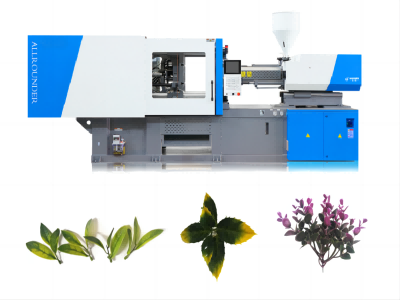
PP serves artificial plant applications that require stiffness, moisture resistance, and snap-fit assembly precision. Flower stems, branch connectors, and structural hubs commonly use PP. The material processes at melt temperatures of 180–240°C with mold temperatures of 50–90°C.
Where PP Adds Value?
PP outperforms PE in stiffness and tensile strength, making it suitable for flower stems that must hold their shape under the weight of leaves or blooms. The material resists moisture absorption, so PP stems do not swell or degrade in humid environments. Snap-fit connectors molded from PP maintain their grip through repeated assembly and disassembly.
PP also offers a favorable cost-to-performance ratio. Its density of 0.90–0.91 g/cm³ makes it the lightest common plastic, reducing shipping weight for large artificial plants.
Recommended PP Processing Parameters
| Parameter | Recommended Range | Notes |
|---|---|---|
| Melt temperature | 180–240°C | Wide processing window |
| Mold temperature | 50–90°C | Higher temperature improves surface |
| Injection pressure | 80–130 MPa | Moderate; PP flows well |
| Drying | Usually not required | PP absorbs minimal moisture |
| Shrinkage rate | 1.5–2.5% | Requires uniform cooling |
PP Limitations for Artificial Plants
PP’s surface finish cannot match PE’s realistic texture. A PP needle looks smooth and plastic, not organic. For this reason, manufacturers rarely use PP for visible needles or leaves. Instead, they deploy PP for hidden structural components—stems, internal branch hubs, pot liners, and assembly clips.

How Does ABS Perform in Artificial Plant Injection Molding?
ABS provides high rigidity and impact strength for large artificial tree trunks, heavy branch assemblies, and premium structural components. It processes at cylinder temperatures of 210–240°C with mold temperatures of 45–70°C. ABS requires mandatory drying at 75–80°C for 2–4 hours.
ABS for Structural Rigidity
Large artificial trees—especially those over 180cm—require a trunk that supports the weight of dense branch assemblies without bending. ABS delivers that rigidity. Its tensile strength and impact resistance exceed both PE and PP, and it maintains dimensional stability under load.
Premium outdoor artificial trees frequently use ABS as the trunk and hub material. HRtrees reports using imported ABS plastic combined with high-toughness PE for its large artificial tree products, all compliant with EU RoHS and REACH environmental certifications. Their workshop runs 30 high-precision multi-material injection machines with clamping forces from 920 to 3500 kN and a one-time molding rate of 99.2%.
Recommended ABS Processing Parameters
| Parameter | Recommended Range | Notes |
|---|---|---|
| Cylinder temperature | 210–240°C | Higher end for thin-wall parts |
| Mold temperature | 45–70°C | Higher temperature improves gloss |
| Injection pressure | 90–130 MPa | Moderate to high |
| Drying | 75–80°C / 2–4 h | Mandatory; moisture causes silver streaks |
| Shrinkage rate | 0.4–0.7% | Low shrinkage, excellent dimensional control |
A key ABS processing requirement: drying is non-negotiable. Moisture content above 0.1% produces silver streaks on the part surface, a defect that instantly marks a product as defective.
ABS Limitations for Artificial Plants
ABS costs more per kilogram than PE, PP, and PVC. It also lacks inherent UV stability—outdoor ABS components require UV-stabilized grades or protective coatings to prevent yellowing and chalking. For these reasons, manufacturers reserve ABS for internal structural parts where its rigidity justifies the cost, rather than for visible needles or leaves.

Material Selection Decision Matrix for Artificial Plant Components
Select PE for visible needles and leaves that require realistic texture and UV resistance. Choose PVC for cost-sensitive needle film and branch wraps. For flower stems, connectors, and moisture-resistant structural parts select PP. The large tree trunks and load-bearing hubs, select ABS.
| Component | First Choice | Alternative | Why |
|---|---|---|---|
| Christmas tree needles | PE | PVC (cost-driven) | PE delivers realistic texture and UV stability |
| Flower stem | PP | ABS | Stiffness + moisture resistance + snap-fit |
| Large tree trunk | ABS | PP + steel insert | Rigidity under load |
| Outdoor leaf | PE (UV grade) | PVC (UV grade) | Color fastness and weather resistance |
| Branch hub/connector | PP | ABS | Stiffness at lower cost |
| Pot liner | PP | ABS | Moisture resistance and low weight |
What Are the Common Defects in Artificial Plant Injection Molding?
The most common defects are short shots (thin needle tips), weld lines (branch junctions), warpage (long thin leaves), silver streaks (ABS moisture), and uneven filling (multi-cavity needle molds). Each defect traces back to specific material and parameter causes.
Short Shot on Needle Tips
Cause: Thin-wall needle tips (0.5–1.0mm) cool before filling completes. Low melt temperature or insufficient injection speed.
Solution: Raise barrel temperature by 5–10°C. Increase injection speed in the fill stage. Verify gate size is adequate for the flow length. Konger’s artificial flower machines mitigate uneven filling and short shots on thin-wall stems through fast injection response and optimized screw design.
Weld Lines at Branch Junctions
Cause: Multiple flow fronts meet around branch forks. Low mold temperature prevents complete fusion.
Solution: Increase mold temperature by 10–15°C. Optimize gate location to balance flow paths. Improve venting at weld line locations.
Warpage on Long Thin Leaves
Cause: Uneven cooling between the thin leaf tip and thicker base. PP and PE both shrink during cooling, and differential shrinkage bends the part.
Solution: Balance cooling channel layout. Increase packing pressure and holding time. For PP leaves, raise mold temperature to promote uniform crystallization.
Silver Streaks on ABS Components
Cause: Moisture in ABS resin turns to steam during injection, creating surface streaks.
Solution: Dry ABS at 75–80°C for 2–4 hours before processing. Verify dryer performance. Store dried resin in sealed containers.
Uneven Filling in Multi-Cavity Needle Molds
Cause: Pressure drop across the runner system causes cavities far from the sprue to underfill.
Solution: Use a balanced runner system. Increase injection pressure moderately. Consider a hot runner system for large cavity counts.
How Do You Choose the Right Injection Molding Machine for Artificial Plants?
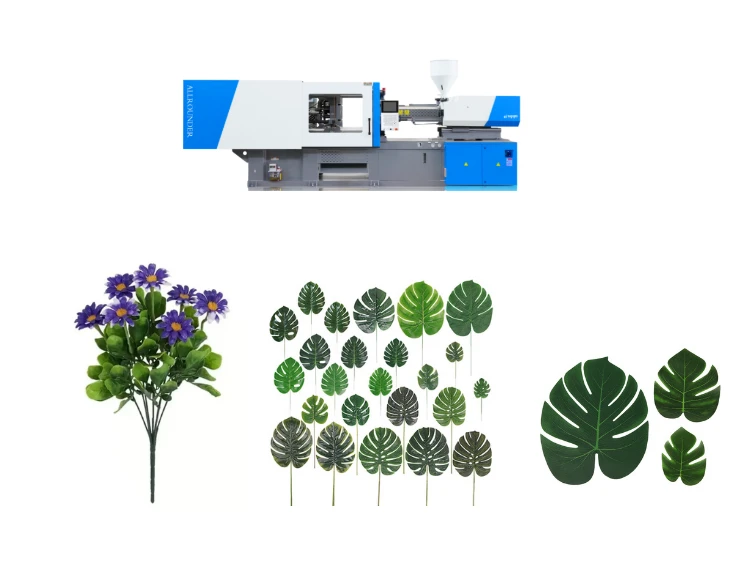
Match machine tonnage to the projected area of your largest plant component. Thin-wall needle molds typically require 80–180 tons. Large trunk molds may require 300–650 tons. Choose a machine with shot weight 20–30% above total mold shot weight and injection rate sufficient for thin-wall filling.
Machine Configuration Guide
| Plant Component | Recommended Tonnage | Screw Diameter | Typical Cavities | Cycle Time |
|---|---|---|---|---|
| Christmas tree needles | 80–150 T | 25–35 mm | 16–48 | 8–15 s |
| Flower stem | 100–180 T | 30–40 mm | 8–24 | 10–18 s |
| Large leaf | 150–250 T | 35–45 mm | 4–12 | 15–25 s |
| Tree trunk/hub | 300–650 T | 45–65 mm | 1–4 | 30–60 s |
Pre-Purchase Checklist
-
Clamping force: Match to projected area of largest component
-
Shot weight: 20–30% above total mold shot weight
-
Injection rate: Sufficient for thin-wall needle tips
-
Screw configuration: General-purpose for PE/PP; corrosion-resistant for PVC
-
Drying capability: Mandatory for ABS; recommended for PVC
-
Mold temperature control: Range must cover 20–90°C
FAQ
Which material is best for artificial Christmas tree needles?
PE is the best material for premium artificial Christmas tree needles. It injection-molds with realistic vein texture, resists UV fading, and returns to shape after bending. PVC serves the low-cost segment but feels stiffer and develops permanent creases.
Can PVC and PE be molded on the same machine?
Yes, but the machine must meet PVC’s corrosion resistance requirements. PVC releases HCl gas when overheated, so the screw and barrel need hard chrome plating or bimetallic construction. PE processes without corrosion concerns but at similar temperature ranges.
Why does ABS require drying before injection molding?
ABS absorbs moisture from the air. During injection, that moisture turns to steam and creates silver streaks on the part surface. Drying at 75–80°C for 2–4 hours reduces moisture content below the threshold that causes defects.
What causes short shots in artificial plant needle molding?
Short shots on needle tips occur when the thin-wall section cools before filling completes. Raise melt temperature, increase injection speed, and verify gate dimensions. Thin-wall needle tips typically require higher injection rates than standard parts.
How many cavities should an artificial plant mold have?
Christmas tree needle molds commonly run 16–48 cavities. Flower stem molds typically use 8–24 cavities. Larger trunk and hub molds use 1–4 cavities. The choice depends on machine shot capacity and order volume.
What is the cycle time for artificial plant injection molding?
Cycle times range from 8–15 seconds for small needles to 30–60 seconds for large trunk components. Thin-wall needles cool faster and run shorter cycles. Thick trunk sections require longer cooling and holding times.


