In the eyewear industry, the difference between profit and loss often comes down to one number: your eyeglass frame injection molding cost. Every fraction of a cent matters. Your material costs, energy bills, scrap rates, and labor expenses all add up fast. If you are not actively managing these factors, you are leaving money on the table.
The global eyewear market is competitive. Brands and buyers push for lower prices, while material and energy costs keep rising. The gap between a profitable frame line and a break-even one often depends on how well you control your eyeglass frame injection molding cost. The good news is that the right injection molding machine can help you reduce costs across the board.
This guide breaks down the three biggest cost drivers in eyeglass frame production — material, energy, and scrap — and shows you how the right injection molding machine, combined with multi-cavity production and automation, can lower your eyeglass frame injection molding cost significantly.
- Where the Costs Come from in Eyeglass Frame Production
- How the Right Machine Lowers Per-Unit Cost
- Automation – Reducing Labor Costs
Where the Costs Come from in Eyeglass Frame Production
- Material Costs – The Biggest Slice of the Pie
- Energy Consumption – The Hidden Cost That Keeps Growing
- Scrap Rate – The Waste You Cannot Afford

Material Costs – The Biggest Slice of the Pie
Material costs are the single largest expense in eyeglass frame injection molding. Eyeglass frames typically use engineering plastics like PC (polycarbonate), PA (polyamide/nylon), and TR90. High-end, durable plastics for eyewear can cost significantly more than commodity plastics.
Material costs depend on resin type, part weight, and scrap rate. If your part weighs 10 grams, you are using PC at $2.50/kg, and your scrap rate is 5%, the material cost per part adds up quickly.
The key to reducing material costs: Use the right injection molding machine with precise shot control to minimize waste and avoid overfilling. Machines with inconsistent shot weight force you to over-pack the mold to compensate, wasting material on every cycle.
Energy Consumption – The Hidden Cost That Keeps Growing
Energy costs are a significant operating expense. Injection molding for cellulose acetate, for example, ranges between 5.15 and 5.6 kWh/kg. For a factory running multiple machines 24/7, that electricity bill is substantial.
Traditional hydraulic machines run continuously, drawing full power even during cooling and holding phases when no actual work is happening. A servo-driven eyeglass frame injection molding machine adjusts power based on real-time demand, saving energy during idle periods.
The key to reducing energy costs: Switch to a servo-driven machine. Energy savings of up to 70% are achievable with advanced servo systems. Some factories have reported 30% energy reduction after upgrading equipment.
Scrap Rate – The Waste You Cannot Afford
Scrap rate is the hidden profit killer in eyeglass frame injection molding. Industry surveys report typical scrap levels of 2–5% in well-controlled operations, while poorly optimized processes can exceed 10%. High-volume plants often target 1–3% scrap on stable production.
For eyeglass frames, the tolerance requirements are tight — a frame that is even slightly out of spec cannot be sold. Common scrap causes include short shots, warpage, sink marks, and dimensional deviation. Each scrapped part represents wasted material, energy, and labor.
The key to reducing scrap: Invest in a machine with closed-loop control and high-precision shot monitoring. Consistency is the foundation of low scrap rates. A machine that delivers the same shot weight and injection pressure cycle after cycle will produce fewer defective parts. This directly lowers your eyeglass frame injection molding cost by reducing material waste and rework.
How the Right Machine Lowers Per-Unit Cost
- Servo Energy Saving – Cut Your Electricity Bills
- Multi-Cavity Production – More Parts, Lower Cost Per Piece
- Precision Control – Reduce Scrap and Rework
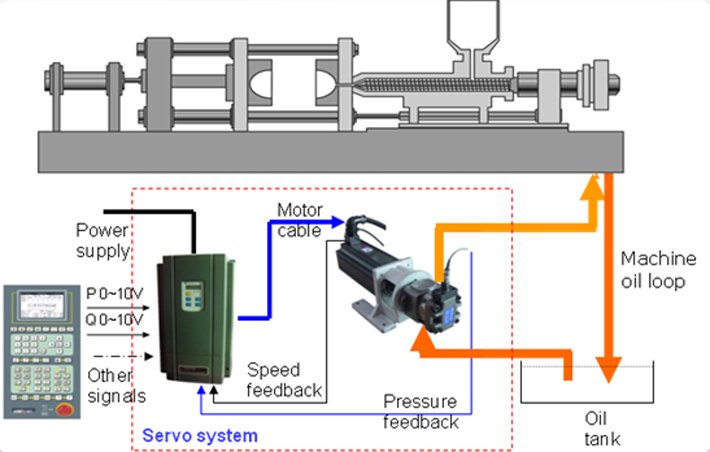
Servo Energy Saving – Cut Your Electricity Bills
The most immediate cost saving comes from switching to a servo-driven injection molding machine. A servo system uses a motor that adjusts speed and power according to real-time need. During cooling and holding phases, the motor nearly stops. This is like a car that shuts off at a red light instead of idling.
Energy savings from servo systems can be up to 70% compared to traditional hydraulic machines. Some manufacturers report 30% energy reduction after equipment upgrades. For a factory running multiple machines around the clock, that saving translates directly to the bottom line.
Haichen’s HCK series machines come with servo energy saving as standard. They deliver consistent power when you need it and conserve energy when you do not. Over a year of 24/7 operation, the electricity savings alone can pay for a significant portion of the machine’s cost.

Multi-Cavity Production – More Parts, Lower Cost Per Piece
Multi-cavity molding is one of the most effective ways to reduce per-unit cost. Instead of producing one frame per cycle, a multi-cavity mold produces four, six, eight, or more.
The logic is simple: the cycle time does not double when you double the number of cavities. A 4-cavity mold takes roughly the same time as a single-cavity mold. That means you get four times the output for roughly the same energy and labor cost.
For eyeglass frames, multi-cavity production is especially effective. A 1-out-12 mold for temple tips can achieve a 25-second cycle with consistent quality. Multi-cavity production yields higher throughput and lower unit costs, which directly reduces your eyeglass frame injection molding cost.
Haichen HCK Series – Multi-Cavity Eyeglass Frame Production Selection Guide

| HCK Model | Clamping Force | Recommended Cavities | Frame Type | Typical Cycle Time | Key Features |
|---|---|---|---|---|---|
| HCK110 | 110 tons | 4 cavities | Small frames, children’s eyewear | 18–22s | Compact design, ideal for low-volume production |
| HCK150 | 150 tons | 4–6 cavities | Standard optical frames | 16–20s | Balanced performance for medium-volume production |
| HCK180 | 180 tons | 6–8 cavities | Standard optical frames, sunglasses | 14–18s | High-speed injection, suitable for 8-cavity molds |
| HCK230 | 230 tons | 8–12 cavities | Sunglasses, sports eyewear, temple tips | 12–16s | Large platen, supports 12-cavity molds for high-volume production |
| HCK280 | 280 tons | 12–16 cavities | High-volume standard frames | 10–14s | Heavy-duty clamping, ideal for 16-cavity high-output production |
Selection Notes:
-
4–6 cavities: Best for small-batch production or complex frame designs that require higher precision per cavity. HCK110 and HCK150 cover this range.
-
8 cavities: The sweet spot for most eyewear manufacturers. HCK180 provides the right balance of clamping force and injection speed for standard optical frames and sunglasses. The HCK180 with 8 cavities can produce about 1,000 pieces per hour for typical frame designs.
-
12 cavities: For high-volume production of standard frames or temple tips. HCK230 supports larger platens and higher shot capacity, making it ideal for 12-cavity molds that require more clamping force.
-
16 cavities: For ultra-high-volume production. HCK280 delivers the clamping force and platen size needed for 16-cavity molds, significantly reducing per-unit cost.
Haichen offers injection molding machine configurations that support multi-cavity molds. Whether you need 4-cavity, 8-cavity, or 12-cavity setups, we match the machine’s clamping force and shot capacity to your mold design for optimal efficiency.
Precision Control – Reduce Scrap and Rework
Scrap reduction starts with machine precision. A machine with closed-loop control monitors injection pressure, speed, and position in real time. It corrects deviations instantly, ensuring every cycle matches the target.
High-precision shot monitoring ensures consistent part weight from cycle to cycle. When shot weight varies, you get dimensional deviations, sink marks, and other defects. Precision control eliminates these variations.
Temperature control is equally critical. Eyeglass frame materials like PC and TR90 require specific drying and processing conditions. TR90 granules need drying at 80–100°C for several hours to avoid bubbles when melting. Cycle times for TR90 frames typically run 20–25 seconds. Cooling time is controlled within 15–25 seconds.
Haichen’s injection molding machines feature multi-zone PID temperature control, high-precision electronic rulers, and closed-loop injection control. These systems work together to maintain consistent shot weight, uniform melt temperature, and stable part dimensions. The result: fewer rejects, less rework, and a lower eyeglass frame injection molding cost overall.
Automation – Reducing Labor Costs
- Insert Molding Automation
- Robot Part Removal

Insert Molding Automation
Many eyeglass frames require metal inserts — hinges, nose pads, or decorative elements. Insert molding traditionally involves an operator placing each insert into the mold before every cycle. That is labor-intensive and error-prone.
Vertical injection molding machines with automatic insert feeding systems can place inserts automatically. A vertical machine combined with an insert feeder eliminates manual placement, reduces cycle time, and prevents insert misalignment. Labor costs drop, and quality improves.
Automation for insert molding can significantly reduce labor costs. Some eyewear factories have reported 50% labor cost reduction after implementing automation.
Robot Part Removal
Manual part removal is slow and inconsistent. An operator must wait for the mold to open, carefully remove the frame (or frames), and then trim sprues. This adds seconds to every cycle and creates variability.
A take-out robot removes parts as soon as the mold opens. It places them on a conveyor or into a cooling station. The robot works the same way every time — no fatigue, no variation, no damaged parts.
For multi-cavity molds, robots can remove all parts simultaneously. This shortens cycle time, reduces labor requirements, and improves consistency. Eyewear factories using robotic automation have reported 50% increases in production efficiency.
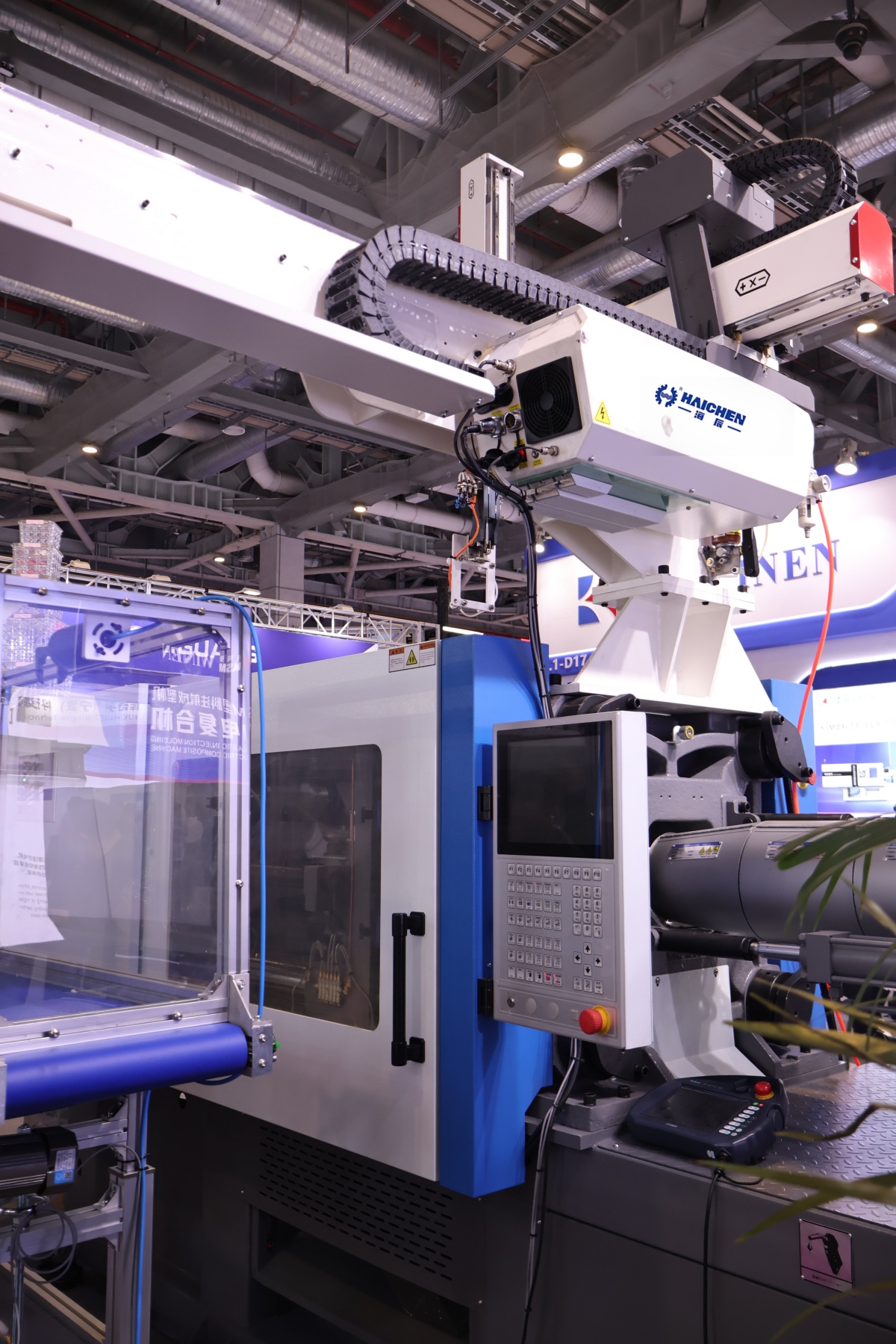
Haichen’s injection molding machines come with CE12 robot interfaces as standard. You can connect most major robot brands plug-and-play. Start with manual removal and add automation later, or install it from day one — the choice is yours.
Mostly Asked Questions
What is the typical cycle time for eyeglass frame injection molding?
For TR90 frames, cycle times typically run 20–25 seconds. Cooling time is controlled within 15–25 seconds. PC and PA frames may have longer cycle times depending on wall thickness and cooling requirements. Multi-cavity molds do not significantly increase cycle time, making them an effective way to boost output.
How much can servo energy saving reduce electricity costs?
Servo-driven injection molding machines can save up to 70% on energy consumption. Some factories report 30% energy reduction after upgrading equipment. The actual saving depends on your production volume and operating hours.
What scrap rate should I target for eyeglass frame injection molding?
Well-controlled operations typically achieve 2–5% scrap. High-volume plants often target 1–3% scrap on stable production. If your scrap rate exceeds 5%, you should investigate your machine’s precision, material drying, and process control.
How many cavities should my eyeglass frame mold have?
It depends on your output target. For medium-volume production, 4 cavities is a good starting point. For high-volume production, 8 or 12 cavities can significantly lower per-unit cost. More cavities require higher clamping force and larger shot capacity — match your machine accordingly. The HCK180 with 8 cavities typically achieves the best balance for most eyewear manufacturers, delivering about 1,000 pieces per hour with stable quality.
How does automation reduce per-unit cost in eyeglass frame production?
Automation reduces labor costs, shortens cycle times, and improves consistency. Factories using robotic automation have reported 50% labor cost reduction and 50% production efficiency increase. The investment in a robot and a machine with automation interfaces typically pays back within 12–18 months.
Haichen – your injection molding machine partner. From servo energy saving to multi-cavity production and automation integration, we help you reduce per-unit cost across your entire eyewear production line.
Author: Yang, Senior Engineer, Haichen Machinery