
The global demand for plastic eyeglass frames continues to grow. More people need vision correction. Fashion trends also drive frame consumption. For eyewear manufacturers, choosing the right plastic spectacles frame injection machine directly affects product quality and production efficiency.
Many buyers do not understand the technical parameters of injection molding machine for eyeglass frames: New vs Used. They may select the wrong equipment. This leads to defective frames, wasted materials, and higher costs. This guide explains the key parameters for selecting a plastic eyeglass frame injection molding machine. It also provides practical purchasing advice for eyewear producers.
Selecting the right plastic spectacles frame injection machine requires understanding your production needs and machine capabilities. The key factors to evaluate are specialized machine design, precision, stability, and total cost.Consider the machine’s clamping force, injection unit, screw design, temperature control, and repeatability. Also consider energy costs, maintenance expenses, and after-sales service.
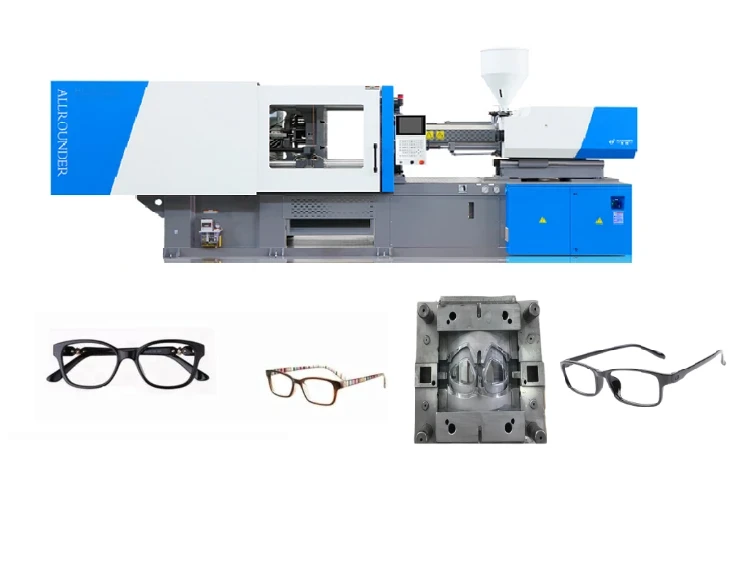
Why Eyeglass Frame Injection Molding Machines Differ from Standard Machines
Three Special Characteristics of Plastic Eyeglass Frame Making Machine
Eyeglass frames have unique design features that standard plastic eyeglass frame injection molding making machines cannot handle well.
First, frames have thin walls and complex curved shapes. The plastic must flow through long, narrow paths to fill the mold. Uneven flow creates visible flow marks on the frame surface.
Second, frames must meet strict dimensional tolerances. The left and right lens grooves must match exactly. A 0.01mm difference can make the lens impossible to install.
Third, frames require excellent surface finish. Any sink mark, weld line, or bubble ruins the appearance. Customers reject frames with visible defects.
These characteristics demand higher machine precision than standard injection molding applications.
Common Purchasing Mistakes
Some buyers purchase general-purpose injection machines for eyewear production. This often leads to problems.
General-purpose machines do not have screws optimized for frame materials like TR90, PC, or nylon. The plastic may not melt evenly. This creates quality issues.
Standard machines also lack the injection speed consistency needed for thin-wall filling. Speed fluctuations cause dimensional variations between production batches.
HAICHEN offers plastic optical eyeglasses frame lens injection molding making machine solutions with specialized screw designs. Our machines include servo-hydraulic systems that maintain consistent injection speed. This ensures stable production quality for eyewear manufacturers.
Five Critical Parameters for Selecting an Eyeglass Frame Injection Molding Machine
Clamping Force: How Much Do You Need?
Clamping force holds the mold closed during injection. Insufficient clamping force allows the mold to open slightly. This creates flash—thin plastic that leaks out at the parting line.
For eyeglass frames, typical clamping force ranges from 900 kN to 1600 kN.
Single-cavity or two-cavity molds work well with 900 kN machines. Higher cavitation molds need 1200 kN to 1400 kN.
Consider your production volume when selecting clamping force. Higher cavitation molds produce more frames per cycle but require larger machines.
Check the mold size and weight as well. The machine platen must accommodate your mold dimensions.
Injection Unit: Why Frames Need Small Shots with High Precision
Eyeglass frames have small part weights. A typical frame weighs 10 to 30 grams. The injection unit must deliver accurate shot volumes for these small parts.
Look for machines with injection volumes between 74 cm³ and 120 cm³. This range matches typical eyewear frame production.
Injection rate affects fill quality. Frames fill in less than one second. The machine must maintain consistent injection speed throughout the short fill time.
Speed fluctuations during filling create flow marks on the frame surface. These defects appear as visible lines on the finished frame.
Eyeglass Frame Injection Tonnage: 110T vs 180T vs 230T
HAICHEN machines use closed-loop servo control to maintain stable injection speed from cycle to cycle. This consistency reduces flow mark defects.
| HCK110 PLASTIC INJECTION MOLDING MACHINE | ||||
| INJECTION UNIT | ||||
| ITEM | UNIT | A | B | C |
| INJECTION UNIT | ||||
| Screw diameter | mm | 32 | 36 | 40 |
| Screw L/D ratio | L/D | 24.7 | 22.0 | 19.8 |
| Shot volume(theoretical) | cm3 | 145 | 183 | 226 |
| Injiection weight(ps) | g | 132 | 167 | 206 |
| oz | 4.7 | 5.9 | 7.3 | |
| Injection pressure | Bar | 2393 | 1890 | 1531 |
| Injection rate | cm3/s | 94 | 118 | 146 |
| Plasticizing capacity | g/s | 8 | 12 | 19 |
| Screw speed (Max.) | r/min | 250 | ||
| CLAMPING UNIT | ||||
| Clamping force | Kn | 1100 | ||
| Space between tie bars(W×H) | mm | 410*360 | ||
| Platens size | mm | 595*545 | ||
| Opening stroke | mm | 350 | ||
| Min.Mold height | mm | 170 | ||
| Max.Mold height | mm | 420 | ||
| Distance between platens(daylight) | mm | 770 | ||
| Ejector stroke | mm | 110 | ||
| Ejector force | Kn | 40 | ||
| OTHERS | ||||
| Systerm pressure | Bar | 175 | ||
| Pump motor | Kw | 15 | ||
| Heating power | Kw | 9.4 | ||
| Oiltank cubage | L | 160 | ||
| Machine dimension(L×W×H) | m | 4.3*1.2*1.6 | ||
| Machine weight | t | 3.6 | ||
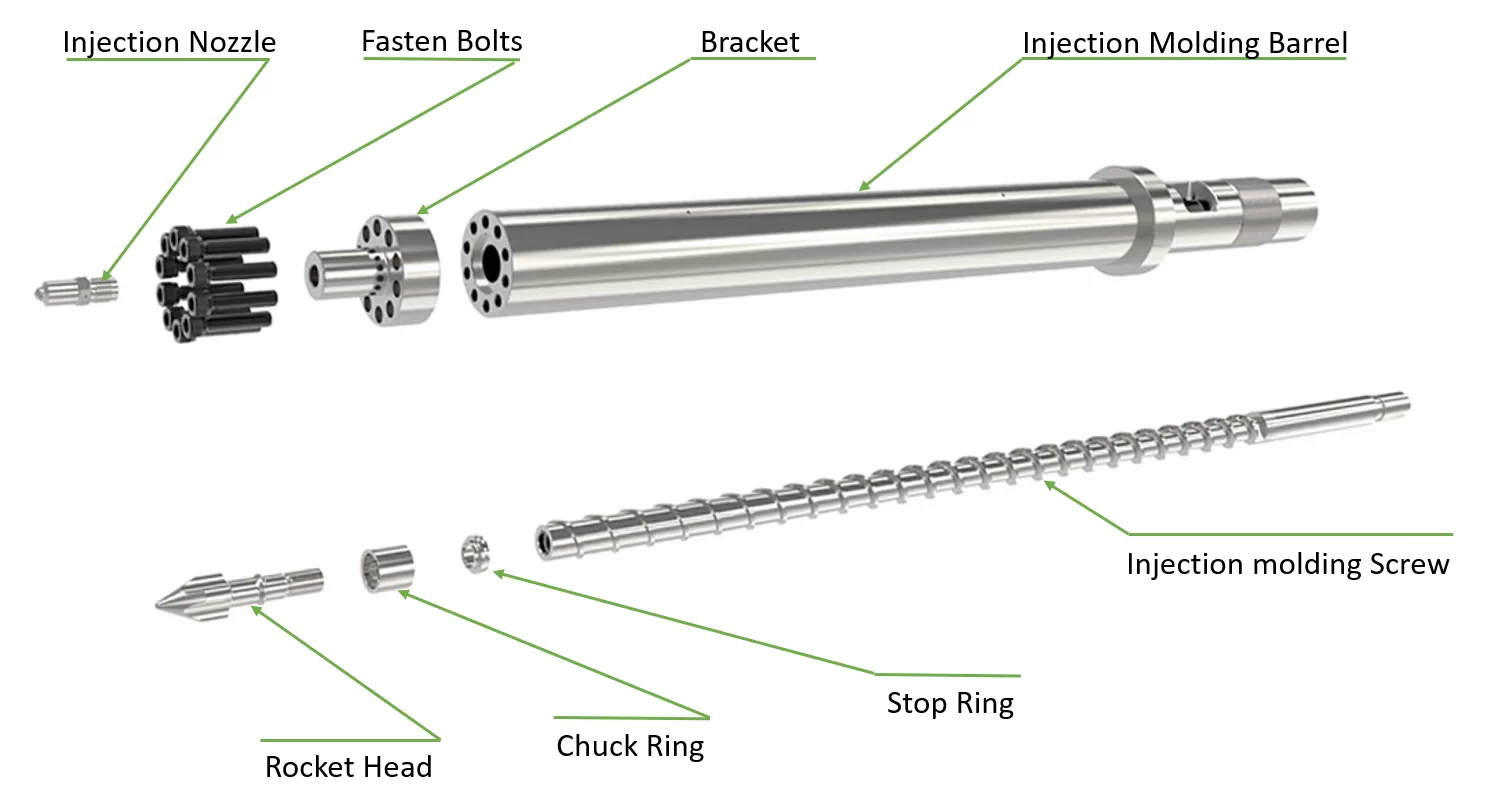
Screw Design: Different Materials Need Different Screws
Eyewear manufacturers use various plastics for frames. Each material has different processing requirements.
TR90 is a popular frame material. It offers light weight and good flexibility. TR90 has high viscosity and requires a screw with good melting capacity. It can cause material blockage if the screw design does not match the material.
PC is clear and impact-resistant. It has a narrow processing temperature window. The screw must maintain precise temperature control to prevent material degradation.
Nylon (PA) offers high strength and wear resistance. It requires a screw with good compression ratio for proper melting.
TPE is used for soft temple tips. It has low viscosity and requires careful screw design to prevent leakage.
A dedicated plastic eyeglass frames making machine uses different screw configurations for different materials. Standard screws cannot process all materials effectively.
HAICHEN provides customized screw options for TR90, PC, nylon, and TPE materials. Each screw design matches the material’s specific flow characteristics.
Temperature Control Precision: Why ±1°C Affects Lens Groove Quality
Temperature control is critical for frame production. The mold temperature directly affects material flow and part cooling.
The lens groove requires precise dimensions. Temperature variations change the material’s flow behavior. This creates groove size differences between batches.
If the groove is too small, the lens will not fit. If it is too large, the lens will sit loosely. Both cases cause product rejection.
Typical processing temperatures:
-
PC: 190°C to 210°C
-
Nylon: 150°C to 200°C
-
TR90: 200°C to 230°C
The machine barrel must maintain the set temperature within ±1°C. Temperature fluctuations degrade material quality and affect part dimensions.
Good temperature control systems use multiple heating zones. Each zone monitors and adjusts temperature independently. This ensures consistent melt quality throughout the barrel.
Stability and Repeatability: How to Ensure Consistent Production
Eyeglass frames require tight dimensional tolerances. The machine must produce identical frames from the first shot to the ten-thousandth shot.
Traditional hydraulic machines show performance variations as oil temperature changes during long runs. The injection pressure drops when the hydraulic oil heats up. This creates dimension differences between frames.
The solution is closed-loop control technology. The control system monitors injection pressure and speed in real time. It adjusts the machine to maintain set parameters.
HAICHEN machines use high-response servo-hydraulic systems. The response speed is 40% faster than conventional systems. This quick response maintains consistent dimensions throughout long production runs.

Vertical vs. Horizontal Eyeglass Frames Injection Molding Machines
Horizontal Machines: Suitable for Standard Frame Production
Horizontal injection machines are the standard choice for most frame production. The mold closes horizontally, and the injection unit sits behind the mold.
These machines work well for high-volume frame production. They can handle multi-cavity molds efficiently. The horizontal design allows easy integration with robots for part removal.
HAICHEN horizontal plastic optical eyeglasses frame lens injection molding making machine models range from 1000 kN to 1400 kN clamping force. This range covers most eyewear frame production needs.
Vertical Machines: Best for Temple Insert Molding
Vertical injection machines operate with vertical mold opening and closing. The injection unit sits above the mold.
Temple pieces are long and narrow. Many temple designs incorporate metal hinge inserts. Vertical machines with sliding tables allow the operator to place inserts easily.
The sliding table moves the lower mold half out of the molding area. The operator places inserts in the exposed mold half. The table slides back for injection. This setup improves operator safety and work efficiency.
Consider a vertical machine if your production includes temples with metal inserts. Consider a horizontal machine if you produce standard frames without inserts.
Three Hidden Costs After Purchase: Energy, Maintenance, and Service
Energy Consumption: How Much Can Servo Technology Save?
Injection machines run continuously during production. Energy costs represent a major operating expense.
Servo-hydraulic technology reduces energy consumption significantly. Traditional hydraulic machines run the pump motor continuously at full speed. Servo machines only run the motor when the machine requires pressure or flow.
A servo-hydraulic machine can save 30% to 70% of energy compared to conventional hydraulic machines.
For a typical 900 kN machine running 24 hours per day, the annual electricity cost difference can reach several thousand dollars.
When comparing machine prices, calculate the total cost over five years. The initial purchase price is only part of the investment.
Maintenance Costs: Why Dedicated Machines Cost Less to Maintain
Eyeglass frame production requires dedicated machines. General-purpose machines may need more frequent maintenance.
How to reduce eyegalss frame injection molding cost? Materials like TR90 and PC can be abrasive. They cause wear on the screw and barrel. Standard screws wear out faster when processing these materials.
Dedicated machines use materials and coatings that resist wear. The screw design prevents material stagnation and blockage. This reduces maintenance frequency and costs.
Machine stability also affects maintenance costs. Stable machines produce consistent parts. This reduces scrap rates and material waste.
After-Sales Service: Why Local Support Matters More Than Discounts
Injection machines represent a long-term investment. Service quality directly affects your return on investment.
Check these service factors before purchasing:
-
Does the manufacturer provide machine testing reports?
-
Can you inspect machines via video before shipment?
-
Does the manufacturer offer overseas engineer support?
-
Do the machines have CE certification for international use?

HAICHEN has over ten years of manufacturing experience. As one of professional plastic eyeglass frame injection machine manufacturer, we provide full technical support from machine selection to production optimization. Our service team helps customers worldwide with installation, commissioning, and process adjustment. Welcome conatct us to purchase your right Plastic Spectacles Frame Injection Machine


